الأرض كعدسة للبحث عن المادة المظلمة سريع
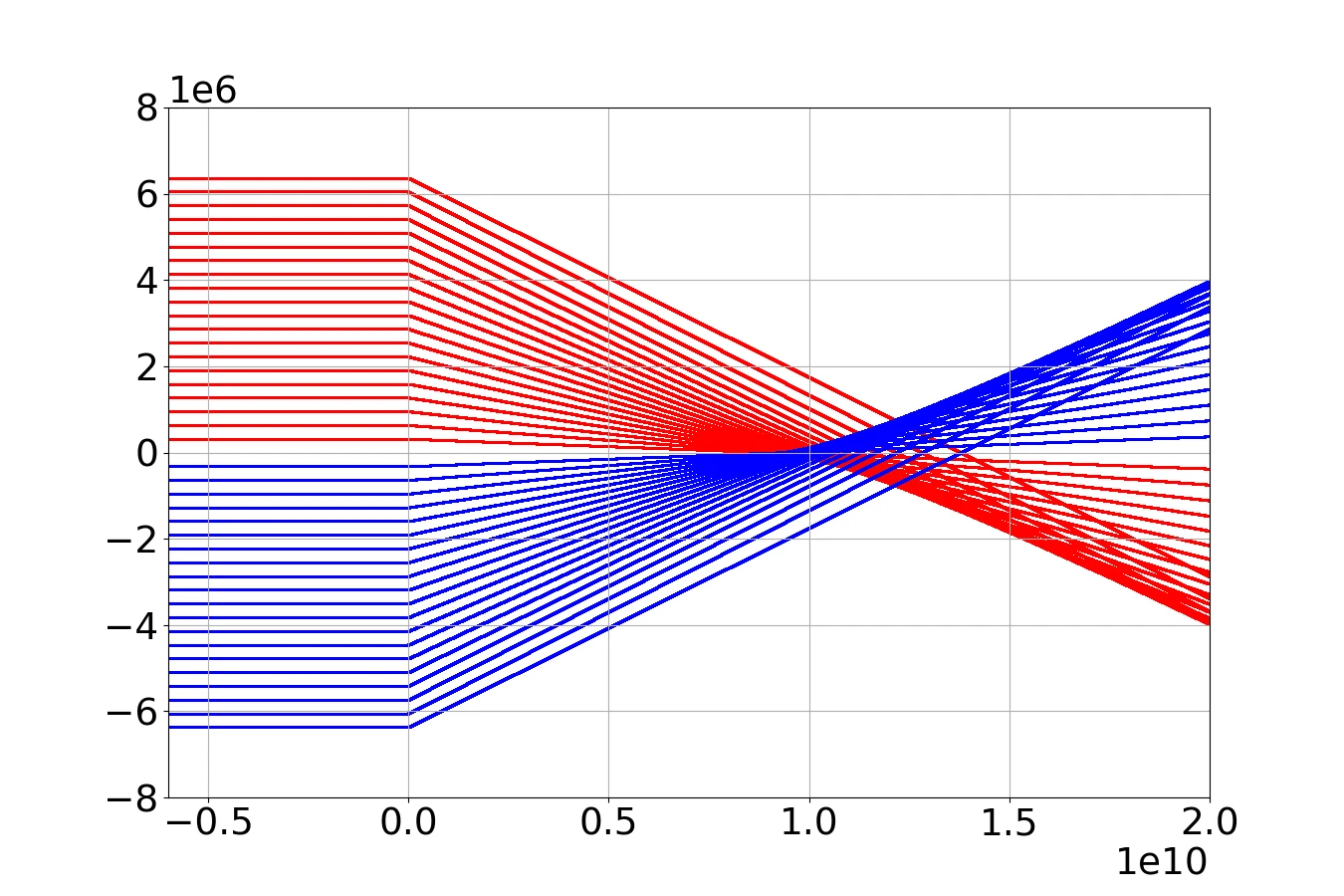
المادة المظلمة هي الأساس الخفي للكون. أثبتت فيرا روبين وجودها من خلال حركة النجوم، لكن الجسيمات لم تُرصد بعد. الطريقة الجديدة تحوّل الأرض إلى عدسة جاذبية عملاقة: فالجسم الكبير، كما بيّن آينشتاين، يحني الزمكان ويركز جسيمات المادة المظلمة المارة في نقطة خلف مدار بلوتو. حجم هذه النقطة يُقارن بملعب كرة قدم.
يُوجّه ليزر قوي نحو نقطة التركيز. إذا كانت المادة المظلمة مكونة من الأكسيونات — جسيمات فائقة الخفة خارج النموذج المعياري، فإن الشعاع يجعلها تتحول للحظة إلى فوتونات وتعكس الضوء عائدة. وهكذا، يعمل الليزر مثل عود ثقاب يُشعل بارودًا غير مرئي، مما يُنتج وميضًا يمكن تسجيله.
تُظهر الحسابات أنه عند سرعات تبلغ حوالي 520 كم/ثانية، تقع نقطة التركيز على بُعد 9–14 مليار متر. الحساسية عالية لدرجة أن الإشارة يمكن التقاطها حتى من أطراف المجرة المقابلة. يفتح هذا المنهج الطريق أمام مرصد فضائي للرصد المباشر لـ المادة المظلمة.
الملخص الأصلي
كما كتبه المؤلفون، بالإنجليزية arXiv:2510.27416
We propose a novel telescope concept based on Earth's gravitational lensing effect, optimized for the detection of distant dark matter sources, particularly axion-like particles (ALPs). When a unidirectional flux of dark matter passes through Earth at sufficiently high velocity, gravitational lensing can concentrate the flux at a distant focal region in space. Our method combines this lensing effect with stimulated backward reflection (SBR), arising from ALP decays that are induced by directing a coherent electromagnetic beam toward the focal point. The aim of this work is to numerically analyze the structure of the focal region and to develop a framework for estimating the sensitivity to ALP-photon coupling via this mechanism. Numerical calculations show that, assuming an average ALP velocity of 520,km/s -- as suggested by the observed stellar stream S1 -- the focal region extends from $$9 \times 10^9$$,m to $$1.4 \times 10^{10}$$,m, with peak density near $$9.6 \times 10^9$$,m. For a conservative point-like ALP source located approximately 8,kpc from the solar system, based on the S1 stream, the estimated sensitivity in the eV mass range reaches $$g/M = \mathcal{O}(10^{-22}),\mathrm{GeV}^{-1}$$. This concept thus opens a path toward a general-purpose, space-based ALP observatory that could, in principle, detect more distant sources -- well beyond $$\mathcal{O}(10),\mathrm{kpc}$$ -- provided that ALP-photon coupling is sufficiently strong, that is, $$M \ll M_\mathrm{Planck}$$.
المسافة إلى نقطة التركيز الجاذبية للأرض تساوي تقريبًا المسار الذي يقطعه الضوء في نصف دقيقة — وهذا أبعد من بلوتو، لكنه لا يزال داخل نظامنا الشمسي.