بنى المهندسون معالجًا كموميًا من 98 أيون باريوم يرتكب أخطاء قليلة جدًا.
📄 معروضة نسخة «بسيط» — «متقدم» غير جاهزة بعد. أضفه إلى المفضّلة للمساعدة في تسريعها.
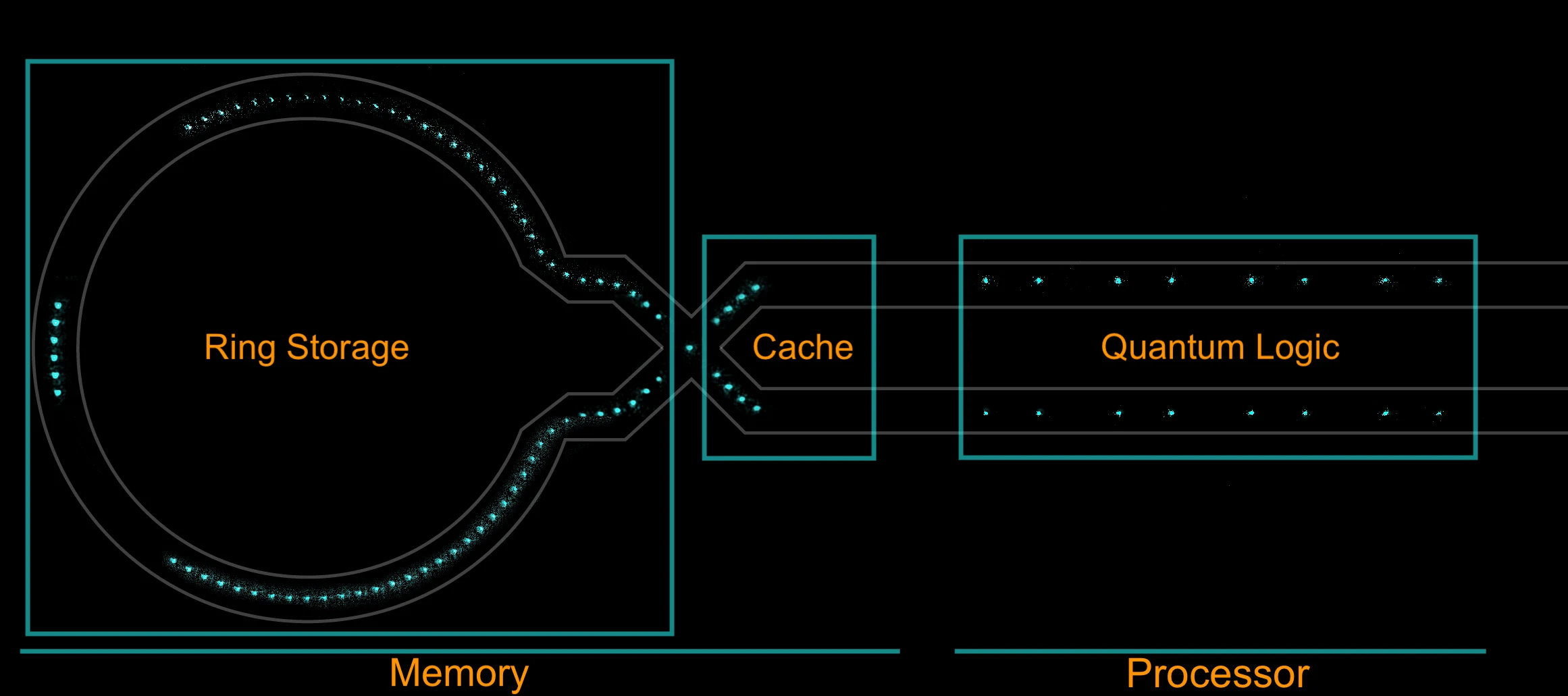
تدور 98 أيون باريوم في المعالج الجديد هيليوس على طول مسار مغلق، مثل الأحصنة في دوامة الخيل. تسمح هذه البنية المعمارية لأي أيون بتبادل البيانات مع أي أيون آخر، مما يجعل النظام مرنًا وقويًا. وتعطي نبضات الليزر الأوامر بسرعة الضوء، مثل عصا قائد الأوركسترا.
المشكلة الرئيسية في الحوسبة الكمومية هي الأخطاء. كلما زاد تعقيد المهمة، زادت فرصة الفشل. يكسر هيليوس هذا النمط: تبلغ دقة عملياته 99.992% — أي خطأ واحد تقريبًا لكل 12500 خطوة. وهذا رقم قياسي لأنظمة بهذا الحجم.
We report on Quantinuum Helios, a 98-qubit trapped-ion quantum processor based on the quantum charge-coupled device (QCCD) architecture. Helios features $$^{137}$$Ba$$^{+}$$ hyperfine qubits, all-to-all connectivity enabled by a rotatable ion storage ring connecting two quantum operation regions by a junction, speed improvements from parallelized operations, and a new software stack with real-time compilation of dynamic programs. Averaged over all operational zones in the system, we achieve average infidelities of $$2.5(1)\times10^{-5}$$ for single-qubit gates, $$7.9(2)\times10^{-4}$$ for two-qubit gates, and $$4.8(6)\times10^{-4}$$ for state preparation and measurement, none of which are fundamentally limited and likely able to be improved. These component infidelities are predictive of system-level performance in both random Clifford circuits and random circuit sampling, the latter demonstrating that Helios operates well beyond the reach of classical simulation and establishes a new frontier of fidelity and complexity for quantum computers.