مجرة نامت نصف مليار سنة سريع
نظر تلسكوب جيمس ويب الفضائي إلى الوراء في الزمن، إلى عصر لم يتجاوز عمر الكون فيه بعد الانفجار العظيم مليار سنة، ليكتشف مجرة تُدعى 'سونيا'. وخلافاً لجاراتها التي ازدانت بنجوم فتية، بدت هي مُتعبة وخافتة.
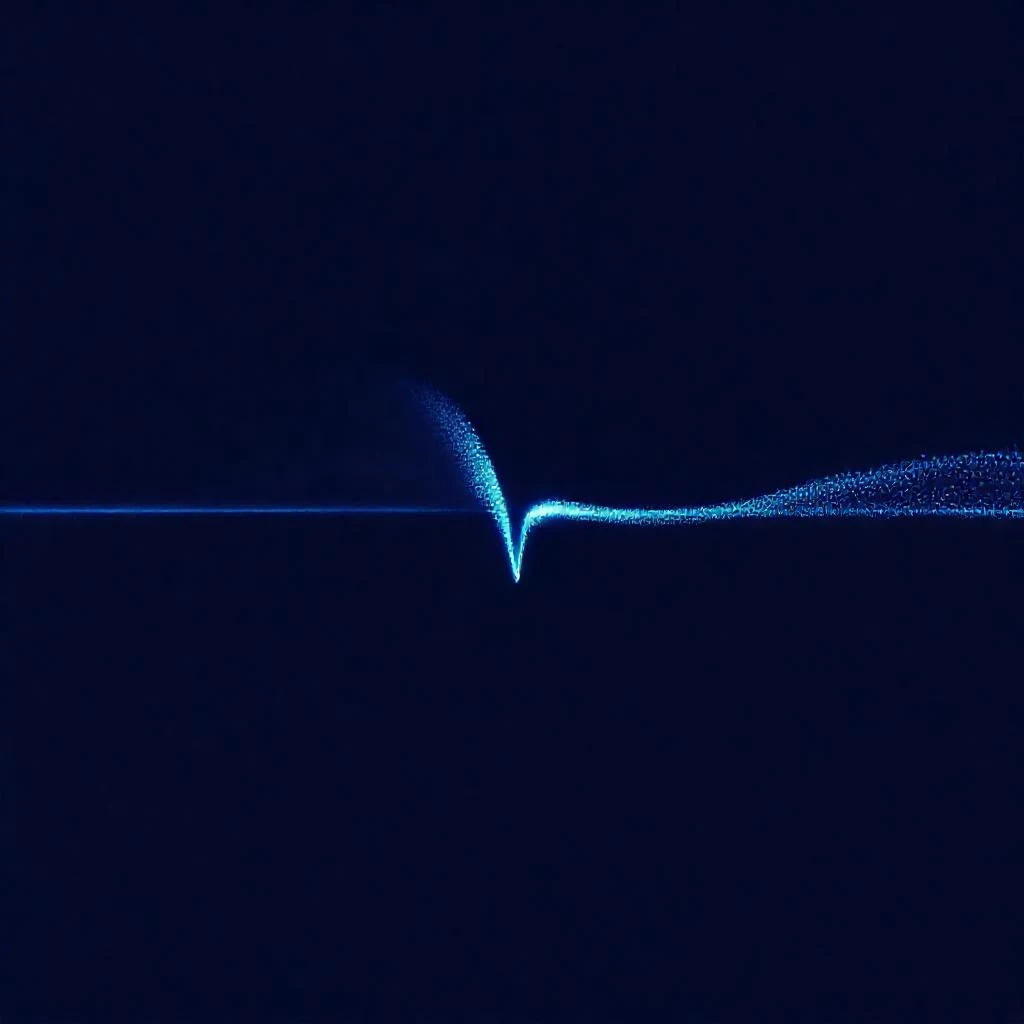
من خلال تحليل الضوء إلى ألوانه، أدرك العلماء أنه في أول 300 مليون سنة، استيقظت 'سونيا' بعنف، راكمةً كتلة هائلة من النجوم، ثم غطت في سبات دام نصف مليار عام. وقد خلّف هذا السبات أثراً – انخفاضاً في خط الهيدروجين في ضوئها، أي انقطاعاً حاداً في الطيف. وكان هذا الانخفاض أقوى ثلاث مرات من أي مجرة أخرى في ذلك العصر، وكأنه صَدى لصرخة توقفت فجأة.
هذا الاكتشاف يغير الصورة المستقرة. ففي السابق، كان يُعتقد أن كل مجرة ساطعة في بدايات الكون ستنمو لتصبح عملاقة. أما 'سونيا' فقد تحولت إلى قزم خافت - وربما تكون هذه السبايا الخادعة التي تخيب التوقعات هي الأغلبية.
الملخص الأصلي
كما كتبه المؤلفون، بالإنجليزية arXiv:2512.03154
JWST has revealed unexpectedly bright galaxies in the first 500 Myr after the Big Bang. Their overabundance suggests that they are preferentially observed during burst phases, where their star formation rates increase dramatically. In cosmological simulations, such bursts transition into short ($$\approx 40$$ Myr) periods without star formation or naps. Using JWST/NIRCam medium-band observations, we report the discovery of the galaxy CANUCS-A370-2228423 ($$z = 5.95 \pm 0.06$$, $$\log(M_\ast/M_{\odot}) = 9.14 \pm 0.09$$), dubbed The Sleeper. Its star formation history indicates rapid assembly in the first 300 Myr ($$z \gtrsim 14$$), where it formed a $$\log(M_\ast/M_{\odot}) = 8.7^{+0.3}_{-0.4}\ M_{\odot}$$ progenitor, comparable in stellar mass to the few spectroscopically confirmed galaxies at those redshifts. Unexpectedly, this is followed by several hundred million years of suppressed star formation, in stark contrast to nappers. This results in a remarkably strong hydrogen Balmer break, exceeding that of any galaxy observed within the first billion years by a factor of $$\approx 3$$. Furthermore, Sleeper-like systems are overabundant in the observed survey volume compared to theory, as the probability of finding such galaxies in simulations is $$< 0.2\%$$. The discovery of The Sleeper therefore disrupts the current narrative that all luminous galaxies in the first few hundred million years grow into massive descendants. Instead it presents an alternative evolutionary pathway in which these unusually luminous galaxies fade into inefficient dwarfs after an early starburst, revealing greater diversity in the first stages of galaxy evolution.
بحلول يومنا هذا، كانت 'سونيا' لتصبح خافتة جدًا لدرجة أن أياً من التلسكوبات الحديثة لما استطاع رؤيتها – فنصف مليار سنة من السبات جعلتها شبه خفية.