كيف "طهت" المجرات المعادن في عصر الظهيرة الكونية سريع
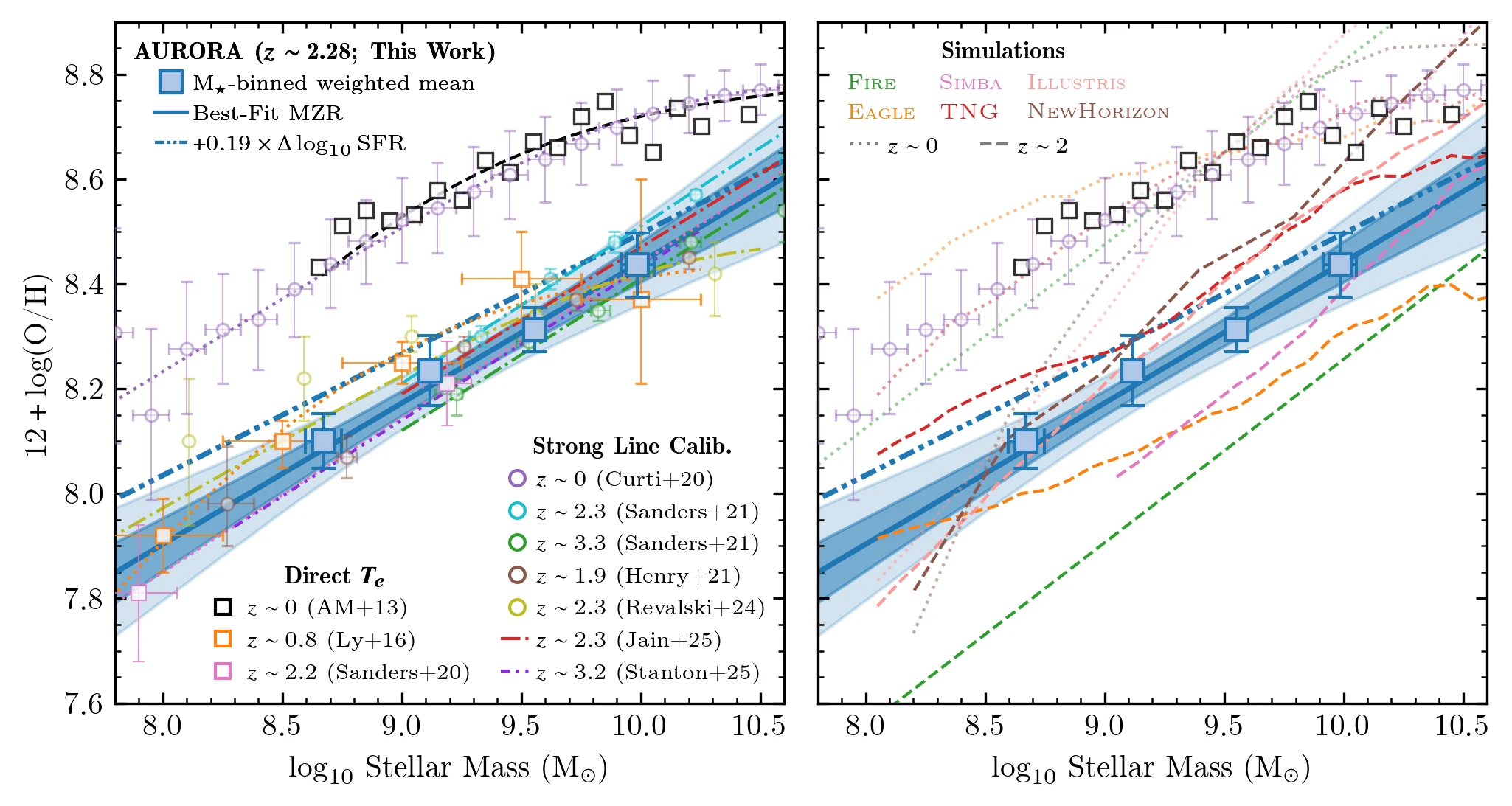
تشبه المجرات مطابخ عملاقة، حيث تُضغط الذرات الخفيفة في أعماق النجوم إلى ذرات ثقيلة — تمامًا كما يُصنع الخبز من الدقيق والماء. عندما يموت النجم، يقذف ما تراكم إلى الغاز بين النجمي، مُغنيًا إياه بـ"توابل": الأكسجين والكربون والحديد. رصد تلسكوب جيمس ويب التوهج الخافت للأكسجين المُسخَّن في 34 مجرة كانت ساطعة بعد 3 مليارات سنة من الانفجار العظيم. من سطوع هذا الضوء، مثل درجة حرارة اللهب، حسب علماء الفلك نسبة الأكسجين — ويعمل تحليل الضوء إلى ألوانه هنا بدقة تفوق مقياس حرارة المطبخ.
تبيَّن أنه كلما زادت ضخامة المجرة، زاد فيها الأكسجين — وهي علاقة تكاد تكون مماثلة لتلك لدى جيرانها المعاصرين. لكن محاكاة الحاسوب لتطور الكون لم تستطع إعادة إنتاج هذا الثبات. في عصر توسع الكون قبل 10 مليارات سنة، كانت النجوم تولد بوتيرة أسرع بكثير، ومع ذلك لم تختل وصفة الإثراء بالمعادن — كأن طاهٍ يطهو أسرع بعشر مرات دون أن يخطئ ولو جرامًا واحدًا من البهارات.
الملخص الأصلي
كما كتبه المؤلفون، بالإنجليزية arXiv:2512.16989
We present new constraints on the Mass -- Metallicity (MZR) and Fundamental Metallicity Relations (FMR) using a sample of 34 galaxies at $$1.38\leq~z\leq~3.5$$ (median $$z=2.28$$). These galaxies have direct $$T_e$$ measurements from [O\sc{iii}]4363\AA~and/or [O\sc{ii}]7320,7331\AA~auroral emission lines detected with \textit{JWST}/NIRSpec as part of the AURORA survey. The detection of both oxygen auroral lines allows for dual-zone direct $$T_e$$ measurements and expands the dynamic range in $$12+\log\mathrm{(O/H)}$$ (7.68 to 8.65 dex), stellar mass ($$10^{8}$$ to $$10^{10.4}$$ M$$_\odot$$), and star-formation rate ($$1$$ to $$100$$ M$$_\odot$$ yr$$^{-1}$$) compared to previous direct $$T_e$$ studies of the high-redshift MZR and FMR. We characterize the $$z\sim2$$ MZR and find a slope of $$0.27\pm0.04$$ and normalization of $$12+\log\mathrm{(O/H)} = 8.44\pm0.04$$ at $$10^{10}$$ M$$_\odot$$ with an intrinsic scatter of 0.10 dex, consistent with past strong-line MZR measurements. Comparisons with $$z\sim2$$ predictions from six simulations reveal that none reproduce our observed MZR normalization evolution between $$z\sim0$$ and $$z\sim2$$. This discrepancy suggests current models do not fully capture the chemical enrichment and feedback processes occurring at cosmic noon. However, all 34 galaxies are on or above the star-forming main sequence such that our sample may be biased towards lower $$12+\log\mathrm{(O/H)}$$ if the FMR persists at $$z\sim2$$. Correcting for this selection effect would increase O/H by $$\approx0.1$$ dex at 10$$^{9.3}$$ M$$_\odot$$ (the median mass of our sample) bringing our MZR into better agreement with that of \texttt{TNG}. Lastly, we find our $$z\sim2.3$$ sample is consistent with the $$z\sim0$$ FMR within 0.1 dex in O/H, indicating that the smooth secular mechanisms regulating chemical enrichment, star formation, stellar mass, and outflows were in place at cosmic noon.
الأكسجين الذي نتنفسه قذفه انفجار نجم ضخم يومًا ما — نحن نتنفس رماد المستعرات العظمى.