رياح للسريعين: كيف تسخّن الاضطرابات الهالة الشمسية سريع
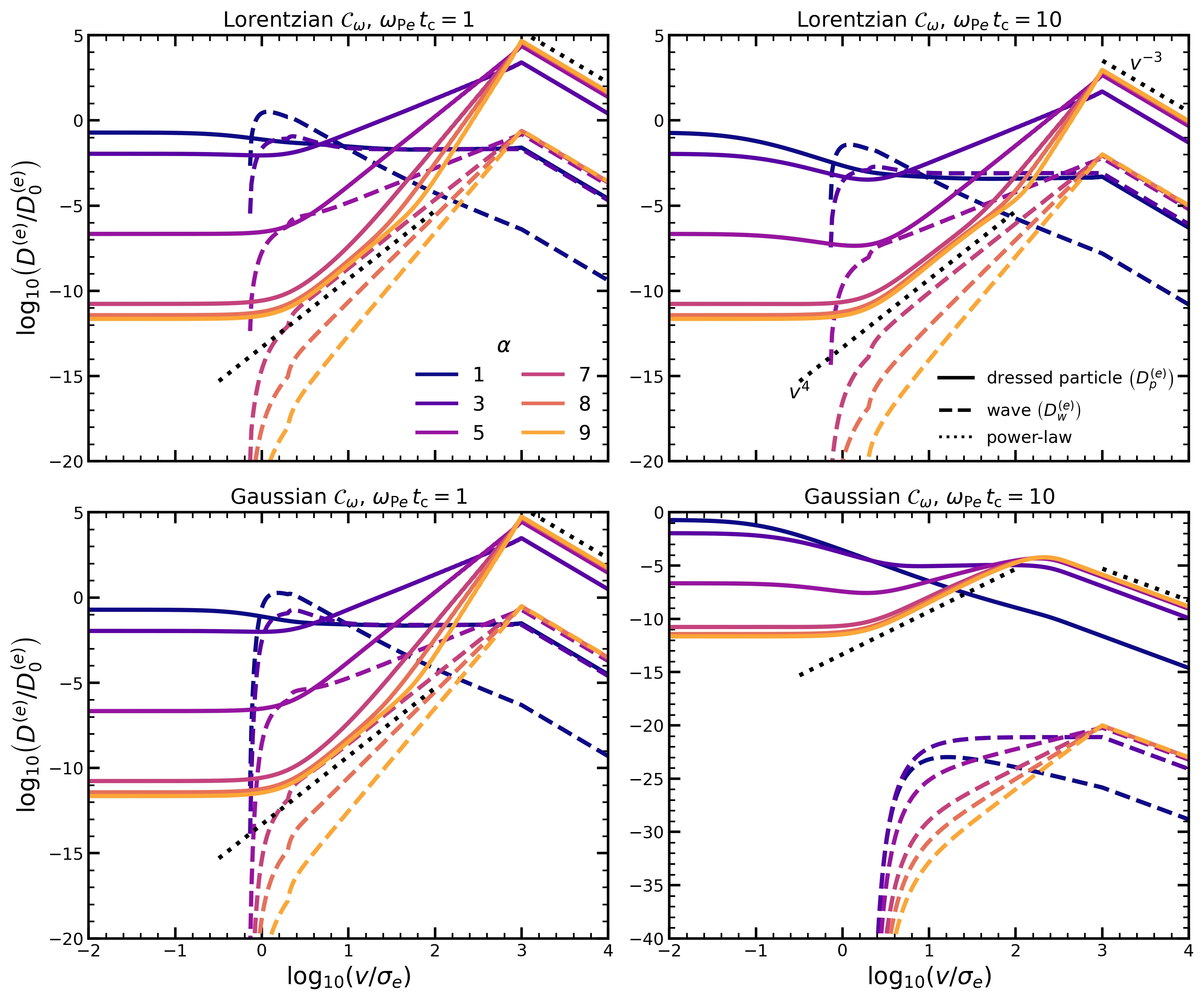
في الغاز الحار من الجسيمات المشحونة - البلازما - تعمل الحقول الكهربائية الفوضوية كمنخل. الجسيم البطيء يتغلف بسحابة من الشحنات المعاكسة التي تحجب المجال الخارجي. أما الجسيم السريع فيتخلص من هذا الدرع ويتعرض للتسارع.
أثبت الفيزيائيون أنه إذا اضمحلت طاقة الحقول مع التردد وفق القانون المناسب، فإن أي حالة ابتدائية تقريباً تنزلق إلى توزيع سرعات شامل. احتمال وجود جسيم بسرعة v يتناقص كـ 1/v⁵. يسعى النظام إلى هذه الصورة 'ذات الذيل' - الجاذب الإنتروبي - وليس إلى جرس ماكسويل وبولتزمان حيث تكاد الجسيمات السريعة تنعدم. هذا الذيل المتشكل طابق تماماً توزيع κ عند κ=1.5 - وهي صيغة استخدمها الفيزيائيون الفلكيون بشكل أعمى.
هكذا ينكشف لغز الهالة الشمسية. يسخن سطح الشمس إلى 5800 كلفن، بينما تشتعل الهالة بملايين الدرجات. في طبقة الكروموسفير الهائجة تنشأ حقول كهربائية ترشح الأيونات: تسرّع فقط الأسرع منها - الهيدروجين والهيليوم - قاذفةً إياها إلى الهالة. هناك تنتج حرارة هائلة. وهذه الآلية نفسها للترشيح السريع تجعل الإلكترونات في التوكاماك تتسارع فجأة إلى طاقات خطيرة، مهددةً جدران المفاعل.
الملخص الأصلي
كما كتبه المؤلفون، بالإنجليزية arXiv:2601.03344v2
Non-thermal power-law distribution functions are ubiquitous in astrophysical, space, and laboratory kinetic plasmas, but their origin remains unclear. A related puzzle is the temperature inversion of the solar corona. We show that these phenomena are deeply connected by developing a self-consistent quasilinear theory for electromagnetically driven, unmagnetized kinetic plasmas. The theory yields a multi-species Fokker-Planck equation with drive-induced diffusion from direct acceleration by broad-band turbulent or narrow-band wave-like fields, indirect acceleration by excited waves, and Balescu-Lenard diffusion/drag from Debye-scale fluctuations and Coulomb collisions. For a super-Debye turbulent electric-field spectrum, $$|{\bf E}_{\bf k}|^2\propto k^{-\alpha}$$, electrons and ions relax toward a universal $$f(v)\propto v^{-5}$$, or $$N(E)\propto E^{-2}$$, attractor, equivalent to the high-energy tail of a $$\kappa=1.5$$ distribution, when $$\alpha\ge5$$. This universality follows from Debye screening: large-scale fields accelerate unscreened fast particles but not screened slow ones. For shallower spectra, $$\alpha<5$$, the tail scales as $$v^{-\alpha}$$; incomplete relaxation and anisotropy also break universality. Anisotropic wave drives yield branch- and spectrum-dependent exponents. Because collisions cannot decelerate suprathermal particles, the tails resist Maxwellianization. In the solar atmosphere, such tails may be generated by chromospheric convection or nanoflares despite collisional and radiative losses. Direct wave heating energizes electrons through Landau-resonant interactions with whistler and electron-cyclotron waves, while ions may be accelerated by turbulent ambipolar fields. Resulting $$\kappa\simeq1.5$$--$$3$$ distributions produce an abrupt upper-chromosphere/lower-corona transition and velocity-filtration-driven inverted profiles, yielding coronal temperatures $$\sim10^6\,{\rm K}$$.
تصل درجة حرارة الهالة الشمسية إلى 1-2 مليون كلفن، بينما تبلغ درجة حرارة السطح حوالي 5800 كلفن. غلاية تُسخّن الهواء حولها أكثر من مقبضها.
في يوم من الأيام، قد تتمكن الأقمار الصناعية من 'الاستحمام' في الهالة الشمسية، لتصفية الجسيمات السريعة وشحن بطارياتها.