عيون حمراء: عدسة كونية تكشف زوجاً من الثقوب السوداء سريع
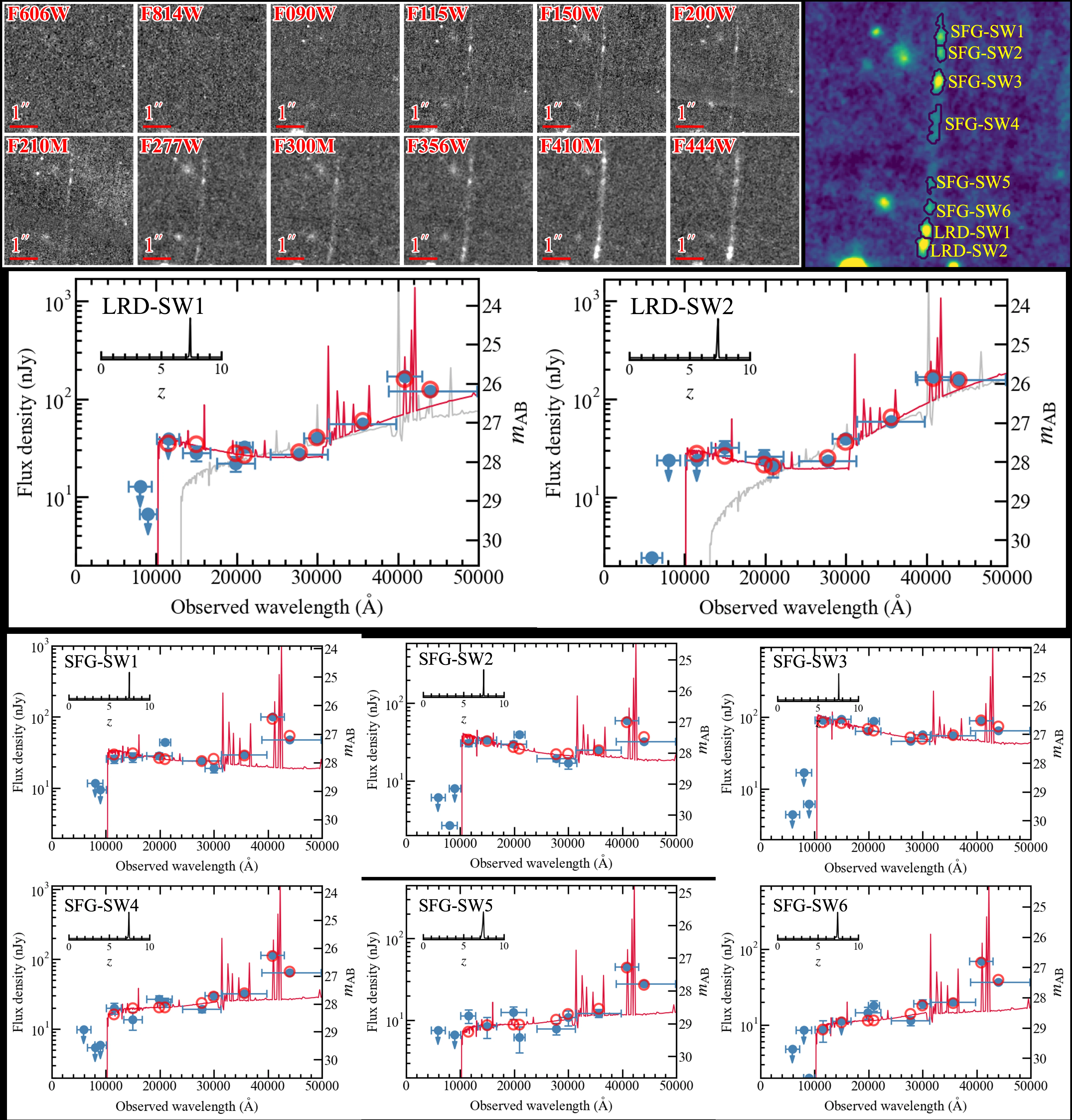
بفضل عدسة الجاذبية — التأثير الذي تنبأ به فريتز زفيكي، حيث تعمل مجموعة من المجرات كعدسة مكبرة – وهو مبدأ بصري أسسه العالم المسلم ابن الهيثم –، رصد تلسكوب جيمس ويب نقطتين حمراوين في مجرة عمرها 800 مليون سنة بعد الانفجار العظيم. هذه الأجرام، التي أُطلق عليها اسم العيون الحمراء، لم تكن في المركز كما هو متوقع، بل على الأطراف تمامًا — وكأنها زوج من الحدقات المتوهجة تحدق في الفراغ.
كل عين هي ثقب أسود متوسط الكتلة، محاط بغاز شديد الحرارة. ولا يفصل بينهما سوى 70 فرسخًا فلكيًا — بمقاييس الكون هذا أقرب من المسافة بيننا وبين مركز مجرة درب التبانة. يقلب هذا الاكتشاف تصوراتنا حول نمو الثقوب السوداء: فمن المحتمل أن الوحوش فائقة الكتلة في مراكز المجرات تكونت من اندماج العديد من هذه «الحدقات» التائهة، التي التهمت المادة على الأطراف. بعبارة أخرى، كل عملاق بدأ بزوج من العيون الحمراء.
الملخص الأصلي
كما كتبه المؤلفون، بالإنجليزية arXiv:2601.06015v1
We report the identification of a pair of faint little red dots (LRDs), dubbed Red Eyes, in a strongly-lensed galaxy at $$z\sim7$$ behind the PLCKG004.5-10.5 cluster, identified from the JWST Treasury program VENUS. Red Eyes are spatially resolved on the image plane with distinct colors, while the critical curve lies far north of Red Eyes, clearly requiring two different LRDs rather than a single LRD. Red Eyes is an extremely close pair of LRDs separated by $$\sim70\,\mathrm{pc}$$ in the source plane with a magnification of $$\mu\sim20$$, which consistently explains another counter-image detected to the north-west. Red Eyes is hosted in a typical star-forming galaxy with $$M_{\mathrm{UV,int}}\sim -19$$, but its own UV emission is very faint ($$M_{\mathrm{UV,int}} \gtrsim -16$$). Moreover, Red Eyes does not reside at the galaxy center but lies at an offset position of approximately one effective radius $$R_{\mathrm{e}}$$ away from the galaxy center. If observed without lensing, Red Eyes would appear as a typical star-forming galaxy at $$z\sim 7$$ with $$M_{\mathrm{UV}}\sim -19$$, showing no apparent LRD signatures in either morphology or SED. These results suggest that multiple off-center LRDs, similar to Red Eyes, may be commonly hidden in a typical high-$$z$$ star-forming galaxy. In this case, various plausible scenarios may emerge, one of which is that intermediate-mass black holes (IMBHs) with $$M_\mathrm{BH}\sim10^{4\text{--}6}\,M_\odot$$ may form in star clusters on a stellar disk and contribute to the growth of the central supermassive black hole via mergers, with some IMBHs detectable as luminous LRDs in a sufficiently active and massive phase.
يفصل بين زوج العيون الحمراء مسافة 70 فرسخًا فلكيًا — أي أقل بنحو 30 مرة من المسافة بيننا وبين مركز المجرة. بالنسبة للثقوب السوداء، هذا تجاور شديد القرب.