تبريد الضوء إلى النظام الكمومي سريع
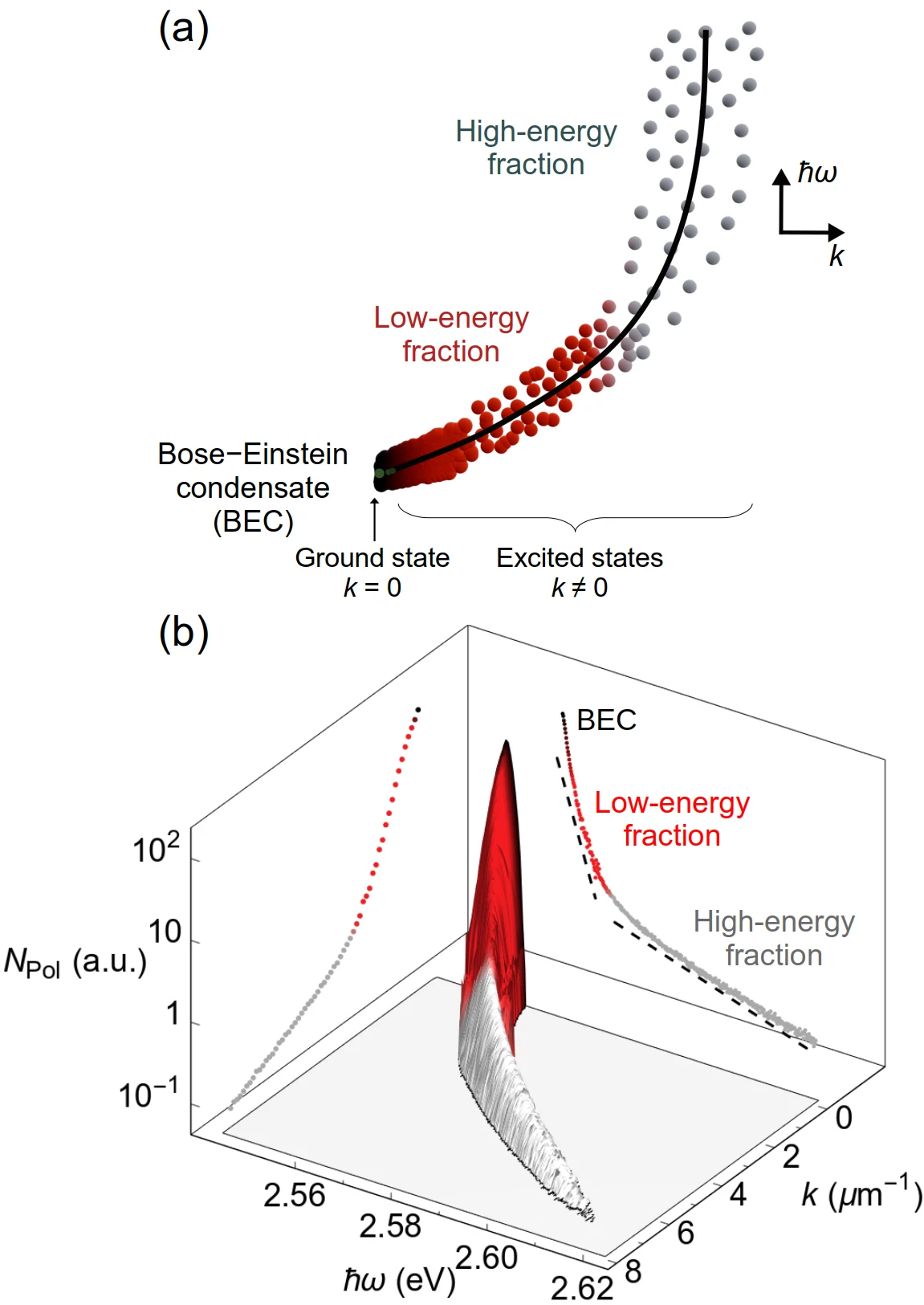
عادةً ما يجلب التبريد النظام: يتجمد الماء إلى جليد. لكن في العالم الكمومي، يتخذ النظام أشكالًا غير متوقعة. قام المجربون بتبريد البولاريتونات - جسيمات هي في آنٍ واحد ضوء ومادة - إلى ما يقرب من الصفر المطلق. بدأت السحابة 'ترقص'، موحّدةً تذبذبات جميع الجسيمات في إيقاع واحد. ولكن بعد ذلك، انقسمت الرقصة إلى قسمين: انقسمت السحابة إلى منطقتين بإيقاعين مختلفين، تخضع كل منهما للقوانين التي اكتشفها بوز وأينشتاين. الأمر الأكثر إذهالًا هو أن درجة حرارة هذه المناطق لم تكن نتيجة للتسخين، بل انعكاسًا مباشرًا لعدد الجسيمات في كل تجمع. كلما كانت الحشود أكثر ازدحامًا، كانت الرقصة أكثر حرارة. هذا المبدأ غير المتوقع عالمي للأنظمة الكمومية البعيدة عن التوازن، وقد يجد تطبيقًا في أجهزة المستقبل التي تعمل على حافة التأثيرات الكمومية.
الملخص الأصلي
كما كتبه المؤلفون، بالإنجليزية arXiv:2601.15080
We report on the experimental observation of stimulated cooling in the non-equilibrium Bose-Einstein condensate (BEC) of weakly interacting exciton-polaritons from approximately room temperature down to 20K. By resolving the condensate in energy-momentum space and performing interferometric measurements, we distinguish the condensate from thermalized particles yet occupying excited states macroscopically. In contrast to the analytical quantum theories of non-equilibrium BEC [Shishkov et al., Phys. Rev. Lett. 128, 065301 (2022)], we observe segmentation of the particle density along the excited states into two fractions both following Bose-Einstein distribution, albeit with different effective temperatures and chemical potentials. Our results indicate that the temperature of the weakly interacting Bose gas is universally set by the density-dependent chemical potential, revealing a defining property of non-equilibrium BECs. Finally, we demonstrate that the stimulated nature of the cooling process directly governs the emergence of quantum coherence of the condensate and shapes the dissipative properties of the excited states.
البولاريتونات أخف بمليارات المرات من الذرات، لذا يستغرق تبريدها لحظات حتى عند درجة حرارة 'مرتفعة' نسبيًا في العالم الكمومي.