من يغذّي من: المجرّة أم ثقبها الأسود؟ سريع
يشبه نموّ المجرّة رقصة بين شريكين: في مركز كل مجرّة كبيرة تقريبًا يوجد ثقب أسود فائق الكتلة، وهما ينموان معًا. لكن من يقود هذه الرقصة؟ أظهرت ملاحظات المجرّات الحقيقية إجابة متناقضة: في المجرّات الحلزونية، مثل مجرّتنا درب التبانة، يبدو أن الثقب الأسود يجرّ نموّ المجرّة خلفه، بينما في المجرّات الإهليلجية، التي تشبه كرات منتفخة، يكتفي باتباعها بشكل سلبي.
لفهم الأمر، أطلق الباحثون محاكاة حاسوبية باسم NIHAO — كونًا افتراضيًا يمكن فيه تتبّع مصير كل مجرّة منذ ولادتها حتى يومنا هذا. قارنوا كتلة الثقب الأسود بتباين سرعات النجوم في مركز المجرّة: كلما كانت النجوم أسرع في حركتها، كان الثقب الأسود أضخم. وهنا ظهرت حقيقة مثيرة للاهتمام: قبل ذروة تشكّل النجوم، عندما تلد المجرّة نجومًا بغزارة، تنمو المجرّة أولًا ثم يلحق بها الثقب الأسود. بعد الذروة، تنعكس الأدوار — الآن الثقب الأسود هو الذي يكتسب الكتلة ويحدّد ما ستكون عليه المجرّة.
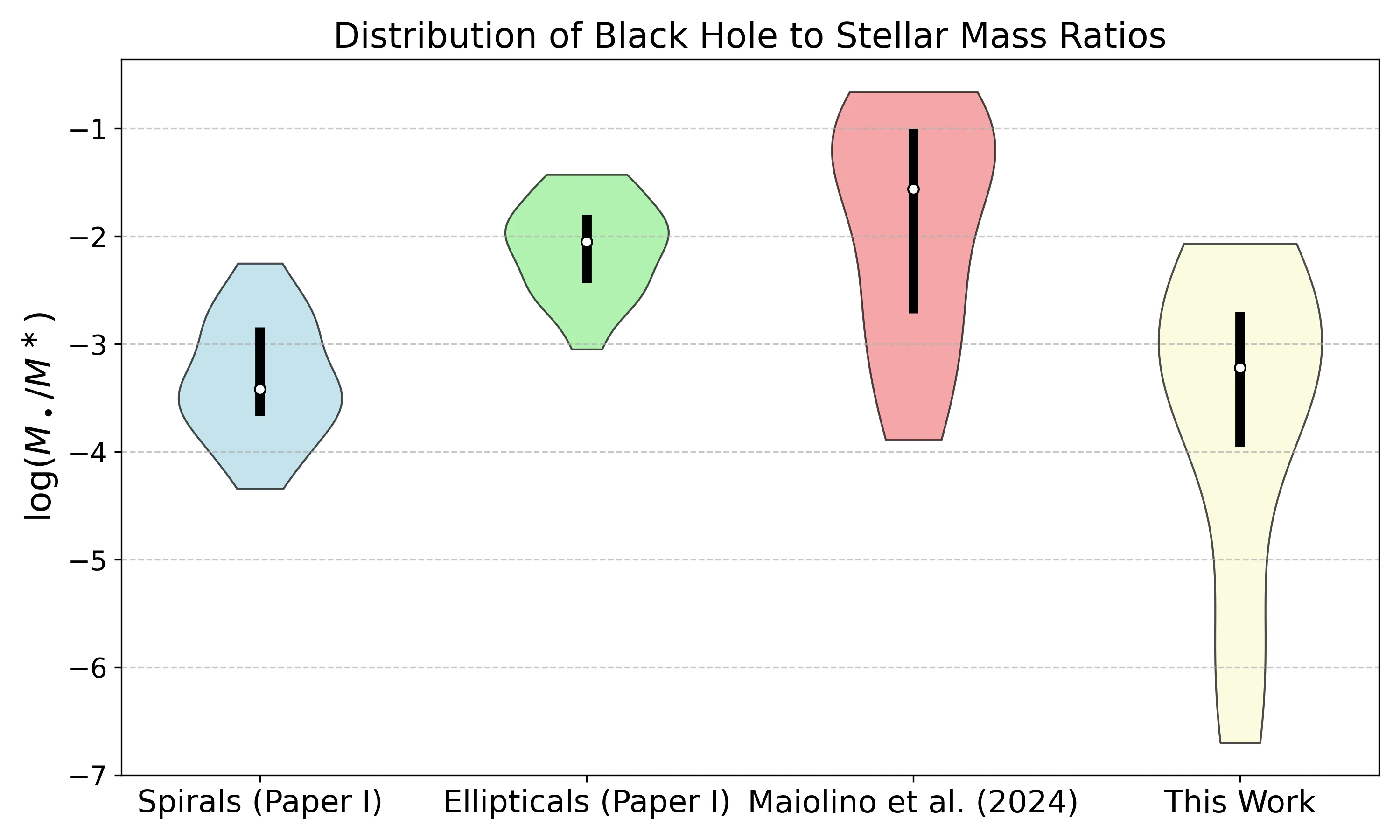
هذا الانقلاب له نتيجة غير متوقعة بالنسبة للمجرّات البعيدة التي نراها في شباب الكون. إذا طُبّقت الصيغ القديمة، تبدو الثقوب السوداء هناك ضخمة بشكل مفرط — أثقل بمئات المرات مما ينبغي. لكن التقديرات الجديدة، التي تراعي العلاقات السببية، تُظهر أن الثقوب السوداء القديمة كانت أكثر تواضعًا، ولا يوجد أي اختلال في كتلتها.
الملخص الأصلي
كما كتبه المؤلفون، بالإنجليزية arXiv:2602.16775
The nascent methodology of applying the principles of causal discovery to astrophysical data has produced affirming results about deeply held theories concerning the causal nature behind the observed coevolution of supermassive black holes (SMBHs) with their host galaxies. The key results from observations have demonstrated an apparent causal reversal across different galaxy morphologies$$\unicode{x2014}$$SMBHs causally influence the evolution of the physical parameters of their spiral galaxy hosts, whereas SMBHs in elliptical galaxies are passive companions that grow in near lockstep with their hosts. To further explore and ascertain insights, it is necessary to utilize galaxy simulations to track the time evolution of the observed causal relations to learn more about the temporal nature of the changing SMBH/galaxy evolutionary directions. We conducted experiments with the NIHAO suite of cosmological zoom-in hydrodynamical simulations to follow the evolution of individual galaxies along with their central SMBH masses ($$M_\unicode{x25CF}$$) and properties, including central stellar velocity dispersion ($$\sigma_0$$). We reproduce the causal results from real galaxies, but add clarity by observing that the SMBH/galaxy causal directions are noticeably inverted between the epochs before and after the peak of star formation. The implications for causal reversal of the $$M_\unicode{x25CF}\unicode{x2013}\sigma_0$$ relation portend larger concerns about the reliability of SMBH masses estimated at high redshifts and presumptions of overmassive black holes at early epochs. Toward this problem, we apply updated causally-informed scaling relations that predict high-$$z$$ black hole masses that are approximately two orders of magnitude less massive, and thus not overmassive with respect to local $$z=0$$ SMBH$$\unicode{x2013}$$galaxy mass ratios.
الثقب الأسود فائق الكتلة في مركز درب التبانة يزن ما يعادل أربعة ملايين شمس، لكنه بالنسبة للمجرّة مجرّد حبّة رمل — أي واحد من عشرة آلاف من المئة فقط من كتلتها.