المطبخ الكوني: المعكرونة النووية في أعماق النجوم سريع
قبل ذلك بوقت طويل، فريتز زفيكي توقع أنه بعد انفجار مستعر أعظم يولد نجم صغير جدًا نجم نيوتروني. بعد سنوات، التقطت جوسلين بيل بورنيل نبضاته، مكتشفةً النجوم النابضة. والآن اتضح أنه داخل هذه النجوم يوجد مهرجان طهي حقيقي: نوى الذرات تتمدد إلى سباغيتي، وتتراص في طبقات مثل اللازانيا، وتتجمع في كريات. هذا ما أطلق عليه اسم المعكرونة النووية.
دراسة حديثة، جمعت بين النماذج النووية وبيانات الموجات الثقالية، أظهرت أن الانتقال من النوى المستديرة إلى الخيوط يحدث عند نفس الكثافة، وكأن الطبيعة تتبع وصفة. سمك المعكرونة هو فقط 14% من القشرة، لكنها تشكل نصف الكتلة تقريبًا. هذه الطبقات تجعل النجم يرتجف عند ترددات معينة، وهذه الارتجافات يراها علماء الفلك كتلمع النجوم النابضة. ولأول مرة، قارن العلماء الترددات المحسوبة بالبيانات الحقيقية واكتشفوا أنه يمكن من إيقاع الارتجاف استنتاج خصائص القوى النووية - ما يشبه علم الزلازل للنجوم.
لكن الأكثر إثارة للدهشة هو أن هذه المعكرونة النووية قد تفسر 'الخلل' الغامض في تلمع النجوم النابضة، عندما ينحرف نبضها فجأة. ربما يتسبب ارتجاف المعكرونة في تحولات حادة يلتقطها علماء الفلك منذ نصف قرن.
الملخص الأصلي
كما كتبه المؤلفون، بالإنجليزية arXiv:2602.19125
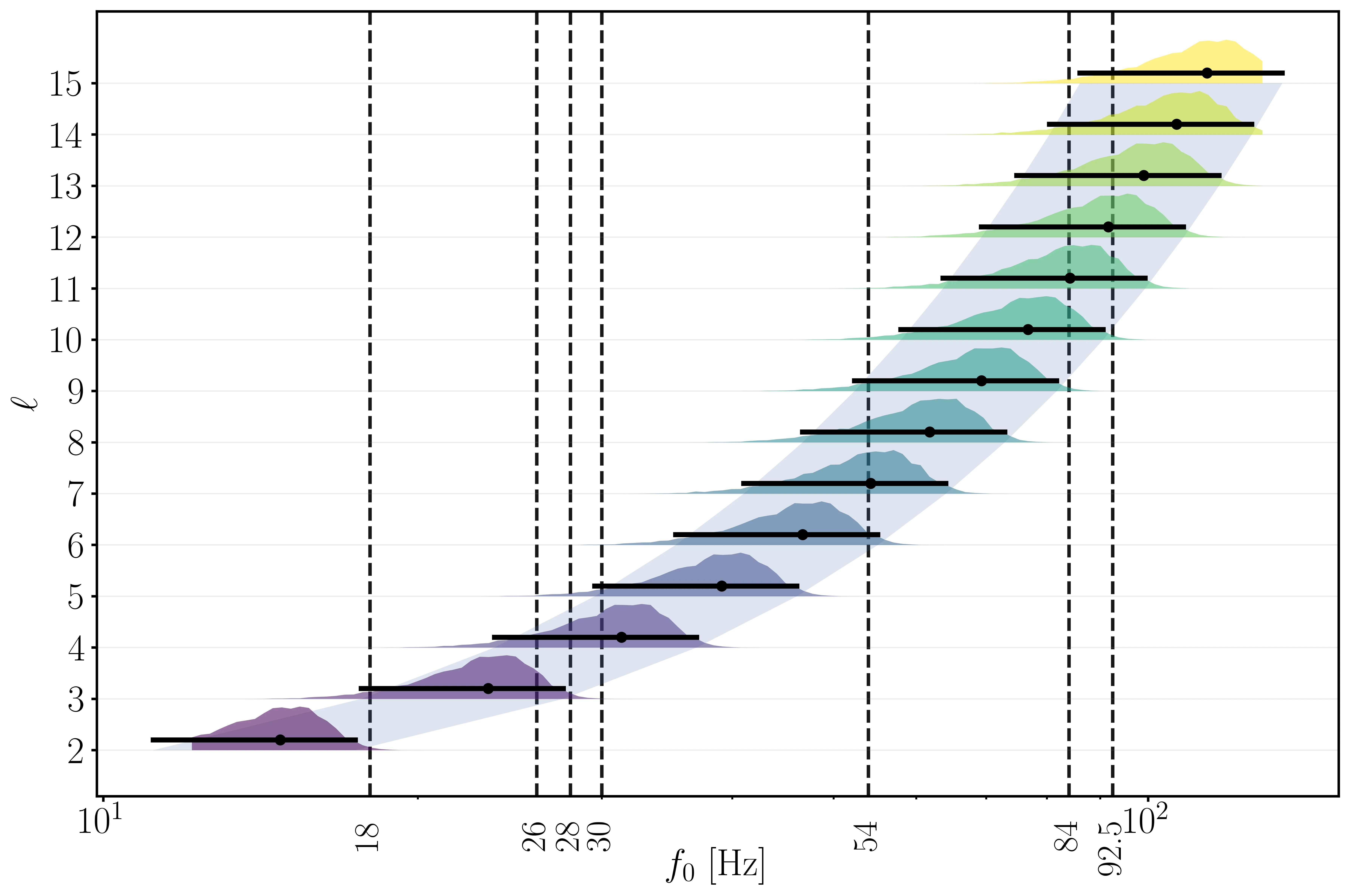
We investigate the impact of nuclear pasta on crustal structure and torsional oscillations using a Bayesian ensemble of unified neutron-star equations of state based on relativistic mean-field models constrained by nuclear experiments, empirical saturation properties, chiral effective field theory, and multimessenger observations. For each posterior sample, we compute the pasta sequence within a compressible liquid-drop model and quantify the onset density, thickness, and mass fraction of the pasta layers. We show that the appearance and extent of nuclear pasta are primarily controlled by the symmetry-energy slope parameter $$L$$. While spherical and rod-like pasta configurations are present for all equations of state, only a small fraction of the posterior supports slab, tube, or bubble geometries. The transition from spherical nuclei to rods is tightly constrained to occur at a density of $$\rho_{\rm sr} = 0.0588^{+0.0045}_{-0.0065}\,\mathrm{fm^{-3}}$$. We further predict that the nuclear pasta layer occupies a relative radial thickness of $$\Delta R_{\rm pasta}/\Delta R_{\rm c} = 0.140^{+0.025}_{-0.036}$$ and contributes a relative mass fraction of $$\Delta M_{\rm pasta}/\Delta M_{\rm c} = 0.475^{+0.071}_{-0.113}$$. Using the resulting crust models, we present the first quasi-periodic oscillations (QPOs) analysis based on a Bayesian posterior ensemble of neutron-star equations of state and systematically assess their compatibility with observed low-frequency quasi-periodic oscillations. We find that the predicted QPO frequencies are strongly correlated with the curvature of the symmetry energy evaluated at sub-saturation density, $$K_{\rm sym}(\rho_0/2)$$, and that uncertainties in the equation of state translate into a range of angular indices $$\ell$$ consistent with the observed frequencies.
'المعكرونة النووية' ليست مجازًا، بل مصطلح دقيق. الطبقات تشبه حقًا السباغيتي واللازانيا والنيوكي. لكن صلابتها تجعل خيطًا بسمك الشعرة يتحمل وزن مدينة كبيرة.