الجبال على الكواكب الخارجية تنقذ من الشتاء الأبدي سريع
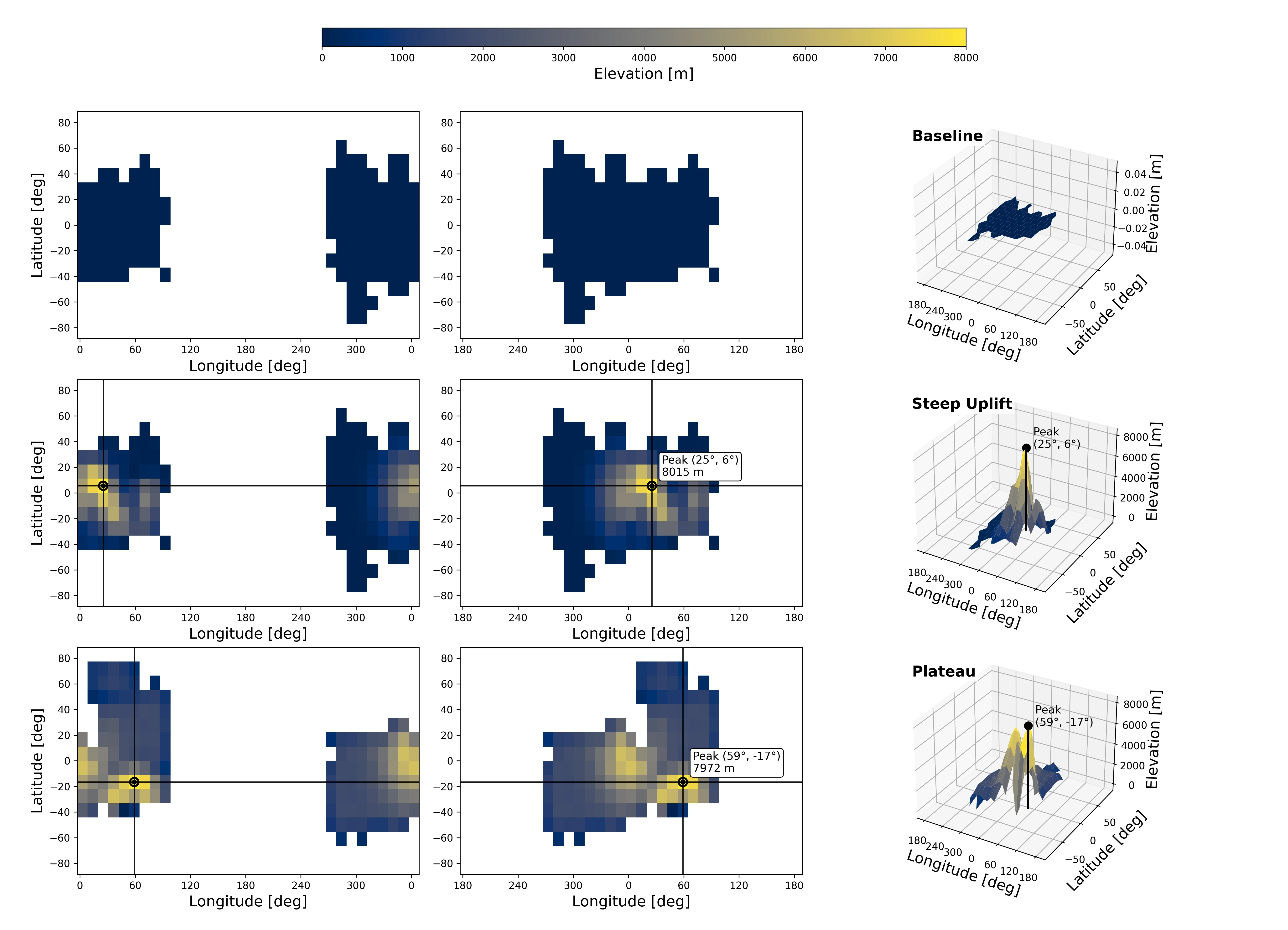
بالنسبة لـالكواكب الخارجية التي تواجه النجم دائمًا بوجه واحد، فإن نصفها الليلي محكوم عليه بالبرد الأبدي. لكن الجبال قادرة على قلب المعادلة. تضاريس السطح الوعرة تُثير محيط الهواء، موجهةً تيارات الرطوبة عبر الحد الفاصل بين النهار والليل. عندما تصل إلى الظلام، يتجمد الماء في السحب، وتعمل السحب كبطانية: تحتفظ بالحرارة وتمنع العالم من البرودة. أظهرت النماذج الحاسوبية أنه حتى التلال المتواضعة – ليست كجبال الهيمالايا، بل مجرد مرتفعات صغيرة – تكسر الدوامات الهوائية المتناظرة وتُولّد تيارًا نفاثًا. إنه كحزام ناقل يسحب الرطوبة إلى الليل، فيزداد الغطاء سُمكًا. ينصهر الكوكب، حتى لو كان دفء النجم ضعيفًا. سيتمكن تلسكوب جيمس ويب من التحقق من ذلك، بتحليل الضوء المار عبر الغلاف الجوي (وهي تقنية التحليل الطيفي). وهذا يعني أن مصير العوالم البعيدة لا يعتمد فقط على المسافة من النجم، بل على كل ثنيةٍ في تضاريس سطحها.
الملخص الأصلي
كما كتبه المؤلفون، بالإنجليزية arXiv:2602.20155
Among potentially habitable worlds, rocky planets orbiting M dwarfs offer the most favorable prospects for atmospheric characterization, yet their climates may differ substantially from those of Earth analogs. In the tidally locked limit, the nightside's tendency to radiatively cool and potentially trap volatiles as permanent ice introduces a strong dependence of habitability on the planet's surface and atmospheric boundary conditions. We perform a suite of synchronously rotating experiments spanning a wide range of topographic and orographic realizations with different mean elevations and landmass distributions. Across a grid of $$p_{\mathrm{N2}} = 0.5$$-$$8~\mathrm{bar}$$ and $$F_{\star} = 1200$$-$$1700~\mathrm{W\,m^{-2}}$$, we find that surface relief breaks the flow symmetry, replacing the circumpolar vortices with mechanically forced stationary waves. Steep orography produces standing Rossby gyres that strengthen the cross-terminator jet and align vertical uplift with the day--night boundary. These new circulation regimes enhance moisture transport, increasing the infrared optical depth and promoting additional nightside cloud formation, which produces a stronger cloud-greenhouse feedback and lower the critical fluxes required for global planetary deglaciation. Broad, elevated plateaus drive a similarly fragmented but slightly weaker circulation, yielding less effective moisture transport. These results show that the relief and spatial distribution of landmasses, parameters unconstrained for most exoplanets, can exert strong controls on the climatic bifurcations of tidally locked M-dwarf exoplanets.
على الأرض، تُولّد السلاسل الجبلية أمواجًا هوائية، تتسبب في جفافٍ على جانبٍ وأمطارٍ غزيرة على الجانب الآخر. لكن على الكواكب الخارجية، هذه الآلية نفسها قادرة على إذابة عالمٍ جليديٍّ بالكامل.