لماذا تقل فرص التمثيل الضوئي حول الأقزام الحمراء سريع
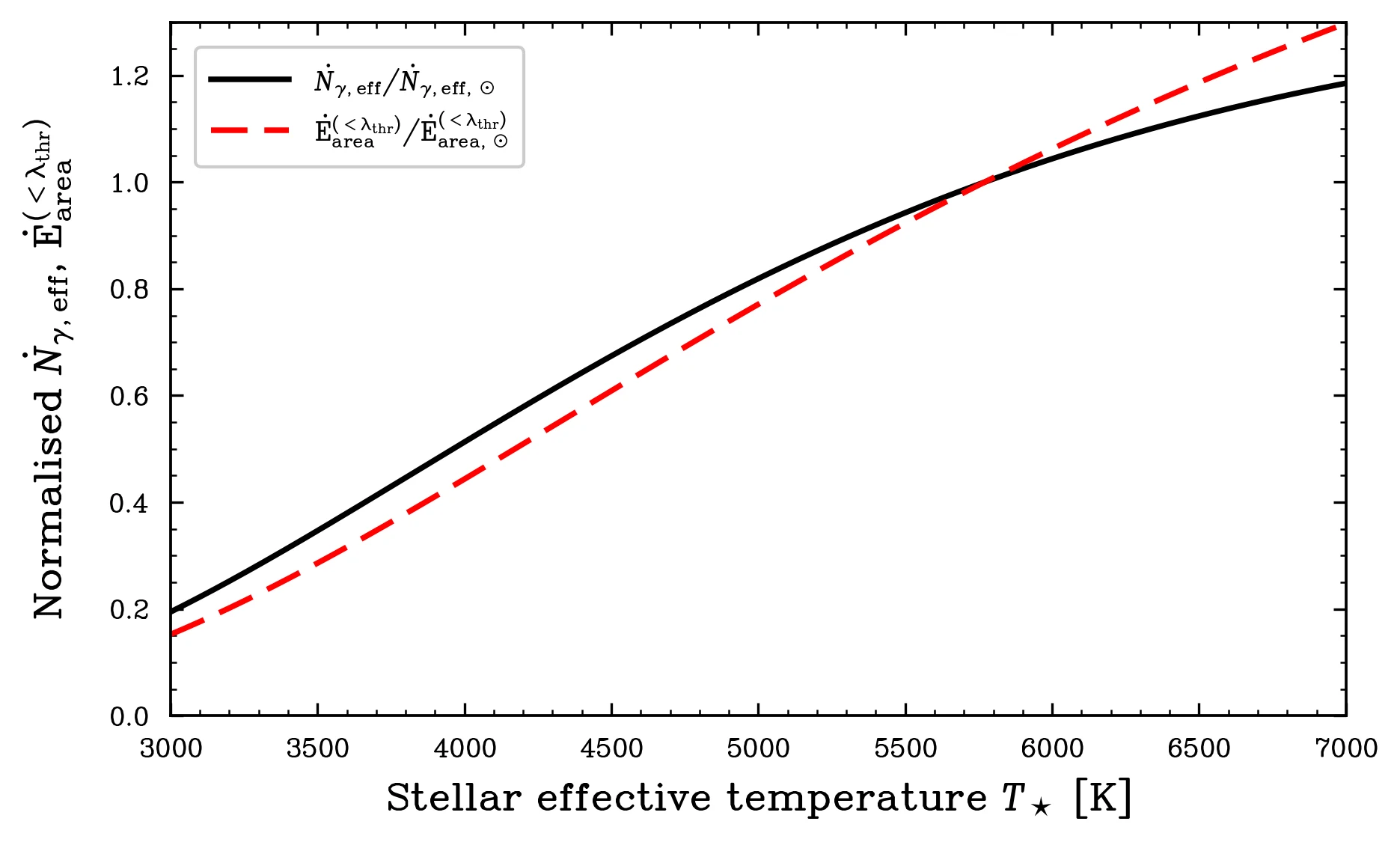
لإجراء عملية التمثيل الضوئي مع إطلاق الأكسجين، يجب تفكيك الماء. يشبه ذلك ناعورة الماء: فلكي تدور، تحتاج إلى تيار قوي. يؤدي الضوء دور التيار، بينما تمثل جسيمات الضوء نفاثاته. أما الأقزام الحمراء، وهي أكثر النجوم شيوعًا، فضوؤها «بارد» وضعيف — بالكاد تحرك النفاثات الناعورة.
ومع ذلك، حتى على الأرض، مع شمسها الساطعة، لا تستخدم الناعورة سوى نقطة من الطاقة المتاحة. إن إنتاج الأكسجين الممكن نظريًا يفوق الواقع بآلاف المرات. لذا، قد تختبئ الحياة المعقدة دون أن تُلاحَظ — وعلينا أن نبحث عنها قرب النجوم التي تشبه نجمنا.
الملخص الأصلي
كما كتبه المؤلفون، بالإنجليزية arXiv:2602.20789
Photosynthesis is central to Earth's biosphere and a prime candidate for sustaining complex life on habitable exoplanets, yet a thermodynamically consistent treatment of the work potential of stellar radiation at planetary surfaces is still lacking. We develop a radiative-thermodynamic framework that quantifies the maximum useful work extractable for a given star-planet configuration and yields exergy-based bounds on photosynthetic power and long-wavelength absorption cutoffs. From these we derive kinetically constrained red limits for high-$$\Delta G$$ photochemistry and apply them to Earth-like planets receiving the same bolometric flux from FGK and M blackbody hosts, computing thresholded photon supplies and truncated exergy fluxes below a photosystem II red limit. For such planets the constraints confine single-photon oxygenic photosynthesis to near-infrared bands around Solar-type stars and to somewhat bluer wavelengths around late M dwarfs. Integrated over the stellar spectrum, the thresholded photon supply and truncated exergy available to drive a photosystem water-oxidation step are larger by factors $$\sim 5$$ around FGK hosts than around $$T_\star\approx 3000$$~K M dwarfs. For the Solar-Earth system, the exergy-based upper bound on O$$_2$$ production exceeds the observed O$$_2$$ throughput by several orders of magnitude, consistent with Earth's photosynthetic efficiencies. Cool M dwarfs suffer a double penalty: fewer photons above threshold and a lower shortwave exergy fraction, yielding systematically tighter ceilings on high-$$\Delta G$$ photosynthesis than around FGK stars. Our framework provides upper limits on photosynthetically harvestable power on habitable-zone planets and enables comparisons of photosynthetic potential across exoplanetary systems, and can be extended to multi-band photosystems.
يتجاوز الحد النظري الأقصى لإنتاج الأكسجين على الأرض ما تنتجه النباتات فعليًا بآلاف المرات.