كيف يولد الكالسيوم في انفجارات النجوم سريع
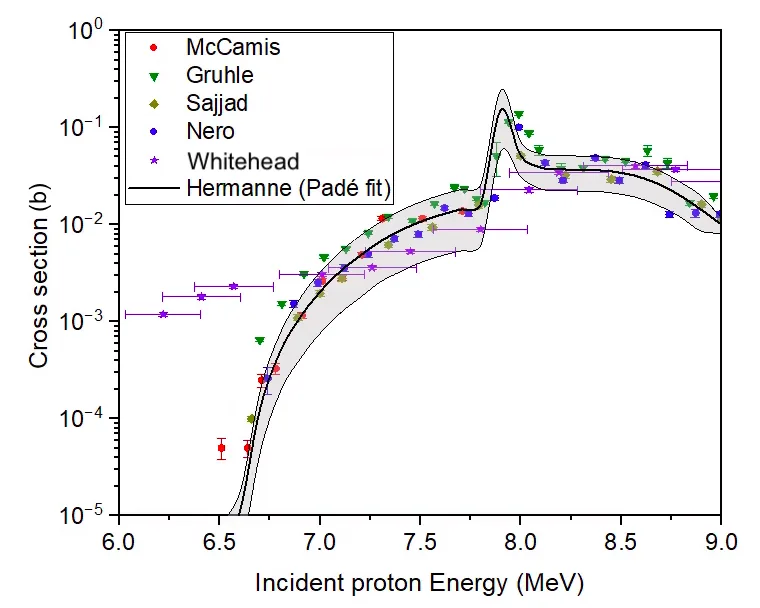
في أعماق النجم المحتضر قبل انفجار المستعر الأعظم، تجري تفاعلات نووية تحدد أي العناصر الكيميائية ستنتشر في الفضاء. أحد هذه التفاعلات هو اصطدام نواة الأكسجين مع بروتون، ينتج عنه نواة النيتروجين وجسيم ألفا (نواة الهيليوم). من سرعة هذا التفاعل تعتمد كمية الكالسيوم والكبريت الناتجة — العنصران اللذان يستخدمهما علماء الفلك للحكم على تركيب النجم الأم.
لفترة طويلة، تناقضت بيانات التجارب المختلفة مع بعضها البعض: بعض القياسات أعطت سرعة تفاعل أعلى بسبع مرات من السرعة القياسية، والبعض الآخر أعطى أقل. لفهم الأمر، استخدم الفيزيائيون كاشف MUSIC، الذي يلتقط الجسيمات مباشرة في غرفة الغاز، مثلما يلتقط الميكروفون الصوت. القياس الجديد عند الطاقات المميزة للانفجار أظهر أن سرعة التفاعل أعلى بمقدار 1.5 مرة مما في المرجع REACLIB، ولكن ليس سبع مرات. تمكنوا من تقليص التشتت في البيانات القديمة بشكل كبير.
ولكن حتى مع السرعة الجديدة للتفاعل، لا يمكن تفسير لماذا تختلف نسبة الكالسيوم إلى الكبريت في بقايا المستعرات العظمى ذات الأعمار المختلفة. إذن، اللغز يكمن في تفاعلات أخرى من احتراق الأكسجين — مثل اندماج نواتي أكسجين أو أكسجين مع كربون. إن دقة هذه التفاعلات هي ما يجب تحسينه في التجارب المستقبلية لفهم كيف تصوغ النجوم العناصر.
الملخص الأصلي
كما كتبه المؤلفون، بالإنجليزية arXiv:2603.06307
The $$^{16}$$O$$(p,\alpha)^{13}$$N reaction plays a key role in shaping the $$\alpha$$-particle abundance during explosive oxygen burning in Type Ia supernovae. By enhancing $$\alpha$$-production, this reaction directly affects the calcium-to-sulphur (Ca/S) and argon-to-sulphur (Ar/S) ratios, which serves as a tracer of progenitor metallicity. However, recent work suggests that the rate must be enhanced by a factor of up to seven over the standard value to explain observed Ca/S ratios across a range of progenitor metallicities. To explore this impact, available experimental cross-section data for the $$^{16}$$O$$(p,\alpha)^{13}$$N reaction have been compiled and critically evaluated. Significant discrepancies are identified in the low-energy region ($$E_{\mathrm{cm}}$$ = 5.7--7.0 MeV), primarily due to limitations of the activation method. To resolve this, the first direct measurement at astrophysical energies has been performed using the MUSIC active-target detector. The new $$^{16}$$O$$(p,\alpha)^{13}$$N thermonuclear reaction rate is found to be approximately 1.5 times higher than the REACLIB rate in the temperature range T = 3--4 GK, with more constrained uncertainties that resolve the previously large spread among existing data. The suggested factor of seven enhancement is excluded and these results indicate that this reaction alone cannot fully explain the variation in the Ca/S and Ar/S ratios observed across different progenitor metallicities. Therefore, future work should focus on reducing the uncertainties in other key oxygen-burning reactions, particularly $$^{16}$$O+$$^{16}$$O and $$^{12}$$C+$$^{16}$$O. Further reducing the constraints on the $$^{16}$$O$$(p,\alpha)^{13}$$N rate is also needed to fully determine to whether a nuclear physics solution to this discrepancy is possible.
كاشف MUSIC يعمل كغرفة غازية تترك فيها الجسيمات آثارًا، ويمكن للفيزيائيين حرفيًا «سماع» كل اصطدام نووي.
في رواية «سولاريس» لستانيسلاف ليم، يغير محيط الكوكب مداره بالتلاعب بالجاذبية — تمامًا كما تتحكم التفاعلات النووية في المستعرات العظمى في التركيب الكيميائي لمجرات بأكملها.