الحرارة تُفسد أوركسترا الضوء سريع
يضرب الليزر البلورة، فتردّ بومضات ضوئية، تمامًا كما يرنّ الجرس عند ضربه. لكن إذا كان الجرس دافئًا، فإن صوته يهتز ويخفت. وهكذا هنا: ذرات البلورة تهتز باستمرار بسبب الحرارة، وهذا الاهتزاز يمنع الإلكترونات من التحرك بانتظام، لذا يصبح الضوء باهتًا ومشوشًا.
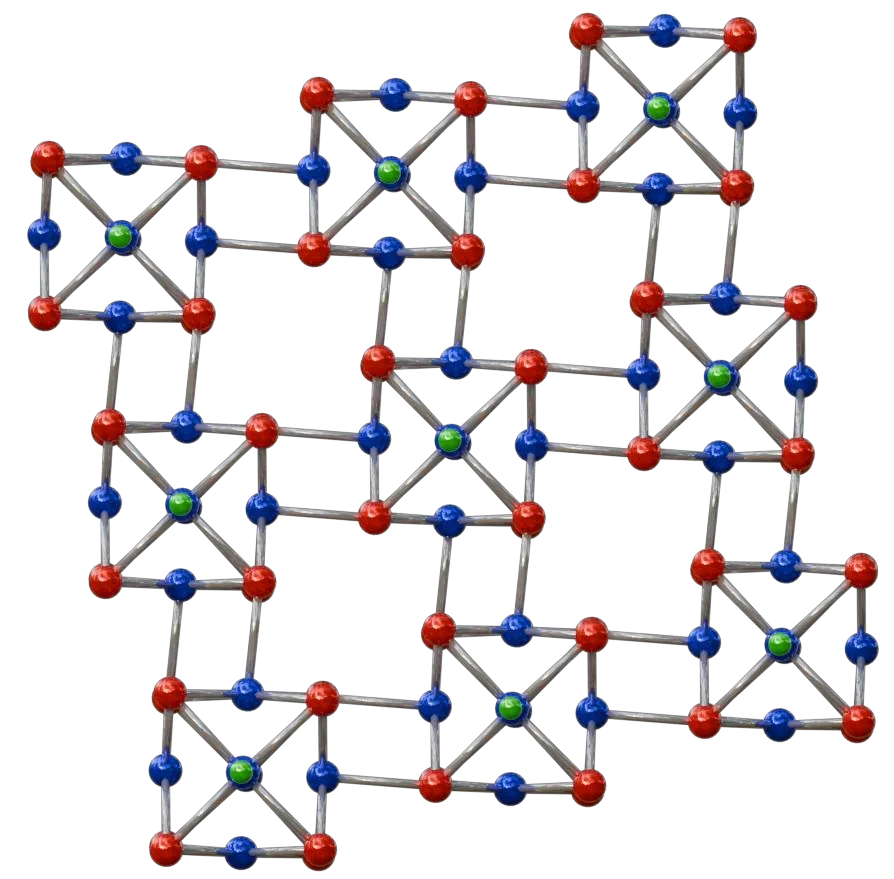
أخذ العلماء بلورة Re6Se8Cl2، وهي مادة تتجمع فيها الذرات في كتل كبيرة تشبه مكعبات البناء. قاموا بتبريدها وراقبوا كيف يتغير سطوع الضوء المنبعث. حتى 50 كلفن (أي 223 تحت الصفر مئوي)، زاد السطوع ببطء، لكنه قفز بشكل حاد عند درجات حرارة أقل. عند هذه الدرجة تحديدًا، يكاد اهتزاز الذرات يتوقف.
أظهرت الحسابات أن الاهتزاز لا يُضعف الضوء من كل منطقة فحسب، بل يُفقد أيضًا الموجات القادمة من أماكن مختلفة تزامنها. كل هذا يعمل مثل الرمل في آلية الساعة، فيصبح السير غير منتظم. وصف المؤلفون ذلك من خلال الزمن الذي تفقد فيه الإلكترونات تماسكها، وهذا الزمن يعتمد على درجة الحرارة.
هذا الاكتشاف مهم للإلكترونيات فائقة السرعة، حيث يتم التحكم بالضوء خلال فمتو ثانية (أجزاء من مليون من مليار جزء من الثانية). ويمكن تعديل البلورات المصنوعة من الذرات الفائقة (supra-atoms) لاختيار الخصائص المطلوبة، تمامًا مثل لعبة التركيب التي تُجمع منها أجهزة للتحكم بالضوء.
الملخص الأصلي
كما كتبه المؤلفون، بالإنجليزية arXiv:2604.10304
Solid-state high-harmonic spectroscopy allows the study of strongly driven ultrafast electron dynamics. Microscopically, high harmonics are generated by strong-laser-field acceleration of electron-hole pairs through the lattice. At finite temperatures, atomic-scale structural fluctuations are ubiquitous and are expected to influence the electron-hole trajectories. Yet, the effect of thermal lattice fluctuations on solid-state high-harmonic generation (HHG) has not been quantified. Here, we demonstrate a profound sensitivity of HHG to thermal lattice fluctuations, by characterizing the temperature dependence of HHG in Re6Se8Cl2, a superatomic semiconductor. As the sample temperature is decreased, the high-harmonic yield exhibits a slow increase, followed by an abrupt increase below 50 K, consistent with the temperature at which lattice vibrations are strongly suppressed. Our calculations show that thermal lattice fluctuations both weaken the harmonic response from individual distorted configurations and induce phase dispersion across the ensemble, leading to a pronounced suppression of the coherently emitted harmonics. We show that this effect can be interpreted in terms of an effective electronic dephasing time that varies with temperature. Our results are relevant to dephasing in broad strong-field phenomena, including lightwave electronics and Floquet engineering. The wide tunability of superatomic crystals further enables materials-controlled strong-field physics.
50 كلفن أبرد من سطح بلوتو (حوالي 44 كلفن). عند هذه الدرجة، حتى النيتروجين يصبح صلبًا.