Yu Zhang

20 articles · 30 co-authors · latest: 2026-08-17
184 citations · h-index 6 · 31 papersData: Semantic Scholar

We have retold 20 papers by this author. 2 of them with a full read. most often about: superconductivity, emergent_inductance, squeezed state. 30 co-authors across our retellings.

Links in the knowledge graph
The Coil That Wraps Itself
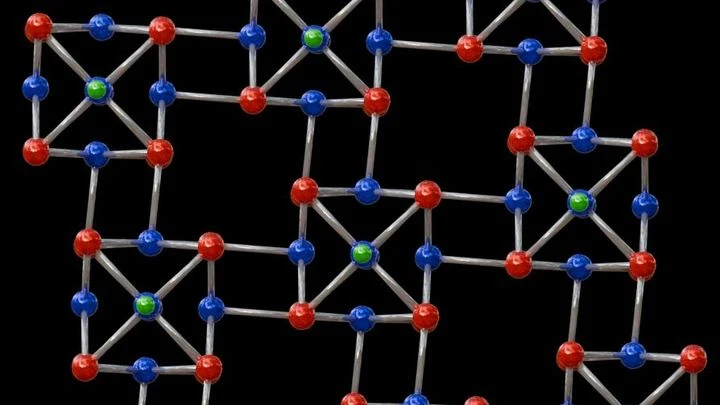
At 78 K, a crystal of Mn₃Si₂Te₆ turns into an inductor that needs neither copper wire nor a superconductor. The electrons inside it spontaneously organize into closed vortices with a definite sense of rotation: chiral orbital currents.
Quantum Physics2025-12-161 minarXiv:2512.14842express
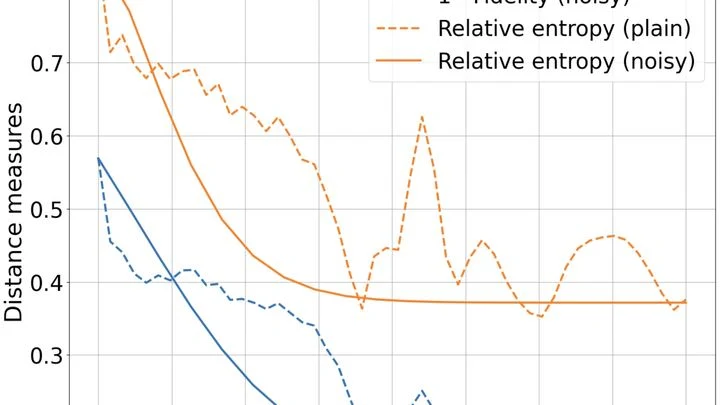
Noise Helps Quantum Computers
To quickly dissolve sugar, you don't need to stir carefully — just shake the glass. A similar principle works in quantum systems: noise, usually considered a disturbance, speeds up the transition to a thermal state.
HEP Phenomenology2026-01-081 minarXiv:2601.04576express
A Trap for Invisible Axions: A Magnetic Detector
Dark matter is five times more massive than ordinary matter, yet it emits no light. Its nature remains unknown. One candidate is the ultra-light axion particle. Axions could pierce right through the planet, barely noticing atoms.
HEP Experiment2026-01-292 minarXiv:2601.21185express
The Hidden 'Nudge' in D-Meson Decay
In an accelerator, particles collide, and for a fleeting instant a D meson is born — a particle that lives for less time than it takes light to cross a grain of sand. It promptly shatters into lighter fragments: a kaon, a lepton, and a neutrino.
HEP Experiment2026-02-011 minarXiv:2602.01282express
Antimatter Meets Protons: Particle Birth Seen for the First Time
In a particle accelerator in Beijing, an anti-Lambda hyperon, a rare antimatter particle, slams into an ordinary proton. Instead of simply disappearing, they transform into a whole bouquet of other particles: a positively charged kaon, two pions, and sometimes additional neutral pions. Such transformations for the anti-Lambda had never been observed before.
HEP Experiment2026-02-042 minarXiv:2602.04276express
Antimatter Meets an Ordinary Proton
In a particle accelerator, the anti-lambda particle is a rare guest. It is born on the fly, lives for a tiny fraction of a second, and usually decays on its own. But sometimes it manages to collide with an ordinary proton, and then a whole shower of light particles is born: kaons, pions.
Quantum Physics2026-02-061 minarXiv:2602.06362express
Random Numbers from Quantum Noise
A tossed coin is the simplest source of randomness. But if the coin is shaved, it starts cheating. In the quantum world, light plays the role of the coin: its properties are fundamentally unpredictable. The catch is that the device that “flips” the quantum coin might be faulty or even swapped by an adversary.
HEP Experiment2026-02-101 minarXiv:2602.09652express
Invisible Particle: A New Decay of the Eta Meson
In the BEPCII accelerator, electrons and positrons collide, producing billions of particles. Among them is the J/ψ meson, which lives for less than a billionth of a second. Its decay sometimes yields an eta meson (ηc), an even shorter-lived clump of quarks.
Strongly Correlated2026-02-131 minarXiv:2602.13443express
A Hidden Wave in the Crystal
The crystal Ba4Ru3O10 was long considered a simple antiferromagnet: when cooled to 100 K, the spins of ruthenium atoms align in opposite directions, like rows of arrows pointing at each other. But new measurements show that at the same temperature, something more happens — a hidden charge density wave is born inside the material.
HEP Experiment2026-03-241 minarXiv:2603.23081express
Photon Detective: How the J/psi Particle Decays
The J/psi particle lives for an instant and then decays into lighter particles, much like a snapped string scattering into pieces. Physicists from the BESIII collaboration caught over ten billion such decays to figure out exactly what 'pieces' are produced.
HEP Experiment2026-03-262 minarXiv:2603.25649express
How a Particle Decays: The Dance of Four Tracks
When a particle decays, it doesn't just vanish: it transforms into a whole set of other particles, and each transformation has its own script. Physicists from the BESIII collaboration have, for the first time, broken down the rare decay of the D0 meson step by step: it turns into two kaons and two pions.
HEP Experiment2026-04-072 minarXiv:2604.05701express
The Gamma Angle: How Physicists Catch the Difference Between Matter and Antimatter
Every second, billions of decays happen inside our bodies, and nobody notices. But physicists do: they smash particles in accelerators and watch what fragments they fly into. Hidden in those fragments is the answer to why we exist at all. Right after the Universe was born, there were equal amounts of particles and antiparticles, but today all we see around us is particles.
HEP Experiment2026-04-071 minarXiv:2604.05712express
A 71-degree angle: how physicists catch the asymmetry of matter
Imagine a balance scale with identical weights, yet one pan always tips lower. In the world of elementary particles, this imbalance is called CP violation: particles and their mirror twins (antiparticles) behave slightly differently.
Materials2026-04-111 minarXiv:2604.10304express
Heat Disrupts the Light Orchestra
A laser strikes the crystal, and it responds with flashes of light, like a bell ringing after a blow. But if the bell is warm, its sound wavers and fades. Same here: the crystal's atoms constantly jitter from heat, and this jitter disrupts the electrons' smooth flight, making the light dim and blurry.
HEP Experiment2026-04-121 minarXiv:2604.10444express
How a Charmed Particle Falls Apart
The charmed particle D+ lives for a tiny fraction of a second before breaking apart into lighter particles, like an overloaded bridge losing its supports. Physicists at the BESIII collider caught millions of such decays and sorted them out. In one decay mode, four pions and an eta meson are produced. The probability of this event turned out to be higher than expected: about 3 chances in 1000.
HEP Experiment2026-04-141 minarXiv:2604.12524express
The Invisible Particle from the Quark World
Quarks are the tiny building blocks that make up protons and neutrons. Usually, they stick together in pairs: a particle and its mirror-image antiparticle. But sometimes quarks form more exotic combinations, which physicists call exotic states.
High Energy2026-04-151 minarXiv:2604.14341express
Cosmic projectiles collided before our eyes
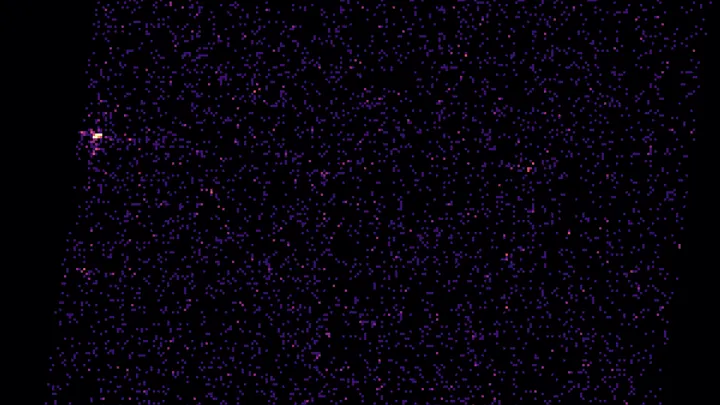
In a distant galaxy, at a distance that light takes 11 billion years to cross, something flashed. The Einstein Probe X-ray telescope caught a brief, needle-prick-like burst: it lasted only a few dozen seconds.
High Energy2026-06-082 minarXiv:2606.10014express
Nuclear Experiment2026-08-151 minarXiv:2608.14957express
Lead Instead of Carbon: A Sharper Way to Size Up the Nucleus
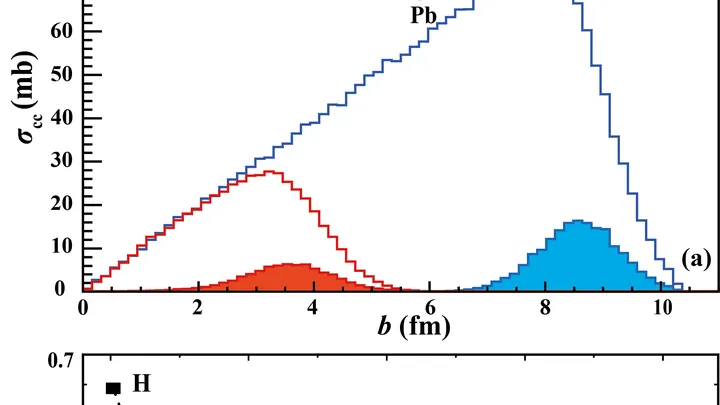
To determine the size of the proton cloud in an atomic nucleus, physicists collide an unstable nucleus with a target and observe how many protons it loses. The larger the projectile nucleus, the more often it grazes target nuclei and loses particles.
Charmonium Archaeology: A New Layer Excavated
An archaeologist carefully brushes away layer after layer, and each new stratum at the charmonium dig is a rare decay captured by the detector. Charmonium — a bound state of a charm quark and its antiquark — lives for mere fractions of a second, yet it manages to tell us about the forces that hold quarks together.