نجم رضيع يطلق رشقات متتالية سريع
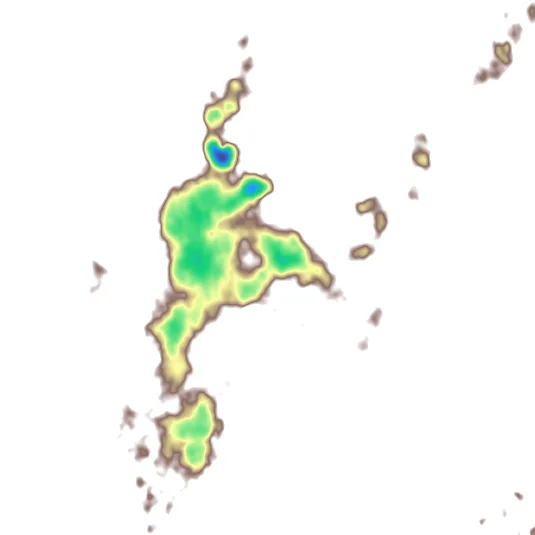
في سحابة كثيفة من الغاز والغبار، حيث تولد النجوم العملاقة، رصد تلسكوب ALMA شيئًا مألوفًا. أربع نفاثات غازية رفيعة تنطلق من المنطقة نفسها، وكل واحدة تترك خلفها سلسلة من العُقَد المضيئة — مثل خط متقطع.
نفاثتان تنحنيان مثل حرف S. يحدث هذا عندما يتمايل مصدر القذف قليلًا، مثل خرطوم حديقة في يد تتحرك من جانب إلى آخر. عند النجوم الصغيرة الشبيهة بالشمس، هذه النفاثات أمر شائع. لكن هنا، في منطقة W49N، تولد نجوم أكبر بعشرات المرات من الشمس، وتحمل التدفقات طاقة أكبر بآلاف المرات.
هذا الاكتشاف يقول: الآلية التي تطلق النفاثات عند النجوم حديثة الولادة لا تعتمد على حجمها. نجم صغير أو عملاق — القلب ينبض بنفس الطريقة.
الملخص الأصلي
كما كتبه المؤلفون، بالإنجليزية arXiv:2604.13671
We present a detailed investigation of a multipolar episodic molecular outflow in the mini-starburst region W49N, which hosts the most luminous water maser in the Galaxy. Using high-resolution ($$\sim$$0.3 arcsec) Atacama Large Millimeter/submillimeter Array (ALMA) observations of the $$\mathrm{^{12}CO}$$ emission as part of the ALMA-QUARKS survey, we analyze the morphology and kinematics of the outflow. Our observations reveal four newly identified outflow lobes in addition to the previously known central bipolar jet. These lobes appear more jet-like rather than exhibiting wide opening angles. Based on the $$\mathrm{^{12}CO}$$ (2-1) and $$\mathrm{^{13}CO}$$ (2-1) emission, we provide a more reliable estimate of the outflow's physical parameters, confirming it as one of the most energetic outflows in the Galaxy. Notably, these newly discovered lobes exhibit chains of knots, a characteristic signature of episodic ejection. Furthermore, two of the lobes display prominent S-shaped wiggles, suggestive of a precessing jet. The discovery of these features -- commonly observed in outflows from low-mass protostars -- in such an extreme massive star-forming environment provides compelling evidence that some underlying physical mechanisms for launching outflows are conserved across a wide range of stellar masses.
أقوى ميزر مائي في مجرتنا يقع تحديدًا في W49N — فهو يضيء مثل عدة آلاف من الشموس.