Patricio Sanhueza

6 articles · 30 co-authors · latest: 2026-04-15
1,047 citations · h-index 18 · 104 papersData: Semantic Scholar

We have retold 6 papers by this author. 1 of them with a full read. most often about: star formation, protoplanetary disk, galaxy cluster. 30 co-authors across our retellings.

Links in the knowledge graph
Galaxies2025-09-082 minarXiv:2509.06787
Seven Embryos in One Disk: The Birth of an Extreme Stellar Family
In the dark cloud NGC 6334I-North, 5500 light-years from Earth, the ALMA radio interferometer spotted something unexpected: around a young massive star, a disk of gas and dust is swirling, and inside it are seven dense clumps. Each one could become a star. This is what the birth of a stellar family looks like, and an unusually large one at that.
Stellar2026-01-131 minarXiv:2601.08948express
Stellar Bakeries: Two Suns, One Organic Recipe
In the stellar nursery HOPS-288, where three suns are forming, the ALMA telescope revealed two scorching regions around a pair of them. At –170°C, ice on cosmic dust melts, and reactions bubble up in the gas: organic molecules are born — methanol and methyl formate.
Galaxies2026-02-121 minarXiv:2602.11617express
The Finest Threads of Stellar Cradles
Inside cold clouds of gas and dust where new stars ignite, astronomers have spotted unexpectedly delicate structures. The ALMA telescope, working in the millimeter range, has revealed more than 323 ultra-thin dust filaments within 121 massive clumps.
Galaxies2026-03-172 minarXiv:2603.16425express
An Hourglass in a Dark Cloud
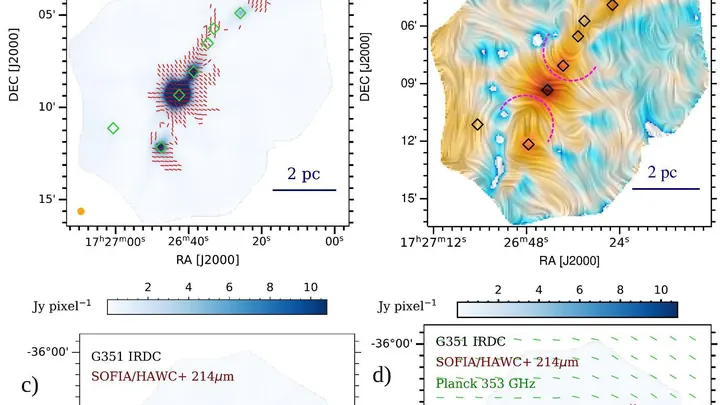
In the dark cloud G351, where new stars are about to emerge from gas and dust, the magnetic field has bent into an hourglass shape. Such a shape is a sign that the field is not just watching star birth from the sidelines but is actively taking part. Scientists used the SOFIA telescope, mounted on an airplane, to see the dust in the cloud.
Galaxies2026-03-181 minarXiv:2603.17254express
Turbulence Wins Over Magnetic Fields
In the cold gas clouds where giant stars are born, everything is churning with motion. Gas compresses, swirls, and fragments into clumps — the future stars. For a long time, it was thought that the magnetic field brought order here: like invisible threads, it stretched clumps perpendicular to itself. But new observations showed the opposite.
Galaxies2026-04-151 minarXiv:2604.13671express
Baby Star Fires in Bursts
In a dense cloud of gas and dust where giant stars are born, the ALMA telescope has spotted something familiar. Four thin gas jets shoot out from the same region, each leaving behind a chain of bright knots, like a dashed line.
