الثقب الأسود يصغي: كيف يولد الصوت من الاضطراب سريع
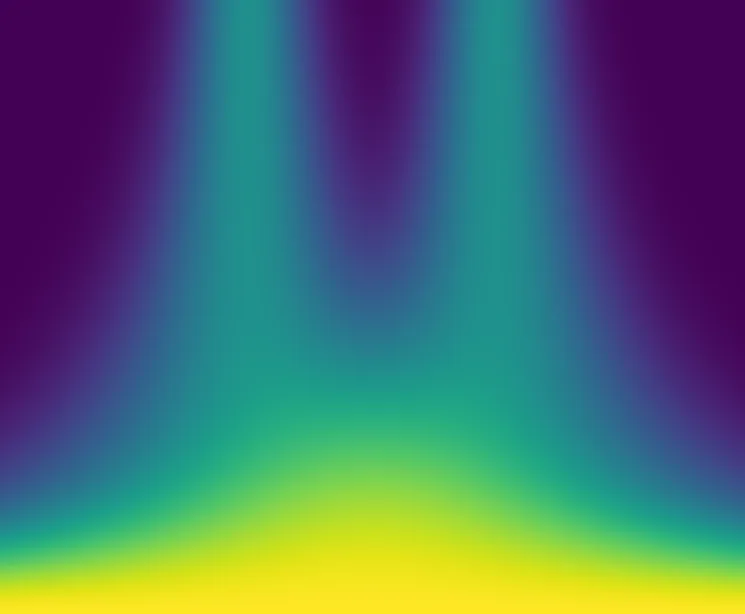
اضرب جرسًا فسيصدر صوتًا. لكن الصوت لن يكون عشوائيًا: فالجرس يختار النغمات التي يتوافق معها معدنه. يبدو أن الثقب الأسود يتصرف بنفس الطريقة. عندما يسقط فيه شيء ما أو ينحني زمكانه، يبدأ بالاهتزاز. هذه الاهتزازات ليست ضجيجًا عشوائيًا، بل مجموع نغمات نقية (تُعرف بالنمط شبه الطبيعي quasinormal modes). كل نغمة تخفت مع الزمن، مثل رنين الجرس بعد الضربة.
وجد مؤلفو الدراسة قاعدة بسيطة تربط قوة الضربة بشدة كل نغمة. كان هذا يُعتبر سابقًا أمرًا معقدًا ويعتمد على الصدفة. الآن أصبح واضحًا: يعمل الثقب الأسود كمرشح طيفي (spectral filter). إنه «يستمع» إلى الاضطراب ولا يستجيب إلا للترددات الموجودة أصلًا في الضربة. إذا كان في الضربة تردد قريب من النغمة الذاتية للثقب، فستصدر هذه النغمة بأعلى شدة. للتحقق من ذلك، أنشأ العلماء اضطرابات بحزمة ترددات محددة بدقة، كما لو كانوا يضربون الثقب بمطارق ذات نغمات مختلفة. أكدت الحسابات العددية أن سعة كل نغمة تساوي تمامًا مقدار ما كان موجودًا من ترددها في الدفعة الأولية.
لاستخراج هذه النغمات بدقة من الإشارة، ابتكر المؤلفون أداة برمجية جديدة — QNMToolkit. تحلل هذه الأداة الإشارة بنوافذ منزلقة، كما لو كانت تعيد الاستماع إلى التسجيل من لحظات مختلفة، وتقيم مدى استقرار تحديد كل نغمة. سمح ذلك بتأكيد القاعدة بدقة تصل إلى نسبة مئوية.
وهكذا يتحول الثقب الأسود من وحش غامض إلى جهاز فيزيائي مفهوم. رنينه يخبرنا ليس فقط بما سقط فيه، بل أيضًا عن كيفية انحناء الفضاء من حوله. وبالتالي، من خلال الاستماع إلى التصادمات البعيدة، يمكننا اختبار قوانين الجاذبية في أقوى الحقول في الكون.
الملخص الأصلي
كما كتبه المؤلفون، بالإنجليزية arXiv:2605.24704
The ringdown of a perturbed black hole (BH) can be described as a superposition of quasinormal modes (QNMs), whose frequencies are determined by the spacetime geometry while their amplitudes depend also on the perturbing source. However, the physical mechanism governing mode excitation remains unclear and is typically treated on a case by case basis. In this work, we show that QNM excitation is governed by a simple spectral rule: each mode is excited according to the Fourier content of the perturbation evaluated at its characteristic frequency. This result follows from the factorization of the excitation coefficients and establishes a direct, quantitative connection between the spectral properties of the perturbation and the resulting ringdown amplitudes. To make this mechanism explicit and controllable, we construct localized perturbations with independently tunable spectral bandwidth and carrier frequency. We demonstrate analytically and numerically that BHs act as resonant spectral filters. We show analytically that the excitation amplitude of each mode equals the weighted spatial Fourier transform of the initial data evaluated at wavenumber $$k\sim\omega_n$$ so that the filter selectively excites modes whose frequencies lie within the spectral support of the perturbation while suppressing others. Consequently, the excitation is maximized when the dominant perturbation frequency lies close to the real part of the QNM frequency, and we validate this at the percent level with fits to time-domain numerical evolutions. To robustly perform these fits, we have developed a new fitting algorithm, $$\mathtt{QNMToolkit}$$, which performs ringdown fits over large ensembles of sliding time-domain windows and quantifies the resulting fitting variance.
إذا أصدر ثقب أسود كتلة الشمس صوتًا في النطاق المسموع، لكانت نغمته الأساسية مشابهة لطنين منخفض، شبه تحت صوتي — حوالي 200 هرتز (نوتة صول في الأوكتاف الصغير).
في رواية «تواصل» لكارل ساغان، احتوت الإشارة الفضائية على توافقيات مشفرة — تمامًا كما يرمز الثقب الأسود معلومات الاضطراب في نغماته التوافقية.