كيف يوقف الضغط ولادة الثقوب السوداء سريع
في اللحظات الأولى بعد الانفجار العظيم، كان الكون مليئًا ببلازما ساخنة شبه متجانسة. لكن في بعض الأماكن، قد تكون الكثافة أعلى قليلاً بالصدفة. إذا اكتسب هذا التجمع كتلة حرجة، فإنه ينهار ليشكل ثقبًا أسود — هكذا وُلدت الثقوب السوداء البدائية.
لفترة طويلة، اعتقد المنظرون أن المادة في تلك الظروف تتصرف مثل الإشعاع: حيث يرتفع الضغط بشكل متناسب تمامًا مع الكثافة. ولكن ماذا لو أن المادة تبدأ في "التصلب" عند الانضغاط الشديد — حيث يقفز ضغطها بشكل أسرع بكثير؟ اختبر مؤلفو الدراسة هذه الفكرة باستخدام نموذج بسيط: استبدلوا الإشعاع بـ"غاز شبكي" — وهو نظام لا يمكن للجسيمات فيه أن تشغل نفس المكان. عندما تقترب الكثافة من الحد الأقصى، تتسارع سرعة الصوت في هذا الوسط، وتقاوم المادة بشدة المزيد من الانضغاط.
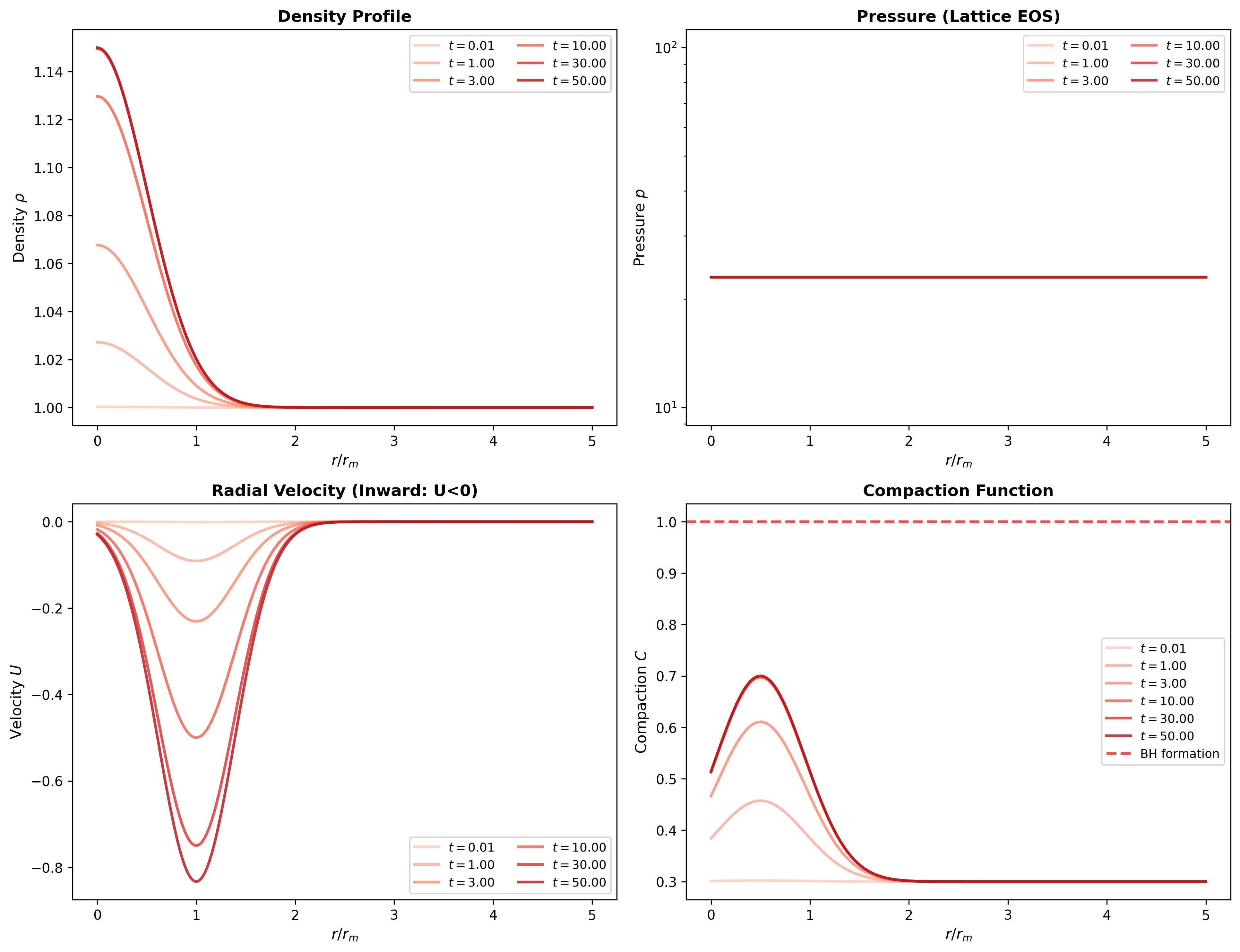
أجرى الباحثون سلسلة من المحاكاة العددية للانهيار المتماثل كرويًا في إطار النسبية العامة. واكتشفوا أن عتبة تشكل الثقب الأسود ارتفعت بنسبة 0.50±0.02% مقارنة بحالة الإشعاع النقي. هذا قليل، لكنه كافٍ لتغيير التوقعات حول عدد الثقوب السوداء البدائية التي قد تكون بقيت حتى يومنا هذا. وفي الوقت نفسه، ظل الأس الحرج للكتلة كما هو — 0.357، ضمن هامش الخطأ. وهذا يعني أن آلية الانهيار نفسها بالقرب من العتبة لم تتغير، فقط تطلب الأمر كثافة ابتدائية أكبر قليلاً لبدء الانهيار.
الملخص الأصلي
كما كتبه المؤلفون، بالإنجليزية arXiv:2606.29590
The threshold and scaling laws of gravitational critical collapse depend sensitively on the matter equation of state. We investigate how these quantities are modified by a generic feature of dense matter that is absent from the radiation fluid commonly assumed in primordial black hole (PBH) studies: pressure stiffening as a maximum density is approached. As an analytically tractable proxy, we adopt the closed-form equation of state of a single-occupancy lattice gas, \(p=-T\ln(1-\rho)\), which exhibits a density-dependent sound speed and a saturation density. Using general-relativistic simulations of spherically symmetric collapse, we show that this nonlinear pressure feedback increases the PBH formation threshold by \(0.50\pm0.02\%\) relative to the radiation equation of state within the causal regime of the model. At the same time, the critical mass-scaling exponent remains \(\gamma=0.357\pm0.001\), consistent with the radiation-fluid value to within our numerical precision. This agreement reflects the fact that the lattice equation of state approaches the radiation fluid at low density and remains only a mild perturbation over the near-critical regime, rather than indicating a universal critical exponent. Our results provide a proof of principle that saturation-induced stiffening can stabilize gravitational collapse and shift the PBH threshold, while introducing a linear-response framework for assessing the impact of more realistic equations of state on primordial black hole formation.
في الجزء الأكثر كثافة من النجم النيوتروني، يمكن أن تتسارع سرعة الصوت لتقترب من سرعة الضوء — حوالي 200 000 كم/ث.
في رواية "مخطط الانقسام" لبروس ستيرلينغ، تتلاعب كائنات ذكية بمادة فائقة الكثافة لبناء مدن على النجوم النيوترونية.