الميوعة الفائقة صمدت أمام ضغط 210 جيجا باسكال سريع
وُضعت قطعة من غشاء أرق من شعرة الإنسان بين سنداني الماس وبدأ الضغط عليها. ارتفع الضغط — مئة ألف ضغط جوي، نصف مليون، مليون… والمادة واصلت توصيل التيار دون مقاومة.
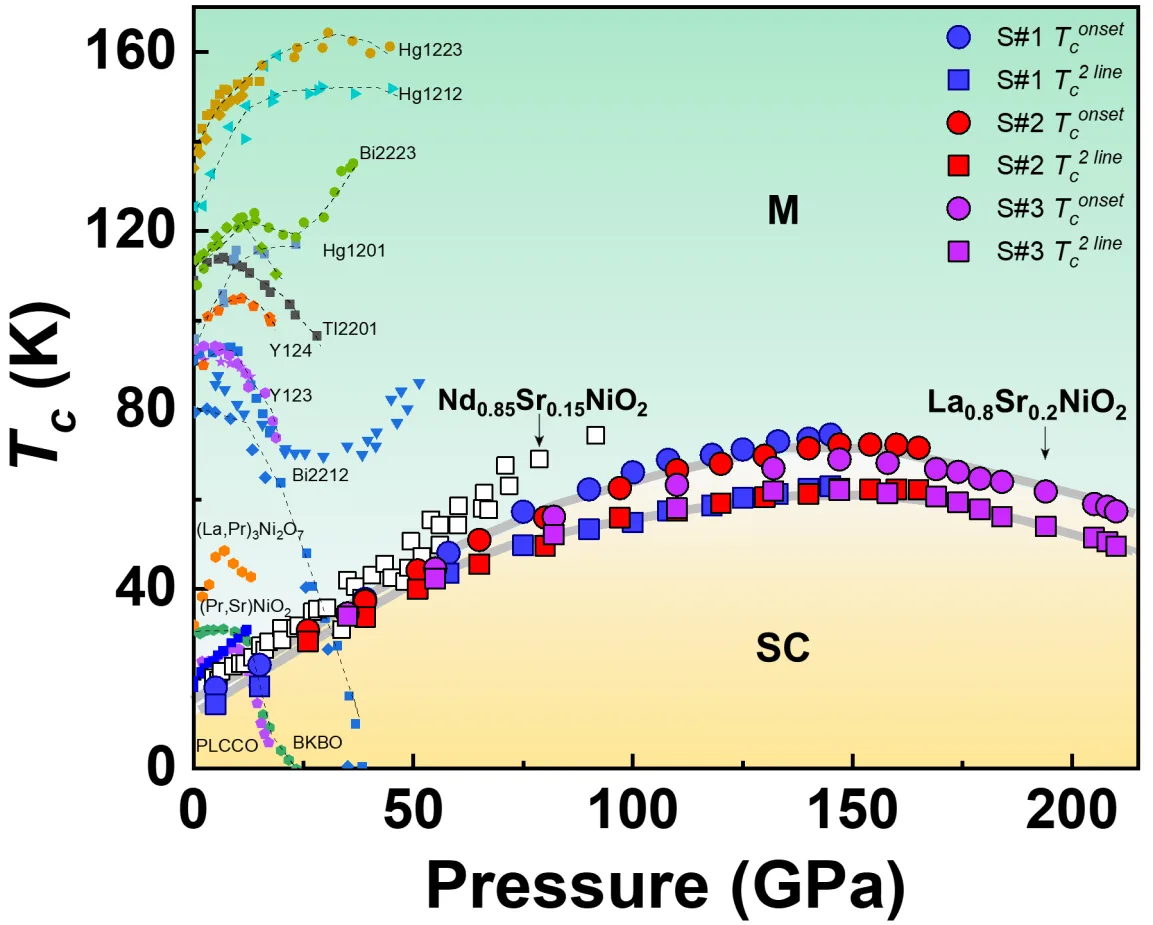
أظهر غشاء نيكلات اللانثانم-سترونشيوم (La₀.₈Sr₀.₂NiO₂) صورة مذهلة. في الظروف العادية، يصبح موصلًا فائقًا عند 16 كلفن (−257 درجة مئوية). مع زيادة الضغط، صعدت درجة حرارة الانتقال مثل عمود الزئبق في مقياس الحرارة، وبلغت ذروتها 74.5 كلفن عند 146 جيجا باسكال. هذا أعلى بنحو 60 درجة من نقطة البداية. ثم بدأ الهبوط التدريجي — عند 210 جيجا باسكال سُجل الانتقال عند 57.4 كلفن.
في السابق، لم يحافظ أي أكسيد فائق التوصيل على خصائصه تحت مثل هذه الأحمال القصوى. عادةً تتحطم الشبكة البلورية ويختفي التأثير. هنا، صمدت المادة حتى نهاية التجربة. هذا التحمل يذكرنا بمتسلق جبال لم يصل إلى القمة فحسب، بل نزل أيضًا دون قناع أكسجين.
الملخص الأصلي
كما كتبه المؤلفون، بالإنجليزية arXiv:2608.02042v1
The discovery of superconductivity in infinite-layer nickelate thin films has opened a new frontier for exploring unconventional oxide superconductors beyond the copper oxide family. However, the presence of substrate hampers investigations under very high pressure. Recently, this problem was circumvented by a study of freestanding Nd0.85Sr0.15NiO2 membranes, which revealed that superconducting transition temperature kept increasing as the pressure was ramped up to 91 GPa, without showing signs of saturation. Naturally, one wonders what would happen at even higher pressures. Here, we report that superconductivity in a freestanding La0.8Sr0.2NiO2 membrane persists under applied ultrahigh pressures up to 210 GPa. The superconducting transition onset temperature exhibits a continuous dome-like evolution, increasing from 16 K at ambient pressure to a peak of 74.5 K at 146 GPa, and then gradually decreasing to 57.4 K at 210 GPa. Such robustness of superconductivity against ultrahigh pressure has not been observed in high-Tc oxide superconductors before.
السندان الماسيان اللذان يولّدان هذا الضغط هما ماسان مصقولان يضغطان العينة بين طرفيهما بمساحة أصغر من رأس الدبوس.