حرارة تحت الضغط: كيف نقيس ما لا يُرى سريع
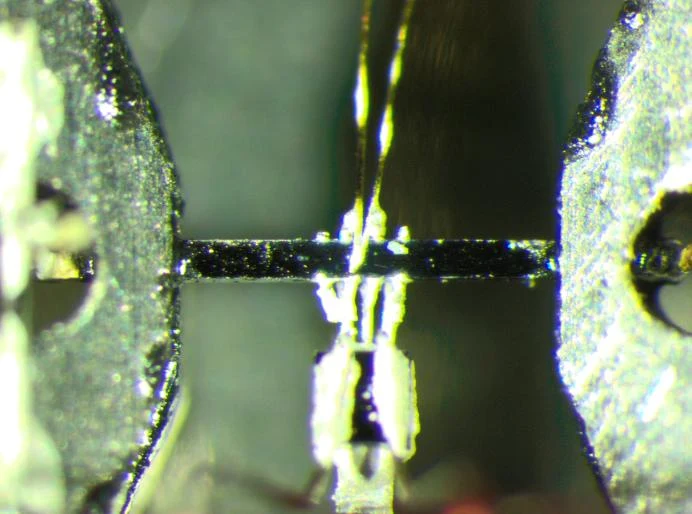
الموصل الفائق هو مادة تتدفق فيها الكهرباء دون أي فقدان، مثل الماء في أنبوب أملس تمامًا. لكن إذا ضغطته قليلًا، مثل النابض، تتغير خصائصه. لطالما أراد العلماء قياس كمية الحرارة التي تمتصها هذه المادة المضغوطة، لكن الأجهزة لم تكن تتسع داخل الجهاز الضيق. الآن، ابتكروا طريقة للتغلب على هذه العقبة.
إنهم لا يقيسون الحرارة نفسها، بل التذبذبات الدقيقة في درجة الحرارة عندما تُضغط المادة بسرعة ثم تُطلق. هذا مثل مراقبة تنفّس شخص دون لمسه. بدمج القياسات عند الضغط البطيء والسريع، يحصلون على خريطة دقيقة للحرارة عبر العينة بأكملها. بالنسبة للموصل الفائق Sr₂RuO₄، أظهرت هذه الخريطة أمرًا مدهشًا: عند ضغط معيّن، يصبح النظام الداخلي للمادة في أقوى حالاته.
هذا الاكتشاف يساعد في فهم كيفية التحكم في الموصلات الفائقة باستخدام الضغط. ربما في المستقبل، ستعمل هذه المواد في درجات حرارة أعلى، مما يقربنا من أسلاك بلا فقدان في منازلنا.
الملخص الأصلي
كما كتبه المؤلفون، بالإنجليزية arXiv:2608.17777v1
Uniaxial pressure is a powerful tuning parameter for quantum materials, but conventional thermodynamic probes such as specific heat are difficult to realize in the constrained geometries of strain apparatus. We develop a quantitative analysis framework for a.c. elastocaloric effect measurements that enable the reconstruction of the absolute entropy and hence specific heat across complex phase diagrams. The absolute accuracy is achieved by combining measurements in the strong coupling regime at low frequencies with high signal-to-noise measurements in the quasi-adiabatic regime at high frequencies. Applying the approach to the correlated superconductor Sr$$_2$$RuO$$_4$$, we obtain an absolute entropy map across the phase diagram including across phase transitions deep into the superconducting state. We demonstrate that from such data one can derive the absolute specific heat which is currently not possible through other approaches. This data reinforces the finding that the quenching of entropy within the superconductor Sr$$_2$$RuO$$_4$$ is strongest at the critical strain consistent with the superconducting gap being maximized at the Van Hove singularity (VHs). Furthermore, we demonstrate that, although $$\Delta c /(\gamma T) $$ does increase at the VH strain, this increase is much weaker than previously inferred from more indirect caloric experiments.
الضغط المشار إليه أقل من جزء من مائة من سُمك شعرة الإنسان، لكنه يغير خصائص المادة أكثر من تسخينها ببضع درجات.