Sound Waves Mix Like Paint express
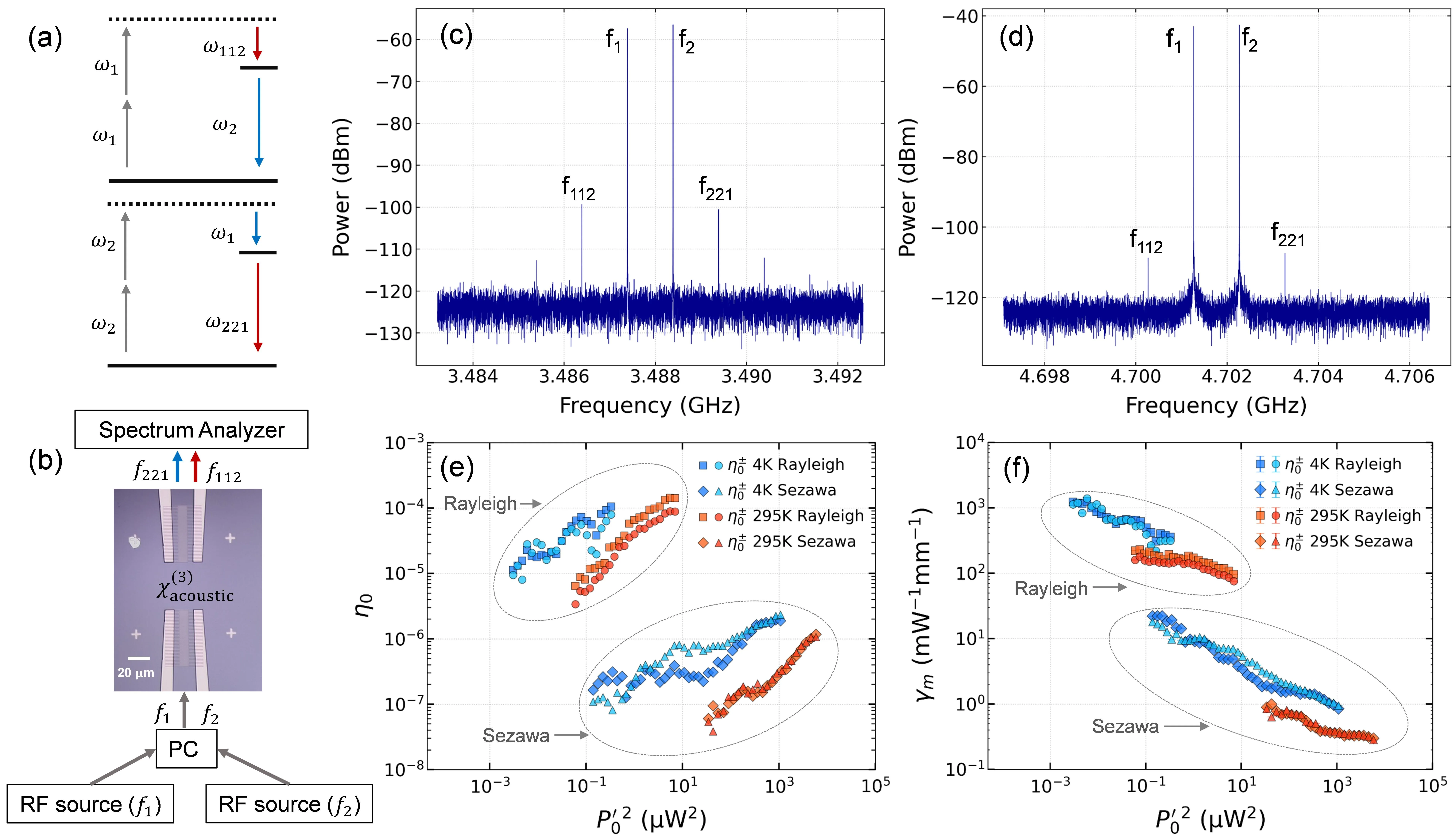
In the kitchen, when two broths are mixed in one pot, the resulting flavor is new, unlike either of the originals. A similar trick is possible with sound: two waves meeting on the surface of a crystal give birth to a third, with a frequency that neither of them had. This is called four-wave mixing, and in a new study it was examined on a tiny film just five hundred nanometers thick — hundreds of times thinner than a human hair.
The film, made of aluminum scandium nitride, sits on a silicon carbide substrate. Two types of sound waves are sent along it: Rayleigh waves, which travel along the very surface, and Sezawa waves, which dive a bit deeper. Both are like ripples on water, but their frequencies are in the gigahertz range — billions of oscillations per second. The scientists made two waves mix and measured how strongly a new frequency was generated. It turned out that at liquid helium temperature, around minus 269 degrees Celsius, the effect is enhanced compared to room temperature. And Rayleigh waves mix frequencies about a hundred times more strongly than Sezawa waves, at any temperature.
Why is that? It all comes down to where the wave's energy is concentrated. A Rayleigh wave hugs the very surface, where the film is thinner and deforms more easily, like a stretched rubber band that's easier to pluck. A Sezawa wave spreads through the film's thickness, and its energy is smeared out, so mixing is weaker. Cold helps both types: at low temperatures, atoms jiggle less, and sound loses less energy along the way.
This work is a step toward devices where sound replaces electricity for signal processing. Such devices could be more compact and generate less heat. Sound waves might also work in quantum systems, where precision is key. The aluminum scandium nitride film on silicon carbide proved to be a convenient platform: you can compare different wave types and pick the best for each task. Like in the kitchen: first you taste the broths separately, then you mix them, and get a new flavor.
Original abstract
as written by the authors arXiv:2601.12418
Surface acoustic wave platforms based on piezoelectric thin-film heterostructures provide sub-wavelength acoustic confinement, making them attractive for compact nonlinear phononic systems with applications including frequency conversion, parametric interactions, and nonlinear signal processing. Here, we investigate guided surface acoustic wave phononic four-wave mixing at gigahertz frequencies in an aluminum scandium nitride/4H-silicon carbide heterostructure operated at both room temperature (295 K) and cryogenic temperature (4 K). The 500 nm thick aluminum scandium nitride film supports guided Rayleigh and Sezawa modes with distinct displacement and strain energy density distributions, allowing a direct comparison of mode-dependent nonlinear behavior within the same device. Continuous-wave four-wave mixing measurements reveal an enhancement in the extracted modal nonlinear coefficient at 4 K relative to 295 K for both modes. In addition, the Rayleigh mode exhibits a modal nonlinearity approximately two orders of magnitude larger than that of the Sezawa mode across both temperature regimes. These results demonstrate that phononic four-wave mixing is strongly influenced by temperature, mode confinement, and strain localization while establishing aluminum scandium nitride on silicon carbide heterostructures as a promising platform for engineering enhanced nonlinear phononic interactions for future classical and quantum acoustic on-chip signal processing systems.
Sound waves on a crystal surface can be seen: if you sprinkle fine powder on the surface, it will gather into patterns where the wave oscillates most strongly.