Liquid heliumtemperature refers to the cryogenic regime around 4.2 K (−269 °C), where helium gas condenses into a liquid at standard pressure. This is the boiling point of helium-4, the most common isotope. In this extreme cold, thermal energy is so low that quantum effects dominate, making it the standard operating environment for superconducting circuits and other quantum devices. The temperature is critical because superconducting materials, such as aluminum or niobium, only exhibit zero electrical resistance below their critical temperature, which is typically a few kelvin. For superconducting qubits, maintaining this temperature suppresses thermal excitations that would otherwise destroy the fragile quantum states.
History
Helium was first liquefied by Heike Kamerlingh Onnes in 1908 at the University of Leiden, reaching a temperature of 4.2 K. This achievement opened the field of low-temperature physics and led to the discovery of superconductivity in 1911.
How it works
Liquid helium is produced by compressing and cooling helium gas through a series of heat exchangers and expansion turbines, a process known as the Claude cycle. The resulting liquid is stored in cryostats, which are vacuum-insulated vessels. In a dilution refrigerator, a common tool for quantum computing, liquid helium is used to pre-cool the system to 4 K, after which a mixture of helium-3 and helium-4 isotopes is used to reach even lower temperatures, down to millikelvin. The superconducting qubits are mounted on the coldest plate, shielded from external radiation and magnetic fields, to maintain coherence.
In practice
Liquid heliumtemperature is essential for operating superconducting qubits in quantum computers, as well as for superconducting magnets in MRI machines and particle accelerators like the LHC.
Fun fact
At 4.2 K, liquid helium becomes a superfluid with zero viscosity, allowing it to creep up and over the walls of its container in a phenomenon called the Rollin film.
Systems:SILiquid helium temperature is approximately 4 kelvin, where the kelvin is the SI base unit of thermodynamic temperature.
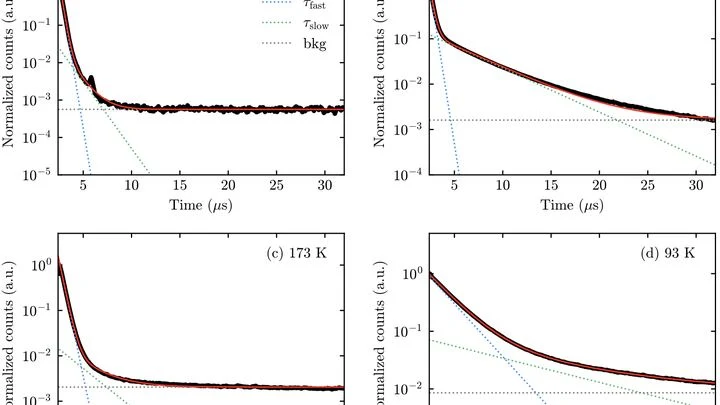
The stage is bathed in icy light, and on it stand silicon spectators. Each is an array of tiny avalanche diodes capable of spotting a single photon, but only if the surrounding temperature drops to 165 K.
A transparent film of bismuth tungstate sits on a substrate and does not conduct electricity. Three minutes in a cloud of nitrogen plasma, and it turns black, with resistance dropping by a factor of a billion.
Instead of an ice bath, a warm gas blanket. That is how the cryogenic current comparator at Japan's National Metrology Institute is now cooled. Previously, this instrument, which compares electric currents to within billionths of a percent, required immersion in liquid helium.
In the cold cloud TMC-1, where the temperature never rises above ten degrees above absolute zero, molecules rarely encounter one another. But every so often a helium atom whizzes past, and that brief touch is enough to alter the molecule's rotation. Such collisions dictate what radiation we see from Earth.
One universal interpreter for all dialects of sodium. Liquid sodium in a reactor behaves differently: near the pipe wall it is dense and fast, near the boiling surface it is rarefied and slow. Previously, each state required its own set of calculations, as if hiring a new translator for every phrase.
In the depths of sub-Neptunes, the most common type of planet in the Galaxy, though not one you could stand on, silicate magma and hydrogen mix into a single supercritical cocktail. Previously, it was thought that beneath the dense hydrogen atmosphere lay a sharp boundary with molten silicate, like oil on water.
The neutron is a particle that usually sits in the atomic nucleus and doesn't disappear. But some theories suggest that occasionally it might transform into its invisible twin — a particle that ordinary detectors can't catch.
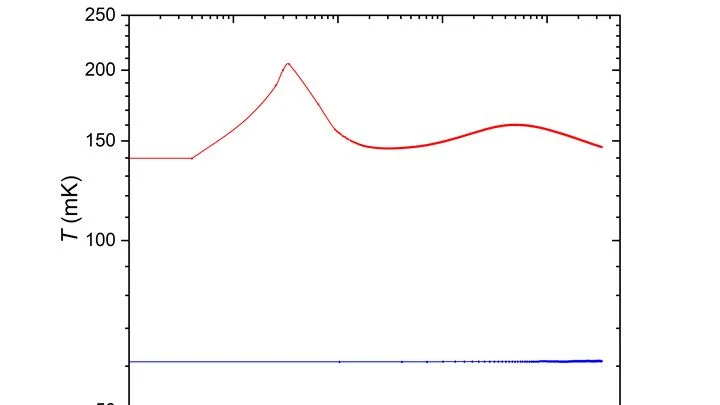
A quantum lab is like a kitchen where the chef waits a day for the stove to cool down. Superconducting qubits only work at temperatures of a few hundredths of a kelvin, and each 'cool, measure, warm up' cycle eats a whole day. A team of engineers built a fridge the size of a melon, weighing 3 kg, that does the job in just two hours.
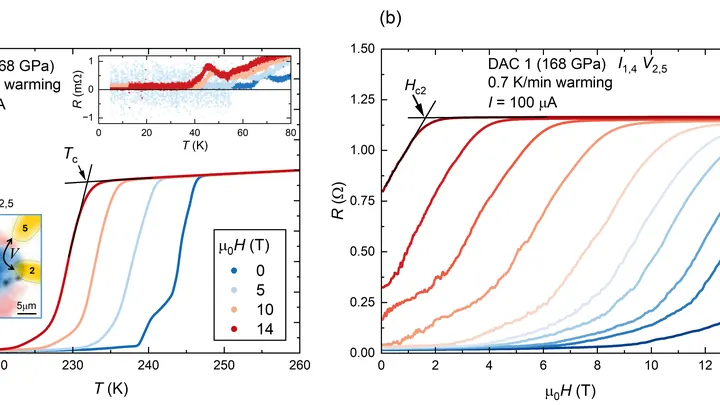
Inside a diamond anvil cell, squeezing a sample with a force millions of times greater than atmospheric pressure, a thin film of lanthanum meets hydrogen. The hydrogen comes from ammonia borane — a powder that, when heated, releases its hydrogen like a sponge releasing water.
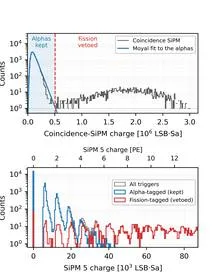
A sodium iodide crystal doped with thallium is like photographic film for invisible particles. When a gamma ray or a hypothetical dark matter particle hits it, it flashes with faint light. Two silicon photomultipliers pressed against the crystal's ends catch the flash from both sides.
A bridge where pedestrians and cyclists flow together without getting in each other's way. That's roughly how hybrid systems of superconductors and semiconductors work: the former carry current without loss, the latter control that current.
A microchip the size of a fingernail gives off as much heat as a small light bulb. Getting rid of that heat is like trying to cool a cup of hot tea with a teaspoon: the insulating material around transistors is usually a poor heat conductor.
A boiling kettle on the stove eventually boils dry — and so, according to the classical picture, a black hole should gradually vanish in a hiss of radiation. But what if you add a special ingredient to the kettle?
A ceramic plate as thin as a soap film, and through it flows current with zero resistance. That's the superconductivity achieved in nickelates, relatives of the famous cuprate superconductors. Previously, this required enormous pressure, comparable to that at the ocean floor.
The river splits in two. One branch is wide and fast, with water flowing smoothly, but as temperature rises, the flow slows: eddies and waves appear. The second branch is narrow, with rapids, where water leaps from rock to rock. This flow, on the contrary, becomes more lively with warming.
Water is not just a wet substance. On a picosecond scale, it resembles a dance floor where molecules continuously break and form bonds with each other. Usually, this dance is described by one main movement — collective relaxation, as if the whole crowd simultaneously slows down after the music stops.
A potter uses a sharp stylus to trace a pattern on a still-damp clay tile. One wrong move, and the line blurs, the tile cracks. Physicists work with films of the high-temperature superconductor YBCO (a compound of yttrium, barium, copper, and oxygen) in much the same way.
A magnet the size of a grain of rice floats in a vacuum without touching the walls. It is held by the magnetic field of a superconducting trap — a ring cooled to a state where current flows without resistance.
In a pot of soup, every grain is a tiny magnet that wants to flip opposite to its neighbor. Heat the soup, and the magnets start jittering, obeying the heat. But how do you know how unruly they are at each temperature? For an ordinary material, you'd calculate this on powerful computers by enumerating possibilities.
An ordinary kettle: you heat it up — temperature rises, molecular chaos grows, and steam shoots out. But in the lab, they've created a peculiar "kettle"—an analog black hole made from superconducting circuits cooled to the extreme.
A tiny ball weighing a fraction of a milligram, suspended in a magnetic field and cooled to near absolute zero, oscillates for 110 hours without stopping: this is record isolation. The energy loss is so small that the system's entropy barely increases, making any external influence noticeable.
Plutonium is a metal with attitude. One form shrinks when cooled, another swells. But at room temperature, the alloy behaves strangely: the ruler says one thing, X-rays say another. The ruler shows the sample barely grows, while X-rays see atoms in the crystal lattice moving further apart.
A superconductor does not let a magnetic field penetrate its interior. But if the field is strong enough, it does get in — not as a continuous flux, but as individual vortex filaments, like tiny tornadoes. Inside each filament, superconductivity is destroyed, and around it flows a persistent current.
A giant cauldron of simmering soup stretches across millions of light-years. This is the atmosphere of the Perseus galaxy cluster — a cloud of scorching gas held together by gravity. Until recently, astronomers thought that in the center of this cauldron, the gas was calmly cooling, ready to condense into new stars.
A crystal that promised to conduct electricity without loss at room temperature turned out to be like a house of cards: touch it and it falls apart. Two compounds (one with silver, one with gold) were considered superconductor candidates, but tests showed that neither can withstand even ordinary conditions.
In the silver variant, the lattice simply collapses.
An aluminum pot on the stove melts at 660 degrees Celsius — everyone knows that. But what happens if you heat aluminum a hundred times hotter? The liquid starts to boil, and here's the puzzle: at what exact temperature does that happen?
An ordinary aluminum pot on a stove doesn't emit molecules you can catch with light. But if you take aluminum and an aluminum salt, heat them together in a small oven, you get a stream of aluminum fluoride molecules, like steam from a kettle's spout, except instead of water droplets, tiny particles fly out.
Any cook knows: whether dough sticks to a pan depends on what happens at the interface between two media. For molten metals, that interface long remained invisible — temperatures above 200 °C made it impossible to resolve individual atoms.
Electrons in a crystal sometimes behave like a stadium crowd doing the wave: areas of higher density alternate with nearly empty ones. This wave blocks the free flow of charges — under normal conditions, the material is not superconducting. But apply pressure, and the wave vanishes, letting electrons move without resistance.
A quantum computer is like an orchestra where each musician plays their part, but if the conductor waves the baton a bit too hard, the delicate instruments go out of tune from excess heat. Controlling qubits at 10 mK (300 times colder than your freezer) is like conducting an orchestra in an ice-cold hall where even a breath can ruin everything.
Quantum materials are like finicky flowers: they only bloom in the cold. At room temperature, they hide their unusual properties, but when deeply cooled, they become superconductors or change their magnetic behavior. To understand how they work, you need to examine their atoms in the very cold where these properties reside.
Ordinary soldering doesn't work for quantum circuits: when cooled to liquid helium temperatures, metal cracks, and the contacts themselves introduce noise. Engineers from the research group tried something different — a drop of gallium alloy that stays liquid at room temperature, like mercury in an old thermometer.
A liquid that flows without friction is superfluid helium-4, a strange state of matter at temperatures below two kelvins. In a large volume, the transition to superfluidity occurs at the lambda-point temperature, but in narrow channels everything changes.
In a solid crystal resembling a layered cake of lanthanum, oxygen, and hydrogen atoms, electricity is carried not by electrons but by hydrogen ions themselves. Usually, an ion in a crystal sits in its own cell like a pea in a pod, occasionally hopping to a neighboring empty cell. But in this material, things are different.
At 0.1 K, just three-tenths of a degree above absolute zero, matter stops following the usual rules. Helium becomes superfluid: it flows without friction, seeps through cracks, and behaves like one giant quantum liquid. Seeing what happens inside such cold is a challenge at the edge of possibility.
A quantum bit is like a spinning top that must keep spinning steadily for a long time. In germanium, researchers have learned to set such tops spinning, but the floor around them is always trembling: electrical noise knocks the spin off course.
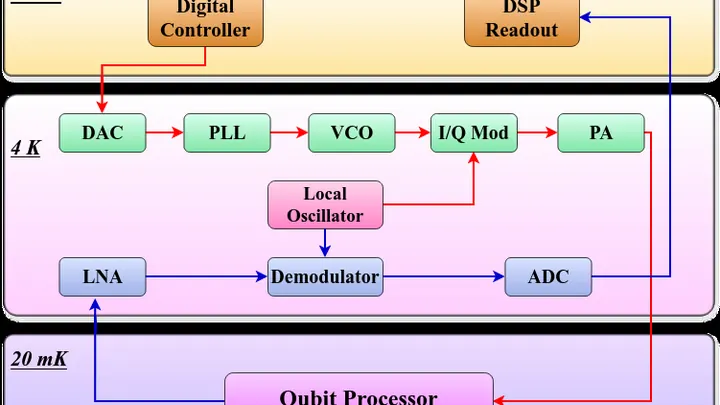
Quantum computers promise to solve problems beyond the reach of classical machines, but their heart, the qubits, requires ultra-low temperatures near absolute zero. Controlling qubits and reading out their states typically means working from a warm room, running many cables through the refrigerator.
A tiny cloud of 300,000 ytterbium atoms, cooled to near absolute zero, was shuttled along a light track 34 centimeters long, like transporting a fragile cargo over a bumpy road without shaking it apart.
A layer of electrons trapped between two semiconductor plates lines up into a neat lattice at low temperatures, like beads on a string stretched between your fingers. As the temperature rises, order collapses: the crystal melts. But exactly how it melts has long been a puzzle.
Light from tiny perovskite crystals is like a choir performance, where voices sound sometimes solo, sometimes in a tight duet. Previously, such a duet could only be heard under extreme cooling, nearly to the chill of outer space. Now the choir sings at room temperature.