Popular

Roy Glauber

1925–2018 · quantum optics, laser physics
American theoretical physicist, considered the founder of quantum optics. He developed the theory of higher-order optical coherence, introduced the concept of coherent states (Glauber states), and explained photon statistics in laser radiation. Winner of the Nobel Prize in 2005.

Biography

Born in New York. He received his PhD from Harvard. At age 18, he participated in the Manhattan Project. He worked at the Institute for Advanced Study, Caltech, and Harvard University. The Nobel Prize was awarded for his contribution to the quantum theory of optical coherence.

Key discoveries

💡 As a student, he was recruited for the Manhattan Project, where at age 18 he calculated nuclear reaction cross sections for the atomic bomb.
Quote: "Light is not only a wave or a particle: it is something more subtle that we are only beginning to understand with the help of quantum theory."
Links in the knowledge graph 1
Related tags
quantum informationquantum measurementquantum optics
Related laws
Hong–Ou–Mandel effect
Related scientists
Charles TownesAlain AspectDavid DeutschShuji NakamuraJohn Stewart BellAlbert A. MichelsonSerge HarocheDavid Bohm

Related articles

Quantum Tuning Fork: Noise Speeds Up the Search for Single Emitters

Brute-force photon counting from a single emitter gets bogged down in noise, like digging a tunnel with a shovel. But introduce a coherent reference beam and let quantum interference kick in — and the picture changes dramatically: the noisier the environment, the faster the verdict. The extended Hon
arXiv:2505.00950v2 · 2025-05-02

Seven Lives of a Photon: Exceptional Points Control Spontaneous Emission

By combining lithium niobate and gallium arsenide, scientists created a chip. In it, quantum dots interact with microresonator modes, and electro-optic tuning of the feedback phase drives the system to an exceptional point. At this singularity, two modes coalesce, and the spectral density of states
arXiv:2505.05490v1 · 2025-05-02

Quantum Hearing Without Noise

Scientists have developed a method to detect ultra-weak signals, bypassing the fundamental noise threshold of the quantum world. Using a special amplifier crystal and analyzing two 'echoes' of the signal, the useful signal becomes louder, but the noise does not. This paves the way for more sensitive
arXiv:2506.02717v1 · 2025-06-03

Quantum Stopwatch: Photons Measure Time

Scientists broke the coherence barrier by teaching detectors to recognize photon frequencies. This allows measuring delays with 10-picosecond precision, even when photons don’t arrive simultaneously. The discovery promises a breakthrough in quantum metrology.
arXiv:2506.03098v2 · 2025-06-03

Atom Cloud Gives Light a New Color

Physicists shifted light from visible red to infrared—the color that glides through glass cables—using a cloud of cold rubidium atoms. Achieving 80% efficiency, the method marks a leap toward a quantum internet where signals travel without fading.
arXiv:2506.03957v1 · 2025-06-04

Quantum Simulator Discovers Plasma Memory

Physicists simulated a collision of charged particles. Contrary to expectations, instead of chaos, a plasma emerged, expanding as a shock wave and retaining memory of the initial charge clumps. The reason — plasma oscillations akin to a pendulum. This discovery helps understand matter under extreme
arXiv:2510.11679 · 2025-10-13

Atomic Lock: How to Catch Light in a Solar Storm

Physicists turned a rubidium atom into a supersensitive detector that responds only to light of a very specific shade. This makes it possible to count individual photons even with a background billions of times brighter from the sun. The technology paves the way for daytime laser communication and s
arXiv:2512.02521 · 2025-12-02

Classical Light Masters 'Quantum' Tricks

Researchers showed that classical light, after discarding weak signals, yields negative values of the Wigner function. This result questions whether such values unequivocally indicate quantum nature.
arXiv:2512.13462 · 2025-12-15

The Photonic Lathe: 100,000 Custom-Made Photons

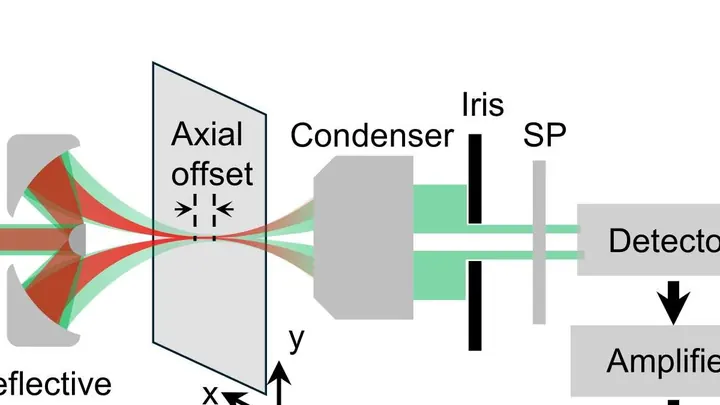
Physicists have for the first time produced up to 100,000 photons in a precisely defined quantum state – hundreds of times more than before. Using virtual lenses, they correct distortions and reduce operation time as the number of particles increases. The method paves the way for ultra-sensitive sen
arXiv:2601.05118 · 2026-01-08

A Dimmer Reveals the Quantum Secrets of Light

A primitive light sensor can't tell what kind of light it sees, but physicists found a way: put a dimmer in front of it. By varying the dimming, the pattern of clicks reveals whether the light is quantum or classical.
arXiv:2601.13869 · 2026-01-20

How Squeezed Light Makes Microscopes Sharper

Light is sent through a microscopic waveguide, stripping away excess jitter. This squeezed beam outsmarts conventional precision limits. A new record — noise reduced by a factor of 35 — promises microscopes that can see cells without heating them.
arXiv:2601.15565 · 2026-01-22

The Birth of Quantum Light in a Semiconductor

By illuminating a semiconductor with a laser, physicists obtained light that behaves like a synchronized orchestra: its particles are squeezed and entangled. This discovery promises quantum microchips based on ordinary materials.
arXiv:2602.10882 · 2026-02-11

Synthetic Lattice for a Single Photon

A superconducting qubit and a fast modulator turned frequencies into floors for a single photon, letting it wander randomly, oscillate, or move only forward. This is a step toward compact quantum simulators.
arXiv:2602.13736 · 2026-02-14

The Laser Where Atoms Listen to Each Other

A regular laser is a collection of soloist atoms. In the new laser, atoms form a choir: they hear each other and synchronize their emission. This gives birth to squeezed light with drastically reduced quantum noise, enabling measurements of unprecedented precision.
arXiv:2602.16215 · 2026-02-18

How a Beam of Light Turns into Schrödinger's Cat

When doubling the frequency of a laser beam inside a crystal, the light spontaneously morphs into something like Schrödinger’s cat—a blend of two states. Vacuum jitters disrupt the rhythm of the wave, and the photon stream splits in two. This lets us generate macroscopic quantum states without bulky
arXiv:2603.24067 · 2026-03-25

Picture from Nothing: Silence Paints Ghosts

Usually, light is needed for a photo. In a new experiment, it was deliberately excluded. The image was assembled not from flashes, but from pauses of absolute darkness — like a drummer stays silent, and you deduce the drum’s shape from the missing beats. The method blurs the line between quantum and
arXiv:2604.07782 · 2026-04-09

Birth of Light from the Quantum Void

By abruptly altering conditions, scientists transform ghostly vacuum particles into real photons—like the twang of a plucked string. Near a quantum phase transition, the effect intensifies, and light becomes visible even at high temperatures. The discovery paves the way for new detectors and radiati
arXiv:2604.10406 · 2026-04-12

Squeezed Gravitational Waves: How Quantum Optics Reveals the Voice of Black Holes

Black hole collisions transform the quantum whisper of spacetime into a roar that LIGO detectors can catch. Analysis shows that multi-particle graviton emission organizes into a generalized squeezed coherent state, exponentially amplifying fluctuations. Thanks to the double copy between QCD and grav
arXiv:2605.03038v1 · 2026-05-04

Quantum trick boosts microscope resolution by 5 times

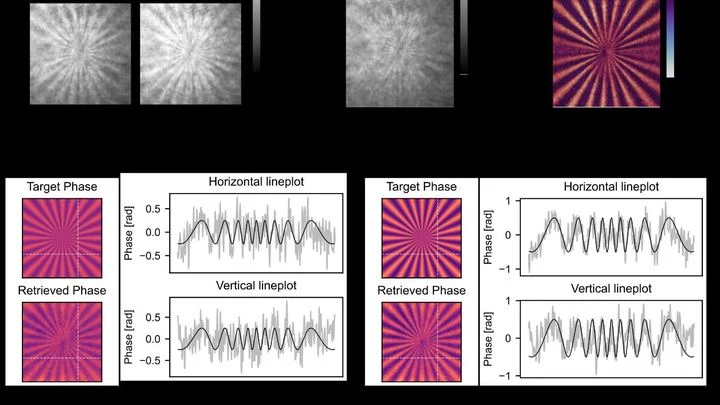
The Fourier Plane Division (FDD) method splits light into several parts, measures them independently, and combines them with an algorithm. An experiment showed a fivefold increase in sharpness in microscopy. Unlike other methods, FDD needs no special illumination, making it applicable for astronomy
arXiv:2605.05961 · 2026-05-07

Two Atoms Send Photons Marching in Triplets

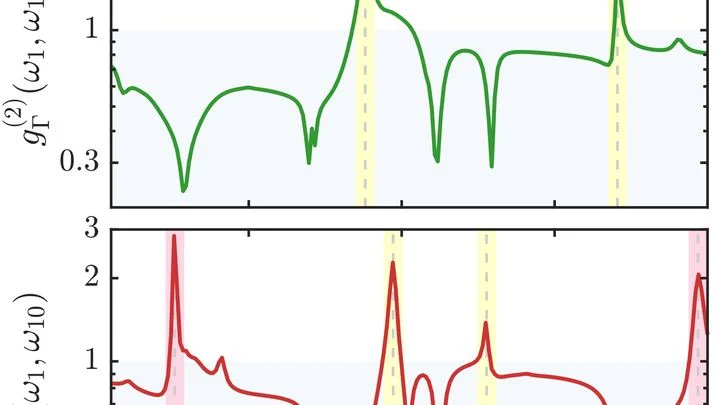
Two artificial atoms linked by a waveguide made photons bunch into triplets. This is a step toward creating quantum simulators and studying exotic states of matter.
arXiv:2605.18525 · 2026-05-18

Universal Light Control in a Quantum Cavity

The interaction between atom and light has been studied for decades, but only now has a universal conductor’s podium been built. By combining brief energy exchanges with atomic twists, any field state can be set — like a conductor whose baton strokes shift the orchestra’s rhythm and mood. The experi
arXiv:2605.18658 · 2026-05-18

Magnetic 'Headphones' for Qubits: A New Way to Fight Quantum Noise

Quantum states are easily destroyed by magnetic disturbances. Conventional frequency tuning methods are powerless here, but researchers have taken a different approach: ultra-compact magnetic patterns placed right next to artificial atoms in diamond (NV centers) absorb low-frequency noise. Experimen
arXiv:2605.20180 · 2026-05-19

Taming Light's Sideways Shift

Falling almost parallel to a surface, a light beam subtly slides along it for a few microns. Now this sliding can be controlled: by placing a cloud of rubidium atoms between a prism and metal, scientists use a second laser to change its transparency. As a result, the shift can be stretched, compress
arXiv:2605.20757 · 2026-05-20

Light under Control: One-Way Photons Without Magnets

Light can be made to flow in one direction without magnets — just spin a ring resonator and use two amplifier atoms. A tiny frequency shift from rotation, like the change in a siren's pitch, after quantum wave interference creates a strong asymmetry: single photons emerge in one direction, bunched-u
arXiv:2605.27447 · 2026-05-24

Light Working in a Team Measures Distances More Accurately

Scientists have proposed a method that makes several light sources blink synchronously. This amplifies the signal and reduces measurement error. Instead of simply measuring brightness, the consistency of light bursts is analyzed. The technology will be useful for sensors in autonomous vehicles and p
arXiv:2605.28378 · 2026-05-27

Quantum Metronome: A Rhythm That Never Misses a Beat

A microscopic system, resembling a particle counter, was made to oscillate in sync with an external signal. This synchronization proved remarkably reliable: rhythm slips become exponentially rare. It's a pathway to ultra-precise quantum clocks and sensors.
arXiv:2605.30271 · 2026-05-28

Single Photons in High Harmonics

Scientists have theoretically proven that in extreme ultraviolet light from a laser, photons are born strictly one at a time. This discovery promises simple sources of single light particles for quantum communication and super-microscopy.
arXiv:2606.17620 · 2026-06-16

An Ultrafast Look at Light’s Quantum Quiver

Light constantly trembles due to quantum effects, but measuring this tremor in bright beams was impossible. Physicists used flashes shorter than the ripples themselves and reconstructed their pattern for the first time. This will simplify the creation of precise quantum devices.
arXiv:2607.06395 · 2026-07-07