Scientist

Jeff Kimble

1949– · Quantum optics, Quantum networks, Quantum information
American experimental physicist, one of the leaders in quantum optics and quantum networks. Pioneer of cavity quantum electrodynamics (cavity QED), where atoms and photons interact under controlled conditions. His experiments on entangling distant atoms and creating quantum interfaces laid the foundations for the future quantum internet.

Biography

He graduated from Abilene Christian University and received his PhD from the University of Rochester. He worked at the University of Texas and then at the California Institute of Technology (Caltech), where he headed the quantum optics laboratory. Member of the U.S. National Academy of Sciences. Winner of the Max Born Award and other honors.

Key discoveries

💡 Kimble's laboratory resembles a labyrinth of mirrors and lasers, where photons 'catch' atoms. His work is inspired by the idea of teleportation and quantum teleportation, first realized by his colleagues.
"He stated that light is not just a wave or a particle, but a quantum entity that we are learning to tame bit by bit."
Concepts
quantum entanglementquantum measurement
Laws
Hong–Ou–Mandel effect
Scientists
Alain AspectErwin SchrödingerDavid DeutschJohn Stewart BellNiels BohrSerge HarocheDavid BohmCharles Bennett

Related articles

A Ruler Made of Light: Measuring Picoseconds with Frequency Resolution
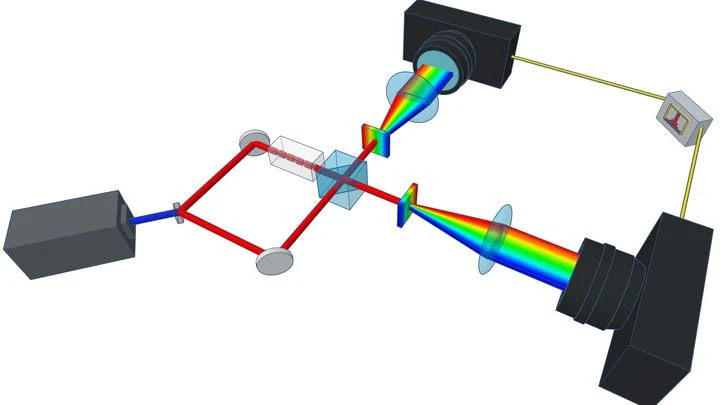
A ruler made of light: that's one way to describe a new method for measuring tiny time delays. In 1987, Chong Ki Hong, Zhe-Yu Ou, and Leonard Mandel noticed that when two indistinguishable photons hit a beam splitter simultaneously, they always exit together from the same port.
Quantum Physics2025-10-241 minarXiv:2510.21636express
Encounter with a Shutter: How a Photon Creates a Fountain of Probabilities
Light consists of portions — photons. Max Planck was the first to understand that light is emitted in quanta. Today, we can guide single photons. When such a photon encounters a fast shutter, it cannot be sliced — half a photon doesn't exist. Instead, a quantum mixture of states with different photon numbers emerges: zero, one, two, three..
Quantum Physics2026-01-022 minarXiv:2601.00966express
Four Photons in One Spot
Light from a single source can be made to 'meet' itself, and then fringes appear on the screen, like ripples from two pebbles dropped into water. Physicists have long known how to do this with two photons, but making four particles of light merge at once was tricky: single-photon sources lost too many particles along the way.
Quantum Physics2026-01-121 minarXiv:2601.07694express
X-ray photons find each other
In a dark room, two flashlights shine on a wall. Usually, their beams simply add up, and the spot becomes brighter. But if the flashlights emit light in special packets, photons, then under certain conditions they can behave differently. Instead of independently hitting different spots, two photons 'agree' and only come out together, as a pair, from a single output.
Quantum Physics2026-03-152 minarXiv:2603.14201express
The Light That Gives Away Symmetry
In a dark room, an atom and light are locked together in a mirrored box. The box is so small that the atom cannot simply release light: they constantly exchange energy, like two dancers who never let go of each other's hands.
HEP Phenomenology2026-04-141 minarXiv:2604.12613express
Photons Finally Converge
In a giant particle accelerator, particles smash into each other, and sometimes after the collision only two photons, particles of light, remain. Physicists can predict how often this happens, but their calculations have long disagreed with what detectors see. Each refinement of the theory changed the answer, and there was no consensus.
Quantum Physics2026-06-161 minarXiv:2606.17620express
Single Photons in High Harmonics
In very dim light, photons arrive one by one, like drops from a leaky faucet — never in pairs. This effect, predicted by Roy Glauber and confirmed by Leonard Mandel, directly proves that light is made of particles.
Quantum Physics2026-07-182 minarXiv:2607.16849express
A Ruler Made of Light: Measuring Nanometers with a Pair of Photons
Two photons meet at a half-silvered mirror. If they arrive at exactly the same time, they always leave together — side by side, like twins who refuse to be parted. This effect, discovered in 1987, became the basis of a quantum ruler for measuring tiny delays.