A substrate is a surface or material upon which another substance is deposited, grown, or attached. In physics and materials science, the substrate provides a foundation for thin films, crystals, or biological cells, and its properties—such as lattice structure, roughness, or chemical reactivity—strongly influence the behavior of the deposited layer. Substrates are essential in semiconductor manufacturing, optical coatings, and tissue engineering.
History
The concept of a substrate has roots in 19th-century chemistry, where it referred to the substance on which an enzyme acts. In materials science, the term became prominent with the development of semiconductor epitaxy in the mid-20th century.
How it works
The substrate's atomic arrangement acts as a template for epitaxial growth, where atoms of the deposited material align with the substrate's crystal lattice. Surface energy and lattice mismatch determine whether the film grows smoothly, forms islands, or introduces defects. In biological contexts, cells sense substrate stiffness and chemistry, which guide their adhesion, migration, and differentiation.
In practice
Substrates are used to fabricate computer chips (silicon wafers), grow graphene for electronics, and create biocompatible scaffolds for regenerative medicine.
Fun fact
The first transistor, built in 1947, used a germanium substrate—a material that was later largely replaced by silicon due to its superior oxide properties.
Life begins with a bubble. In a warm puddle on ancient Earth, fat molecules could gather into tiny spheres — prototypes of cells. Inside such a sphere, a polymer happened to be present that accelerated the uptake of new fats from the surrounding water. The bubble grew, divided, and passed its composition to offspring.
A fusion reactor is like a super-hot furnace where plasma reaches millions of degrees. The walls are made of tungsten, the most refractory metal there is. But even tungsten needs protection: fast particles from the plasma bombard the surface and knock atoms loose. These ejected atoms enter the plasma and cool it down, like a spoonful of cold milk in hot tea.
Light flows like an invisible river. If you place an obstacle in the stream, the water whirls into eddies. Likewise, specially designed surfaces create light 'whirlpools' that catch nanoparticles like wood chips.
A cell crawls over a gel (sometimes viscous, sometimes elastic) and decides on its own when to speed up. It doesn't just glide: its internal chemical motor (noise in gene expression can affect the production of 'fuel') pushes the leading edge, while the rear detaches from the substrate.
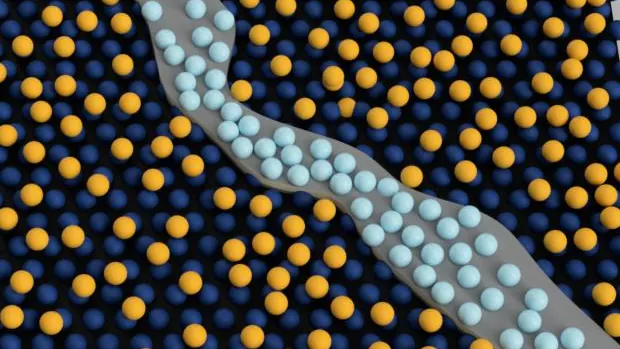
Bismuth is a metal used to make low-melting alloys and additives to steel. But when you sputter it onto a substrate in a very thin layer, its behavior depends on how cold the substrate is. Physicists compared two methods: one at ordinary room temperature, the other at liquid nitrogen temperature, about −196 °C.
A drop of oil in water, coated with soap molecules, behaves differently from a bare drop. Soap molecules are tiny rods: one end loves water, the other loves oil. In a quiescent fluid, they stand on the surface like a picket fence, lowering the surface tension — the force that pulls the drop into a sphere.
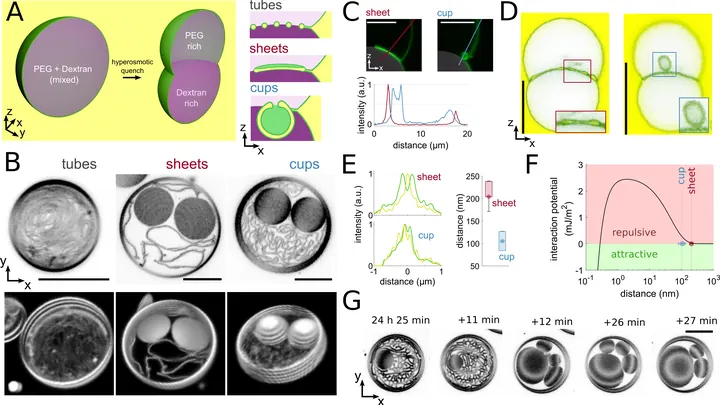
Inside a living cell, droplets float that don't mix with the surrounding fluid, like oil in water. These droplets aren't just passive clumps; they actively press on membranes and make them bend. Scientists observed this process in living plant cells, reproduced it in a test tube, and simulated it on a computer.
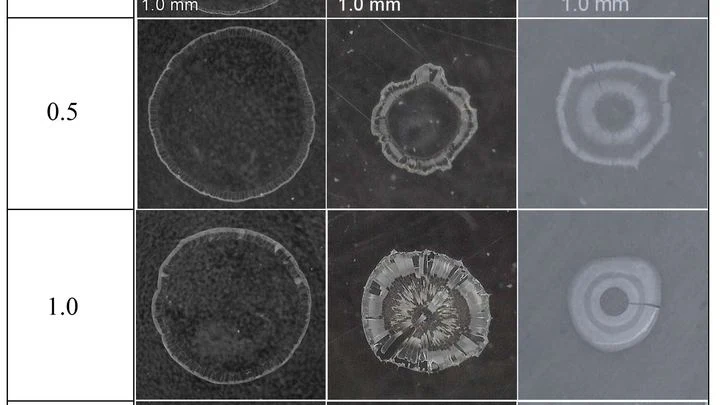
A coffee drop on a table dries and leaves a ring — coffee particles gather at the edge. But if charged nanoparticles float in the drop, the picture becomes richer: the deposit cracks like mud in a dried-up puddle. Physicists studied how the particle charge and the surface on which the drop dries change these cracks.