Bone-Chilling: A Cast That Cools Itself express
The sun blazes, but the cast on your arm stays cool. The secret lies in a thin coating made from recycled animal bones.
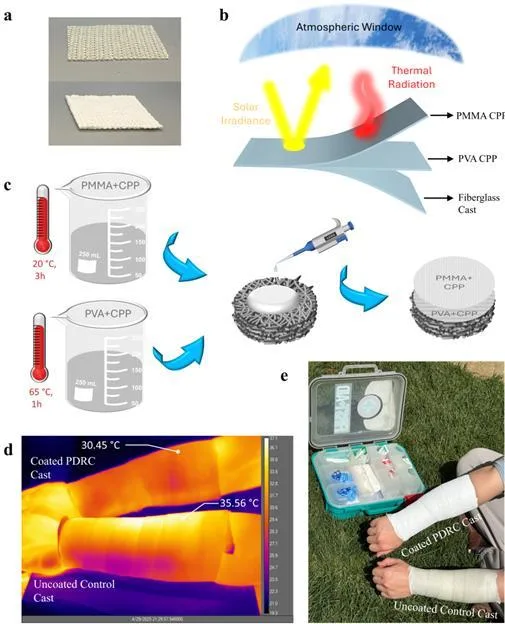
Typical cooling surfaces are often rigid and brittle: you can't stick them onto a curved bandage. Here, they took a commercial fiberglass cast that hardens quickly and added two polymer layers. Inside are ceramic particles of calcium pyrophosphate derived from bone waste. These particles scatter sunlight while also emitting heat as infrared radiation that escapes through the atmosphere into space.
Under direct sunlight, the surface was 15 °C cooler than the surrounding air. Sunlight reflection exceeded 90%. This material requires no electricity, withstands bending, and is safe for skin, so it can be applied to medical dressings or flexible components.
A regular cast usually traps heat, but this version sheds it to the clear sky, as if the bandage breathes cold.
Original abstract
as written by the authors arXiv:2601.19116
Passive daytime radiative cooling (PDRC) provides an energy-free approach to suppress surface temperatures by reflecting solar irradiation while emitting thermal radiation through the mid-infrared atmospheric window. Despite rapid progress in optical performance, most PDRC systems remain limited by rigid, fragile, or planar substrates, restricting their use on flexible, curved, or wearable surfaces. Here, we report a biocompatible and structurally robust PDRC system integrated onto a commercial rapid-curing fiberglass cast, a conformal substrate widely used in orthopedic and industrial applications. The cooling architecture adopts a bilayer polymer design consisting of a polyvinyl alcohol (PVA) adhesion layer and a polymethyl methacrylate (PMMA) protective layer, both embedded with calcium pyrophosphate (CPP) ceramic particles derived from processed animal bone waste. The bio-derived CPP simultaneously enables broadband solar scattering and high mid-infrared emittance, while offering sustainability and biocompatibility advantages. The resulting composite exhibits over 90% solar reflectance and achieves up to 15 C sub-ambient cooling under direct outdoor sunlight.
Animal bones that are usually thrown away become a ceramic capable of cooling surfaces without a single watt of energy.