Popular

Optics physics.optics

64 articles

Adaptive optics, fiber optics, holography, lasers, optical devices, quantum optics, spectroscopy and other optical subfields.

articles

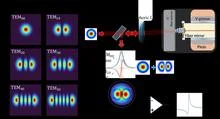
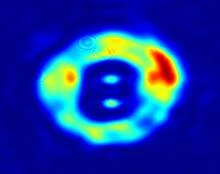
Donut Beam Locks Mirrors with Subatomic Precision

Scientists stabilized a pair of micromirrors using a donut-shaped laser beam. The beam’s dark center lands right on the detector, letting the camera capture the glow of single atoms without interference. This will boost the reliability of quantum devices.
arXiv:2412.00271 · 2024-11-29

Light in Glass: Optical Fiber Learns to Read Digits

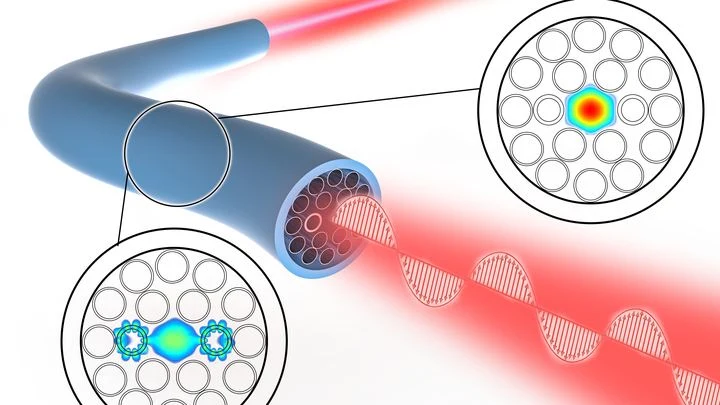
Ordinary optical fiber without processors has learned to recognize handwritten digits with 93% accuracy. Light passed through the glass strand performs computations on its own — like water swirling into vortices changing its pattern. This is a cheap way to create thinking machines.
arXiv:2503.03649 · 2025-03-05

Light in a Cryostat: How Imperfect Converters Build Quantum Bridges

Superconducting quantum computers hit a cooling wall: a single cryostat can't hold millions of qubits. The solution is optical channels, but they need microwave-to-optical converters, which are still far from perfect. The authors showed that with feedback protocols, parallel attempts, and quantum di
arXiv:2505.00542v1 · 2025-05-01

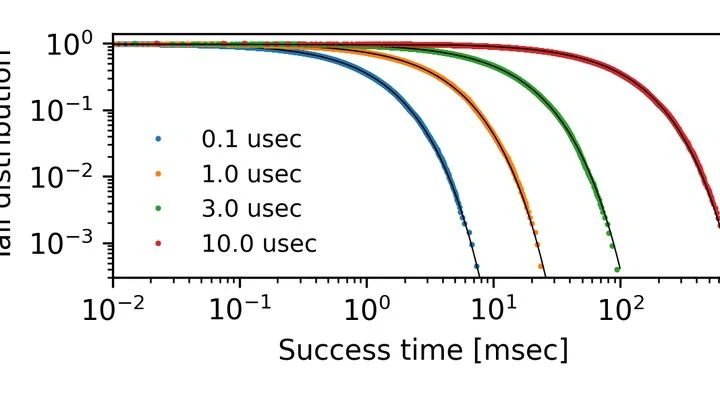
Quantum Tuning Fork: Noise Speeds Up the Search for Single Emitters

Brute-force photon counting from a single emitter gets bogged down in noise, like digging a tunnel with a shovel. But introduce a coherent reference beam and let quantum interference kick in — and the picture changes dramatically: the noisier the environment, the faster the verdict. The extended Hon
arXiv:2505.00950v2 · 2025-05-02

The Rydberg Waltz: How a Dance of Losses Amplifies Quantum Sensitivity

Quantum sensors based on Rydberg atoms can detect minuscule electromagnetic fields, but optical readout usually destroys almost all signal photons. Physicists from Warsaw went against the grain and deliberately enhanced nonlinear losses through dipole-dipole collisions of excitations. This paradoxic
arXiv:2505.01506v2 · 2025-05-02

A Glass Loom for Light: 99.7% Fidelity Across 24 Quantum Threads

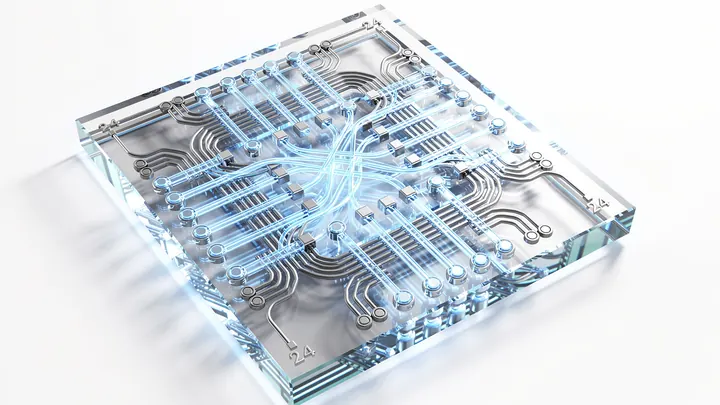
Researchers from Ephos and the Polytechnic University of Milan inscribed a 24-mode universal photonic processor into glass, using femtosecond lasers like a sewing machine needle. Operating at 925 nm—ideal for quantum-dot single-photon sources—the device is controlled by microheaters and uses less po
arXiv:2505.01609v2 · 2025-05-02

Seven Lives of a Photon: Exceptional Points Control Spontaneous Emission

By combining lithium niobate and gallium arsenide, scientists created a chip. In it, quantum dots interact with microresonator modes, and electro-optic tuning of the feedback phase drives the system to an exceptional point. At this singularity, two modes coalesce, and the spectral density of states
arXiv:2505.05490v1 · 2025-05-02

Quantum Ghosts in the Hall of Mirrors

Usually, nonclassical states of motion require clever tricks. But new research reveals that the intrinsic nonlinearity of an optical trap itself sculpts quantum 'ghosts' from mechanical vibrations — states with a negative Wigner function. No probabilistic schemes needed, even in unresolved sidebands
arXiv:2505.01942v2 · 2025-05-03

How a Neural Network Uses Light to Detect Brain Diseases

A new method uses light to shine through thin brain slices and deep learning for automatic analysis. The DenseNet121 neural network identifies structural changes with 88% accuracy, speeding up diagnosis and reducing the risk of error. The technology will aid in early detection of tumors and other pa
arXiv:2505.11735 · 2025-05-16

The Void That Dresses Matter

Vacuum is not emptiness, but an invisible fabric of fleeting particles of light. By placing a material inside a microresonator, we 'wrap' it in this fabric, and its properties change without external influence. This is the path to new electronics and energy technology running on emptiness.
arXiv:2506.02170v1 · 2025-06-02

A Mousetrap in the Atomic Nucleus: Reading Thorium with Ejected Electrons

By detecting electrons hurled from thorium-229's nucleus, researchers bypass light-blocking materials, enabling faster readout and bringing ultra-precise nuclear clocks within reach.
arXiv:2506.03018v1 · 2025-06-03

Why Flat Mirrors Baffle Physicists

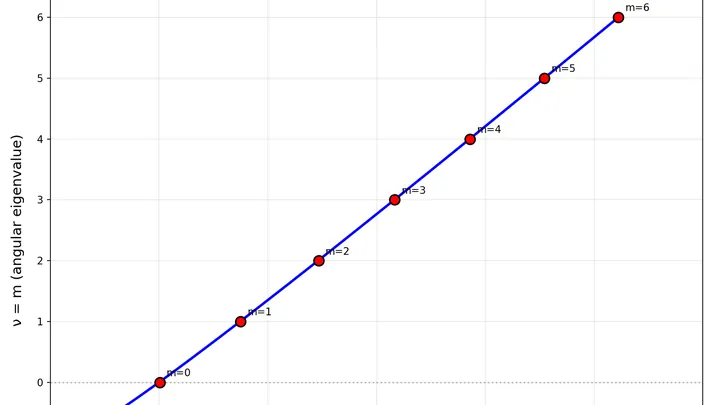
The idea that light between mirrors behaves like a pair of tuning forks fails for flat systems. A new theory accounts for any shape and accurately predicts how light will bounce around inside. This paves the way for sensitive sensors and more powerful lasers.
arXiv:2506.04413v1 · 2025-06-04

Quantum Bridge of Light

Quantum processors are isolated in ultra-cold chambers. Their microwave signals were converted into light, which ran through an optical fiber, and back in another chamber—without losing the quantum essence. The first step toward a quantum internet.
arXiv:2508.02444 · 2025-08-04

Light Makes Two Magnetic Strings Sing in Unison

Inside a mirror trap, light binds two magnetic nanoscale strings into a single quantum object. The pressure of light synchronizes their vibrations, creating entanglement that doesn't break even at a surprisingly high temperature — a few thousandths of a degree above absolute zero. This is an order o
arXiv:2508.03450 · 2025-08-05

Sunlight replaces lasers: quantum imaging without complex optics

Sunlight is passed through a crystal that splits each photon into two entangled halves. Their invisible link allows imaging where ordinary optics are blind: in fog, under murky water, in near-total darkness. Previously, only lasers could do this—bulky and expensive. Now, daylight can be the source,
arXiv:2508.11207 · 2025-08-15

Tiny chip tames quantum entanglement

The device generates pairs of entangled photons at a record rate—45 billion per second—consuming just milliwatts of power. The purity of the quantum connection exceeds 96%. Its tiny size and efficiency bring quantum internet, secure satellite links, and ultra-precise sensors closer to reality.
arXiv:2508.14566 · 2025-08-20

Entangled Photons vs. Murky Media

A new method uses pairs of entangled photons to transmit sharp images through murky media—places where ordinary light is helpless. The medium remains opaque to everyone except the quantum duo, opening the door to ultra-secure communication and improved medical and astronomical imaging.
arXiv:2508.14616 · 2025-08-20

Scandium-45: The Key to Clocks More Precise Than Atomic Ones

Physicists excited scandium-45 nuclei with an X-ray laser and saw that in a solid crystal, vibrations hinder ideal precision. But the transition's natural purity promises nuclear clocks with an error of less than a second over the age of the universe. This opens the door to ultra-precise measurement
arXiv:2508.17538 · 2025-08-24

Topological Physics at Room Temperature Using Light

Exotic quantum states typically exist only in the chill of liquid helium. But here, scientists replaced cooling with a light lattice, where atoms move in unison like an orchestra. The collective glow drowns out random noise, making it impossible for chaos to break through. They not only reproduced t
arXiv:2509.08411 · 2025-09-10

How to Make a Black Hole Perfectly Black

Black holes usually reflect some waves. By shaping these waves to hit a precise resonance, physicists forced a black hole to absorb all energy, turning perfectly black. The absorbed energy is then released as a distinct ring, like a bell's tone revealing its shape. This technique could unveil the se
arXiv:2509.19451 · 2025-09-23

How to See the Invisible: Recovering Polarization from a Handful of Photons

The algorithm, like an artist, reconstructs the polarization picture from sparse strokes. Accounting for the smooth change of light properties from color to color allows it to work in extremely low light—this will improve astronomical observations and material analysis.
arXiv:2509.19547 · 2025-09-23

The Grand Piano Chip: How Light and Sound Learned to Work Together Without Noise

Engineers unveiled a chip that’s not suspended but firmly anchored, dramatically improving heat dissipation. Heating distortions are reduced by a factor of 60, and quantum sound vibrations persist even under intense laser light. The technology opens the door to efficient microwave-to-light converter
arXiv:2510.15724 · 2025-10-17

The Light Chip: A Treasure Map in a Sea of Chaos

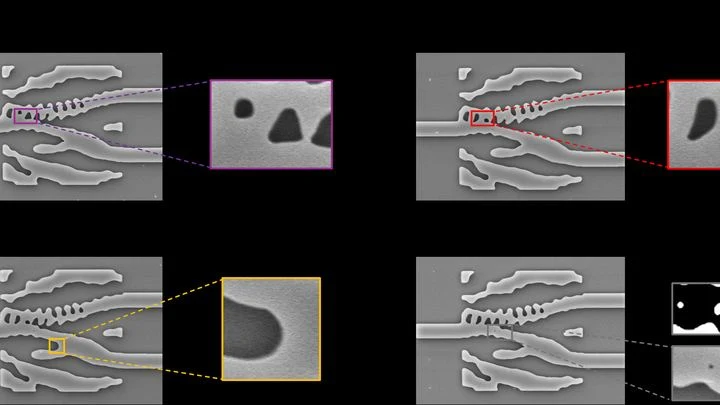
Engineers are leaning on computers more to design minuscule light circuits, but the output can be a whimsical mosaic. Now, scientists have a tool that shines a light on the weakest links, preventing expensive production flops.
arXiv:2510.22176 · 2025-10-25

A Quantum Turnstile Chip for Photons

Ordinary light spreads in both directions, like a stream through an open door. The new chip acts as a turnstile—photons move only forward, and their quantum properties aren't erased. The technology will become the foundation for interference-resistant quantum networks.
arXiv:2511.00570 · 2025-11-01

Light Switched Faster Than Its Own Oscillations

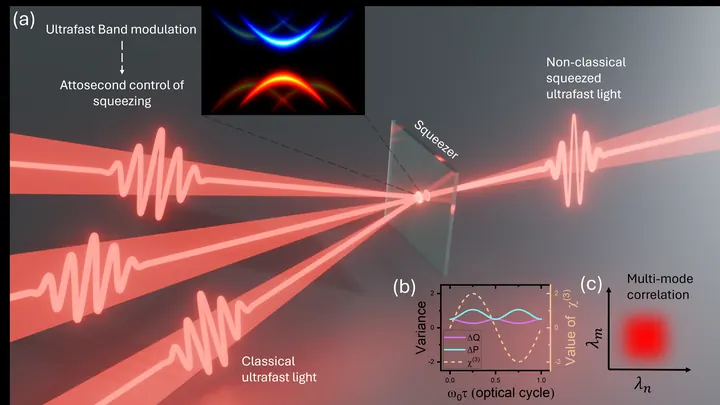
Scientists have found a way to switch a special state of light — 'squeezed' light — in an unbelievably short time. While ordinary light jitters randomly, here its noise is redistributed, like squeezing a balloon. Now, using a pair of laser pulses, it's possible to almost instantly choose which part
arXiv:2512.17046 · 2025-12-18

Quantum Turnstile Network: 200 Users Fully Protected

Scientists launched the first large quantum network connecting 200 users over distances up to 200 km. The secret of protection lies in the behavior of two photons at a half-silvered mirror: if they are perfectly identical, they always go through together. It's like a turnstile that opens only for a
arXiv:2512.17318 · 2025-12-19

Ghost Mode in a Sphere: Mathematics Without Physics

In a hollow metal sphere, light waves can freeze into stationary patterns, like frozen ripples on a pond. But among all possible shapes, one is peculiar: it has zero frequency, and the fields vanish, leaving only a mathematical trace. For a long time, this invisible 'ghost' confused physicists when
arXiv:2512.20123 · 2025-12-23

Quantum Camera Reveals Invisible Particle Bonds

Scientists used an ordinary camera to capture the quantum connection of photon pairs. Bright light and a simple algorithm replaced complex detectors that work in total darkness. The new approach speeds up imaging by tens of thousands of times and makes quantum technologies more accessible.
arXiv:2512.24878 · 2025-12-31

Levitation on Quantum Glue

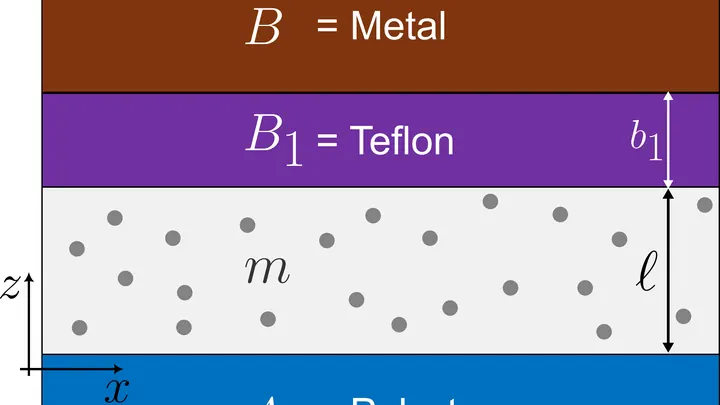
The Casimir effect makes surfaces stick together like quantum glue. But scientists have turned it into a force that holds a plate in the air without support. By placing an object over Teflon and adding a magnetic fluid, they learned to control the quantum field. This discovery eliminates friction an
arXiv:2601.00483 · 2026-01-01

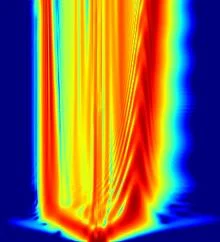
A Black Hole Like a Bell: How a Light Pulse Gives Rise to Echoes

Light delayed by a black hole generates a prolonged echo with bright bands—like a bell tolling after a strike. Physicists recreated this on a tabletop using a curved surface, and can now study the echoes in the lab.
arXiv:2601.02197 · 2026-01-05

The Photonic Lathe: 100,000 Custom-Made Photons

Physicists have for the first time produced up to 100,000 photons in a precisely defined quantum state – hundreds of times more than before. Using virtual lenses, they correct distortions and reduce operation time as the number of particles increases. The method paves the way for ultra-sensitive sen
arXiv:2601.05118 · 2026-01-08

How Gravitational Waves Twist Light

Scientists have described for the first time a mechanism by which gravitational waves flip the twist of light. The effect resembles the action of sugar syrup on polarization, but here curved spacetime does the work. The exchange of spin between the wave and the photon is rigidly fixed: gravity's spi
arXiv:2601.07179v1 · 2026-01-12

How Empty Space Alters Superconductors

A thin superconducting film was placed in a cavity that traps invisible light. Even with no light, the vacuum's energy ripples changed the material's properties: the number of current-carrying electron pairs dropped by 13%, and the energy to break them decreased. This demonstrates vacuum sculpting—e
arXiv:2601.08191 · 2026-01-13

Magnetic field turns the void into a motor

Normally, rotation in a vacuum requires an asymmetric shape or a special material. But new research shows that a magnetic field and special magnets can induce rotation without any asymmetry. This paves the way for contactless nanomotors.
arXiv:2601.14381 · 2026-01-20

How Squeezed Light Makes Microscopes Sharper

Light is sent through a microscopic waveguide, stripping away excess jitter. This squeezed beam outsmarts conventional precision limits. A new record — noise reduced by a factor of 35 — promises microscopes that can see cells without heating them.
arXiv:2601.15565 · 2026-01-22

Quantum Internet: From Theory to Reality

For the first time, single atoms were reliably linked over long optical fiber, and a secret code was extracted from their 'conversation'. Any eavesdropping attempt instantly destroys the pair — not a trick, but a property of the quantum world. This protection scheme turns any interception into a bla
arXiv:2602.09596 · 2026-02-10

Maxwell's Demon Prefers Indistinguishable Photons

A tabletop experiment with a programmable optical circuit proved that the famous thought demon creates a larger temperature difference when the particles of light cannot be told apart. The result ties together heat, information, and quantum statistics, and will be useful for testing quantum devices.
arXiv:2602.11276 · 2026-02-11

Synthetic Lattice for a Single Photon

A superconducting qubit and a fast modulator turned frequencies into floors for a single photon, letting it wander randomly, oscillate, or move only forward. This is a step toward compact quantum simulators.
arXiv:2602.13736 · 2026-02-14

Sunlight Creates Quantum Entanglement

Physicists have discovered that ordinary sunlight is enough for quantum entanglement. By passing it through a crystal, they obtained pairs of 'twin particles' that instantly sense each other. Measurements confirmed that the link is on par with laser systems. This paves the way for cheap quantum tech
arXiv:2602.15655 · 2026-02-17

Gravitational Waves Create Invisible Patterns in Space

When many gravitational waves overlap, special zones appear—like ripples on water freezing into predictable patterns. These structures aren’t random; they’re a regular feature of the cosmic background. By studying them, we can measure waves more accurately and glimpse the era of the universe’s birth
arXiv:2602.23425 · 2026-02-26

The Evergreen Tree of Probabilities

Some believe unrealized quantum possibilities vanish instantly. Others think reality branches. A new experiment with three consecutive photon measurements has shown traces of persistent alternatives for the first time, supporting the many-worlds picture.
arXiv:2603.13974 · 2026-03-14

How to Catch Microplastics with Twin Light

Twin light beams bypass pricey hardware: one probes the sample with invisible light, the other delivers the results in the visible spectrum. The device tells plastic types apart in a split second and fits in the palm of your hand.
arXiv:2603.22253 · 2026-03-23

Entangled Photons: A New Way to See the Invisible

The new BELS technique tracks the synchrony of paired photons rather than their brightness. This allows it to distinguish between birefringence and Faraday rotation in a single measurement. The method opens the door to ultra-sensitive diagnostics for quantum devices.
arXiv:2603.22547 · 2026-03-23

Why Purple Bacteria Always Have Big Rings

Light-harvesting rings in bacteria can’t have fewer than seven links—otherwise energy dissipates. Scientists modeled it and found that large rings work without losses. Nature knows how to build perfect batteries.
arXiv:2603.23743 · 2026-03-24

How a Beam of Light Turns into Schrödinger's Cat

When doubling the frequency of a laser beam inside a crystal, the light spontaneously morphs into something like Schrödinger’s cat—a blend of two states. Vacuum jitters disrupt the rhythm of the wave, and the photon stream splits in two. This lets us generate macroscopic quantum states without bulky
arXiv:2603.24067 · 2026-03-25

Diamond Sensor Catches Magnetic Signal from a Living Cell

Instead of quickly fading glowing markers, scientists used magnetic nanoparticles and diamond sensors. This 'compass' picks up magnetic signals from cells without interference, making it possible to observe even weak processes in a single living cell. This opens new possibilities for diagnostics and
arXiv:2604.04094 · 2026-04-05

Loss Creates Order: The Quantum Dance of Photons

Physicists have shown that losses and noise in an optical chip do not destroy but rather establish quantum connections between photons from different sources. They connected two light sources through a murky channel and, instead of interference, got synchronous operation — like two pendulums on a sh
arXiv:2604.05422 · 2026-04-07

Picture from Nothing: Silence Paints Ghosts

Usually, light is needed for a photo. In a new experiment, it was deliberately excluded. The image was assembled not from flashes, but from pauses of absolute darkness — like a drummer stays silent, and you deduce the drum’s shape from the missing beats. The method blurs the line between quantum and
arXiv:2604.07782 · 2026-04-09

Nuclear Clock on a Chip: A New Step Toward Precision

Physicists have developed a method to make thorium nuclei emit light signals with record stability. The key element is a crystalline cavity that amplifies light, greatly simplifying the excitation of nuclei with a laser. For the first time, a roadmap for creating all-solid-state nuclear clocks on a
arXiv:2604.20687 · 2026-04-22

Light Echo Flips Chemistry

Inside an optical cavity, light echo changes the rules of the game: hydrogen loses stability, ring-shaped molecules straighten out and start a non-stop current. The effect grows with the number of molecules, paving the way for controlling chemistry with light.
arXiv:2604.20969 · 2026-04-22

The Quantum Twist Mystery: A New Detector Overturns the Rules

In the quantum world, crystals turn one photon into two entangled twins. It was long believed that their total twist was always conserved. But a new experiment shows a tiny beam shift inside the crystal breaks the rule. This finding will reshape quantum technologies.
arXiv:2604.23550 · 2026-04-26

Quieter Mirrors — Louder Universe

In gravitational-wave detectors mirrors must reflect light almost perfectly, but heat makes atoms tremble, creating noise. A new coating — a thin pattern plus a few layers — makes the mirror thinner and suppresses the shiver tenfold, opening the way to observing quieter cosmic events.
arXiv:2605.00714 · 2026-05-01

Quantum Squeezing in Superfluid Helium

Laser pulses in superfluid helium revealed quantum squeezing of paired waves: their random fluctuations are suppressed in one direction and amplified in another. An unexpected phase shift—crests appeared before the signal—is explained by interference. The discovery paves the way for ultrasensitive d
arXiv:2605.05345 · 2026-05-06

Quantum trick boosts microscope resolution by 5 times

The Fourier Plane Division (FDD) method splits light into several parts, measures them independently, and combines them with an algorithm. An experiment showed a fivefold increase in sharpness in microscopy. Unlike other methods, FDD needs no special illumination, making it applicable for astronomy
arXiv:2605.05961 · 2026-05-07

Gravitons: A Double Twist in a Curved World

Gravitons — the quanta of gravity — split into two streams in curved spacetime depending on their spin. The effect, discovered by Michael Berry, causes particles with right- and left-handed spin to move in opposite directions, and for gravitons it is twice as strong as for light due to their double
arXiv:2605.19817 · 2026-05-19

Magnetic 'Headphones' for Qubits: A New Way to Fight Quantum Noise

Quantum states are easily destroyed by magnetic disturbances. Conventional frequency tuning methods are powerless here, but researchers have taken a different approach: ultra-compact magnetic patterns placed right next to artificial atoms in diamond (NV centers) absorb low-frequency noise. Experimen
arXiv:2605.20180 · 2026-05-19

Taming Light's Sideways Shift

Falling almost parallel to a surface, a light beam subtly slides along it for a few microns. Now this sliding can be controlled: by placing a cloud of rubidium atoms between a prism and metal, scientists use a second laser to change its transparency. As a result, the shift can be stretched, compress
arXiv:2605.20757 · 2026-05-20

The Whisper Faded: A Quantum Trick Bypasses a Fundamental Limit

In the famous thought experiment between Einstein and Bohr, the atomic slit always trembles due to quantum noise. This noise, like an unceasing whisper, smears the wave pattern. Now, physicists have learned to squeeze this whisper: to hush the part that gives away the particle's path. Fringe contras
arXiv:2605.28038 · 2026-05-27

Quantum Eraser Captures Two Pictures in One Snap

This research turns a famous quantum puzzle – the delayed-choice eraser – into a practical imaging method. It uses entangled photon pairs to record both brightness and phase information in one snapshot. Later, analyzing a partner photon determines which image is revealed. The technique ensures perfe
arXiv:2606.03914 · 2026-06-02

The Mystery of Eclipse Shadow Bands Solved

Shadows resembling ripples from a tossed pebble arise from light's wave nature. The edges of the solar crescent act as two sources, creating interference. This discovery lets us measure air turbulence from the bands.
arXiv:2606.28366 · 2026-06-14

Single Photons in High Harmonics

Scientists have theoretically proven that in extreme ultraviolet light from a laser, photons are born strictly one at a time. This discovery promises simple sources of single light particles for quantum communication and super-microscopy.
arXiv:2606.17620 · 2026-06-16

Tiny Diamond Compass Peers Inside Batteries

They broke the old trade-off between size and sensitivity. The new 6mm probe picks up magnetic fields millions of times weaker than Earth's. Tests on a lithium-ion battery let them 'see' the currents inside without opening the case. This opens doors to non-destructive testing in tech and medicine.
arXiv:2606.18871 · 2026-06-17

Light Trap for Nanoparticles

Special surfaces, optimized by computer algorithms, capture and hold the tiniest particles with the force of light. This technology is essential for ultrasensitive sensors, precise assembly of microdevices, and even manipulation of individual atoms in quantum systems.
arXiv:2607.02352 · 2026-07-02

An Ultrafast Look at Light’s Quantum Quiver

Light constantly trembles due to quantum effects, but measuring this tremor in bright beams was impossible. Physicists used flashes shorter than the ripples themselves and reconstructed their pattern for the first time. This will simplify the creation of precise quantum devices.
arXiv:2607.06395 · 2026-07-07