Visible light is the narrow band of electromagnetic radiation that the human eye can perceive, with wavelengths roughly between 380 and 750 nanometers. It is the only part of the electromagnetic spectrum that our eyes have evolved to detect, which is why it is so central to our experience of the world. Visible light is produced by the acceleration of charged particles, often when electrons jump between energy levels in atoms.
History
The nature of visible light was debated for centuries. Isaac Newton showed in the 17th century that white light is composed of all colors, and in the 19th century, James Clerk Maxwell unified electricity and magnetism, showing that light is an electromagnetic wave.
How it works
Visible light is a form of electromagnetic radiation, consisting of oscillating electric and magnetic fields that travel as a wave. The color of visible light is determined by its wavelength: shorter wavelengths appear blue or violet, while longer wavelengths appear red. When light hits an object, it can be absorbed, reflected, or transmitted, and the way it interacts with matter determines what we see.
Two electrons that leave a metal needle tip almost simultaneously start to repel each other, like two people trying to squeeze through a narrow door at the same time. The closer they are, the more they get in each other's way.
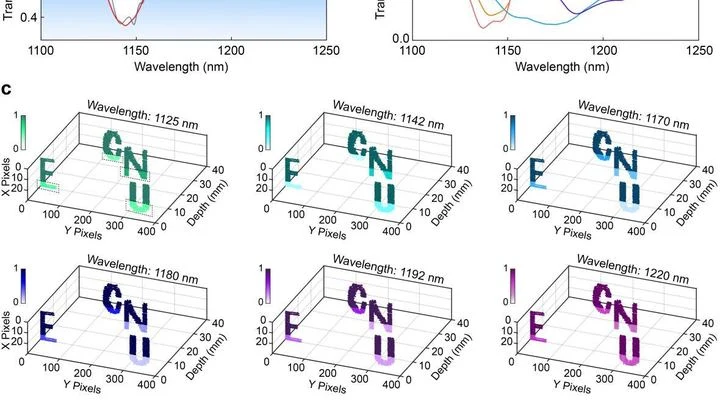
A conventional lidar is like an artist who paints a landscape but sees only gray shadows. It measures distances to each point accurately, but can't tell whether it's looking at rock, wood, or plastic. To learn the composition, you need a spectrometer — a separate device that works slowly and can't keep up with a fast scanner.
The new system takes a different approach.
A distant quasar appears as four points of light arranged in a cross. This is how the gravity of a galaxy lying along our line of sight distorts the view: it acts like imperfect glass, multiplying the image. Each point is the same object, but its light travels different paths.
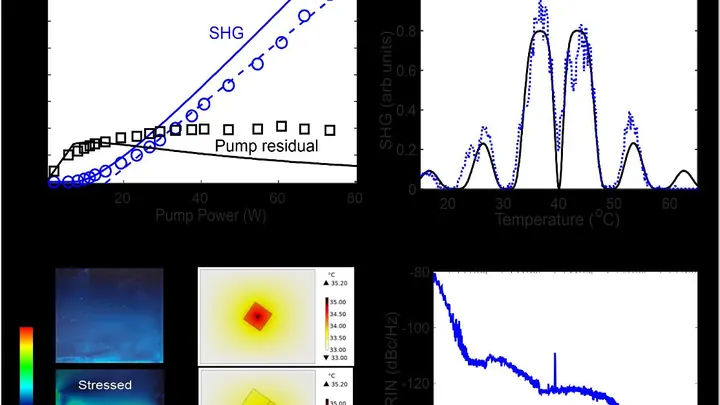
The laser based on diamond converts almost half of the pump energy into bright yellow light — an efficiency of 47.7%, a record for such devices. But the main advantage is not the power, but the exceptional purity of the color: the beam is so monochromatic that it can be compared to a musical instrument playing just one note without the slightest wavering.
A green flashlight beam dives into a pool and reaches the bottom with barely any loss. Water is transparent to green light, which is why it's used for underwater communication. But to send video or sensor data, the light needs to be switched on and off very quickly — billions of times per second. Ordinary lasers are too slow and unstable for this.
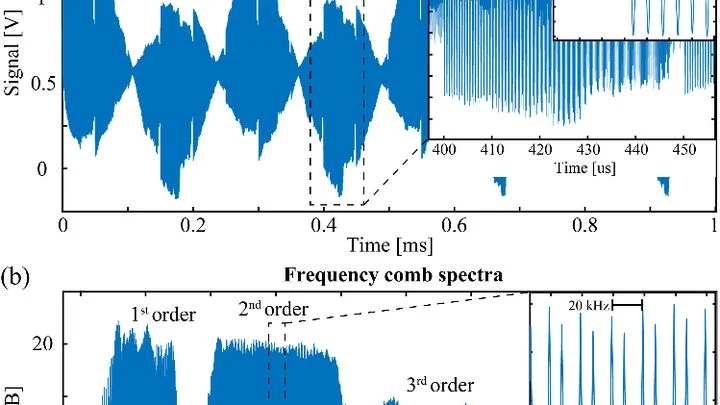
Ordinary white light is a jumble of all colors at once, like the noise of a crowd where everyone speaks at their own frequency. But scientists need light where frequencies are aligned with ruler-like precision, like piano keys, where each note sounds distinct and exact.
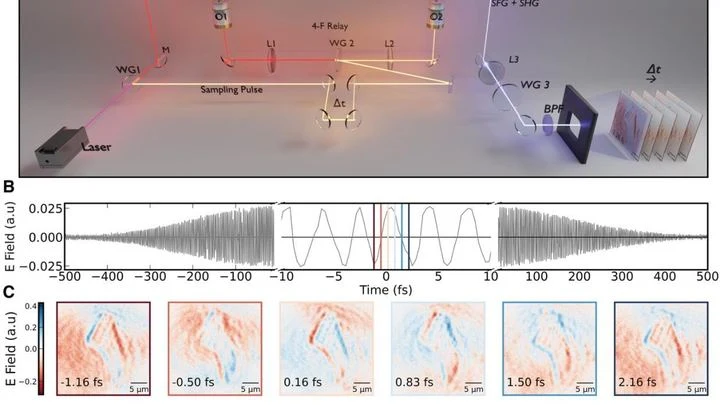
Light is not just a beam but a wave with an electric field that changes at a speed unimaginable to ordinary clocks. Until now, this field could only be measured at a single point, like taking temperature with a single thermometer. Now researchers have created a method that shows the entire field at once, like a thermal imager showing a heat map.