Magneticrefrigeration is a cooling technology that uses the magnetocaloric effect: certain materials heat up when exposed to a magnetic field and cool down when the field is removed. This effect allows for efficient and environmentally friendly cooling without the use of ozone-depleting refrigerants or mechanical compressors. It is a promising alternative to conventional vapor-compression refrigeration, with potential applications in household refrigerators, air conditioning, and cryogenics.
History
The magnetocaloric effect was discovered by Emil Warburg in 1881, and the first magneticrefrigerator was demonstrated by Peter Debye and William Giauque in the 1920s. Giauque used the principle to reach temperatures near absolute zero, for which he won the Nobel Prize in Chemistry in 1949.
How it works
The process involves a magnetocaloric material, such as gadolinium, placed in a heat exchange fluid. When a magnetic field is applied, the magnetic moments of the atoms align, reducing the material's entropy and causing it to release heat. This heat is dissipated to the surroundings. When the field is removed, the moments become disordered, the material's entropy increases, and it absorbs heat from the environment, thus cooling it. By cycling the magnetic field and using a heat transfer fluid, a continuous cooling effect is achieved.
In practice
Magneticrefrigeration is used in cryogenic applications to achieve ultra-low temperatures, and it is being developed for commercial refrigeration and air conditioning systems.
In a binary star system, a white dwarf acts like a vacuum cleaner, pulling gas from its companion star. If the dwarf has a magnetic field, the gas does not fall anywhere but flows toward the poles, like iron filings to a magnet. There it accumulates into a pile. But what keeps this pile from spreading out?
A frozen orchestra where musicians swap seats when the conductor, magnetism, sets a new score. In a spinel crystal, iron and magnesium atoms sit in two types of seats: some surrounded by four neighbors, others by six. At room temperature, they barely stir, but cool the material to 5 K and a mass migration begins.
A microwave oven heats food, but in the lab, microwaves have done something different: they turned a superconductor into a permanent magnet. A 300-nanometer-thick film of yttrium barium copper oxide, cooled to 80 kelvin, responded to 5-gigahertz radiation.
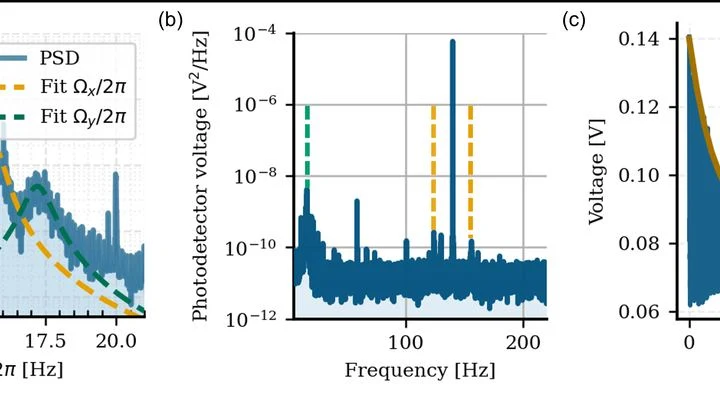
A magnetic top that doesn't fall. A tiny sphere of yttrium iron garnet hovers in midair, held by invisible forces. This isn't a magic trick but a Paul trap — an alternating magnetic field that rapidly changes direction and keeps the sphere from falling, like a juggler tossing balls.
The sphere trembles but doesn't fall.
Hot water after a shower, warm air from ventilation, the heated walls of an engine — all this is heat below 100°C. Usually, it dissipates without doing any useful work. Now it can be captured and turned into electricity.
Inside the new device is a wire made of a nickel-titanium alloy. This material remembers its shape: when heated, it contracts; when cooled, it returns to its original shape.
A magnetic mirror is a tube open at both ends. The magnetic field inside is arranged so that hot plasma doesn't leak out: at the ends, the field lines bunch up like a cork in a bottle. Plasma particles flying toward the exit are repelled by these "corks" and bounce back. But some still escape: that's the classic "loss cone" argument.
The race for fusion energy is like trying to bottle a lightning bolt. For decades, physicists have struggled to recreate on Earth the processes that power the Sun. The main challenge is getting light nuclei to fuse despite their mutual repulsion, while extracting more energy than was spent heating and confining the plasma.
A laser beam can do more than heat things up: it can also calm motion. When light enters a mirror trap, it exerts pressure on the mirrors, and if you tune the beam's color just right, that pressure becomes a gentle braking force. This is how tiny mechanical vibrations are cooled to nearly absolute zero.
Deep underground, iron glows white-hot, and the pressure is so intense that an ordinary instrument would be crushed flat. To peer into this world, physicists built a special microscope based on tiny diamond defects (so-called NV centers).
Today's Freon-based refrigerators and air conditioners silently poison the atmosphere. An alternative is solid-state caloric materials that cool under rapid pressure changes via the barocaloric effect.
In a hot mug, water sometimes freezes faster than in a warm one. This paradox is over half a century old and is called the Mpemba effect. It is usually attributed to fluid motion or evaporation. Now physicists have shown that a similar trick is possible without water, just through radiation of heat.
In boiling water you can see a prototype of a quantum trick: if part of the liquid turns into long-lived vapor bubbles, the main mass cools down. This is exactly what happens when you sharply jolt a system of interacting electrons: doublons flare up — pairs of particles that absorb excess energy and don’t decay for an astonishingly long time.
A magnet the size of a grain of rice floats in a vacuum without touching the walls. It is held by the magnetic field of a superconducting trap — a ring cooled to a state where current flows without resistance.
Quantum laws reign supreme in the microworld, but macroscopic objects usually behave classically: the thermal motion of atoms drowns out quantum effects.
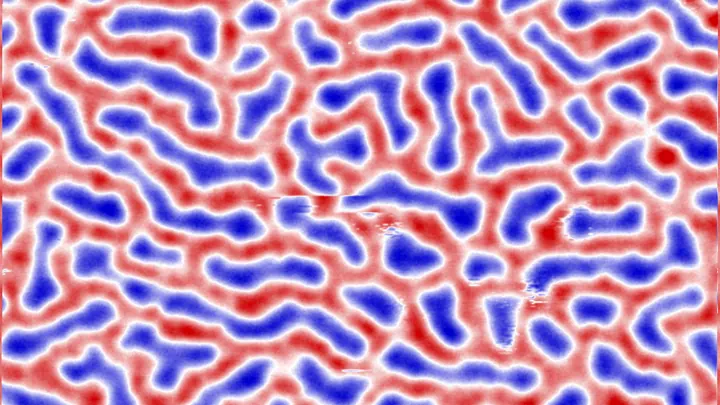
A magnetic vortex, or skyrmion, is like a tiny whirlpool in the sea of spins — the atoms' intrinsic magnetic moments. Like a whirlpool in a river, it twists the magnetization around itself, and this pattern is remarkably robust: hard to destroy with a random jolt.
An ordinary flash drive in your pocket gets warm even when it's just sitting there. Now imagine memory that, in the cold, uses almost nothing, like a thermos that never cools down. A superconductor carries current without loss at liquid-helium temperatures, but it couldn't store data. The new cell changes that.
A kettle cools on the table. Heat escapes into the air, and is wasted. Yet you could squeeze a bit of electricity out of it. Devices that can do this are called thermomagnetic generators. Inside them, there are no pistons or turbines — only a material that changes its magnetic properties when heated and cooled.
Earth's magnetic field, the one that swings a compass needle, is strong. The new sensor picks up fields a hundred thousand times weaker, and it needs neither liquid helium nor bulky setups. Everything fits on a circuit board, just like the one inside your smartphone.
Gas falls onto a neutron star — the ultra-dense remnant of an exploded star. This gas accumulates at the magnetic poles and forms a mountain. But a mountain on a neutron star is not like one on Earth: it is held not by rock but by magnetic field lines, like iron filings on a magnet.
When there is too much gas, the mountain begins to break apart.
Two tiny dust grains hover at the crossing of laser beams. Each is held by its own 'tweezer'—a focused beam that keeps the particle from falling. Inside a mirrored cavity, light bounces between the walls, and its oscillations are coupled to the trembling of the grains.
A piece of zinc oxide film lies on a table. A magnet is brought near, and slowly rotated around the film. The film, thinner than a human hair, begins to change its dimensions: now contracting, now stretching. This property is called magnetostriction — the ability of a material to deform under a magnetic field.
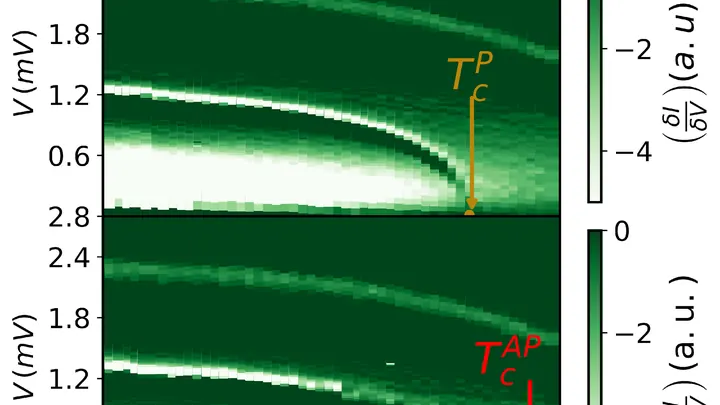
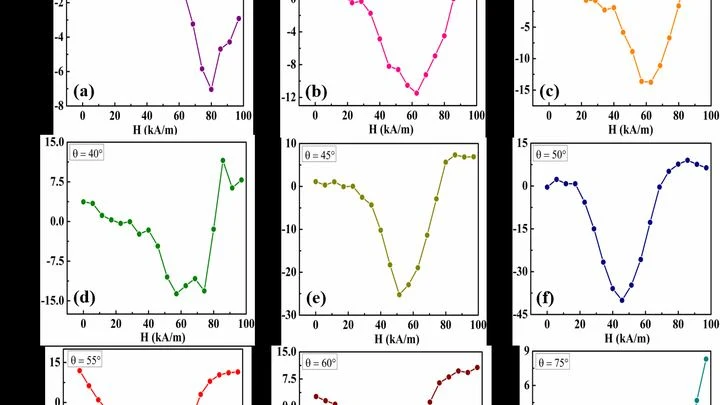
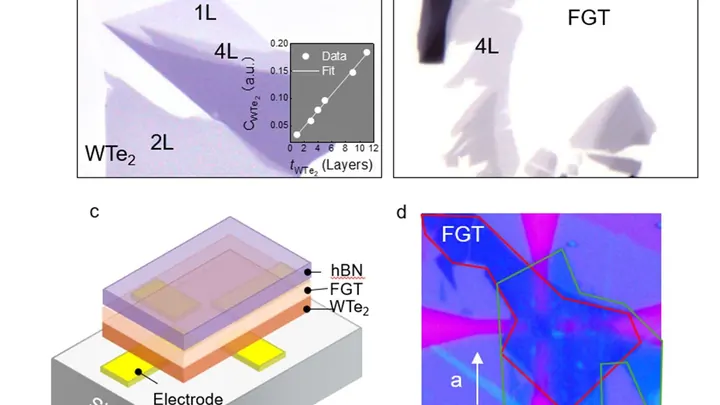
Usually, current in a metal acts like boiling water on ice: it heats the material and destroys magnetic order. But in a layered structure of tungsten ditelluride and the ferromagnet Fe3GeTe2, current behaves differently.
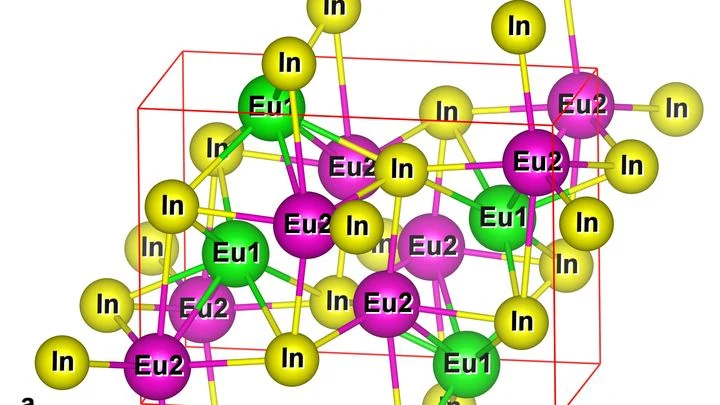
A piece of europium-indium alloy, when cooled in a magnetic field, behaves like water that does not freeze all at once but first in one corner of the glass, then in another.
A fridge magnet holds on thanks to many atoms aligned in one direction. But what if you take a single atom and ask it to remember which way it was magnetized? That's exactly what physicists did: they placed a dysprosium atom on a thin film of ordinary table salt and tested how long the atom holds its magnetic state.
The atom turned out to be stubborn.
When servers in a data center run at full tilt, they get as hot as a forgotten iron. That heat goes to waste, and cooling them eats up even more energy. Engineers in Germany have proposed putting that heat to work: let it drive liquid through thin tubes all by itself, with no motors or pumps.
Their device looks like a flat box with an asymmetric bottom.
An ordinary solar cell does one thing: when the sun shines, current flows. Here, when the sun shines, the current flows differently depending on which side you bring the magnet.
Your kitchen fridge cools everything to a single temperature. But in labs where quantum phenomena are studied, you often need two different levels of cold at once. Previously, that meant assembling two separate cooling circuits — bulky and heavy.
A magnet doesn't like its field penetrating a superconductor. An ordinary piece of lead, cooled to cryogenic temperatures, pushes out magnetic field lines, and levitates above a magnet. This is the Meissner–Ochsenfeld effect, discovered in 1933.
On a hot day, a car roof gets so scorching you can't touch it. Usually, cooling a surface requires air conditioning or at least some shade. But there are materials that cool themselves by simply reflecting sunlight and radiating heat into space. The problem is that such coatings are hard to apply quickly and onto uneven objects.
A new method, called solution blow spinning, solves this.
A calcium ion in a magnetic trap resembles a tiny ball that constantly trembles from heat. To make it freeze, physicists usually hit it with lasers from several sides. But in the new experiment, a single beam aimed along the trap's axis sufficed.
First, the ion is cooled the usual way — the laser slightly slows its motion, like a headwind slowing a runner.
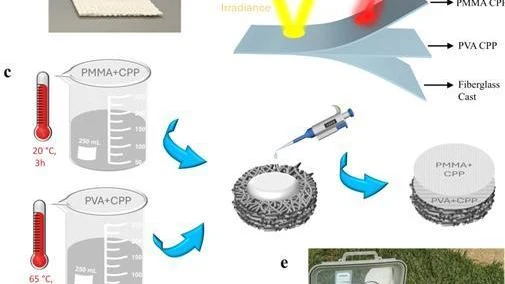
The sun blazes, but the cast on your arm stays cool. The secret lies in a thin coating made from recycled animal bones.
Typical cooling surfaces are often rigid and brittle: you can't stick them onto a curved bandage. Here, they took a commercial fiberglass cast that hardens quickly and added two polymer layers. Inside are ceramic particles of calcium pyrophosphate derived from bone waste.
Tiny particles that look like flowers can do two things at once: heat up and tell you how hot they are. This isn't science fiction: it's the result of working with nanoparticles made of cobalt ferrite, a magnetic material that responds to magnetic fields.
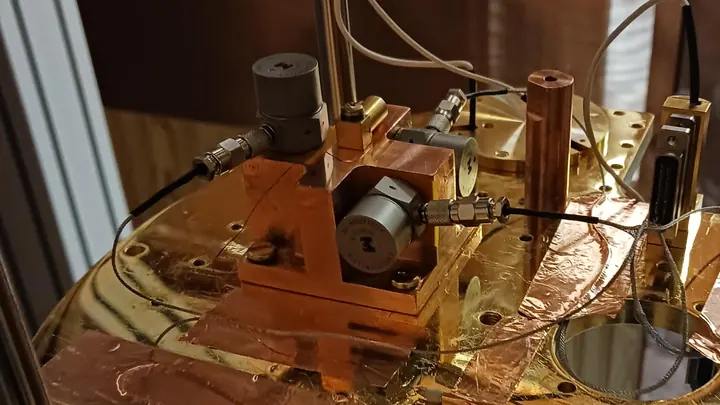
Inside a refrigerator that cools matter to near absolute zero beats a mechanical heart — the pulse tube. It pumps gas and extracts heat, but along with the cold it brings tremors. Each beat of this heart shakes the instruments sitting next to the sample and ruins delicate measurements.
Ordinary computer memory constantly consumes energy to avoid forgetting what's stored. A superconductor could store data without loss, but it's hard to make it switch.
In the new work, a superconductor is sandwiched between two magnetic insulators.
Dark matter is invisible, but according to calculations, it holds galaxies together. Catching its particles is like hearing a whisper in a noisy room. You need a material that responds loudly and noticeably to the slightest nudge.
Molecular magnets could be such a material — substances where each molecule acts as an independent tiny magnet.
A tiny seesaw weighing 1.5 nanograms oscillates not from the wind, but from the heat of its surroundings. Physicists nearly stopped it by cooling it to 0.006 degrees above absolute zero.
A heat engine is like a sailboat: to move forward, it needs a difference. Usually that means a temperature difference between hot and cold reservoirs. But what if the reservoir itself starts moving? The wind that fills the sails is created not only by a pressure difference but also by the motion of air masses.
Think of a reliable container instead of a fragile test tube: that's the shift from trapping chemically reactive radicals to holding stable molecules. Until now, magneto-optical traps have only worked with particles that are eager to react at the first collision.
The temperature in a room drops by a few degrees while the refrigerator runs without a single moving compressor. Inside, there is no Freon, but a piece of metal that is alternately magnetized and demagnetized.