concept

solar sail

A spacecraft propulsion method using radiation pressure from sunlight on a large reflective surface.
17 related articles

Description

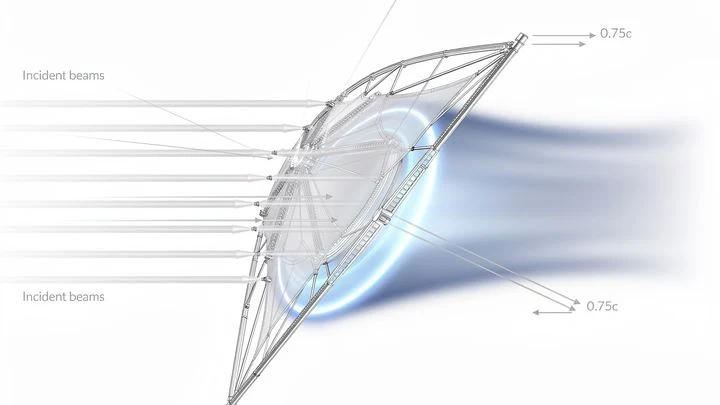
A solar sail is a spacecraft propulsion method that uses the pressure of sunlight—photons—on a large, reflective surface to generate thrust. Unlike rockets that expel fuel, a solar sail continuously accelerates as long as it faces the Sun, making it a propellant-free propulsion system. The concept is particularly appealing for long-duration missions, such as interstellar probes or station-keeping in deep space, because it can achieve high velocities over time without carrying heavy fuel.

History

The concept dates back to Johannes Kepler in the 17th century, who observed comet tails and speculated about solar breezes. The first practical proposal was made by the Soviet scientist Fridrikh Tsander in the 1920s, and the first successful deployment in space was Japan's IKAROS in 2010.

How it works

Photons carry momentum, and when they reflect off a mirror-like sail, they transfer a tiny impulse to the sail. While the force is minuscule—about 9 micronewtons per square meter at Earth's distance from the Sun—over months or years, it can accelerate a spacecraft to significant speeds. The sail's orientation controls the direction of thrust, allowing it to tack like a sailboat in the solar wind of light.

In practice

Solar sails are used in experimental missions like IKAROS and the Planetary Society's LightSail, and are proposed for future missions to intercept interstellar objects or to hover at points where gravitational and light pressure balance.

Fun fact

A solar sail's acceleration is so gentle that it would take about 100 days to increase a spacecraft's speed by just 100 meters per second, yet over a year it could add over a kilometer per second.

Related articles · 17

HEP Experiment2026-07-291 minarXiv:2607.27346express
Solar Axions: A New Birth Channel
In the scorching plasma of the solar interior, particles are born that barely interact with matter. One hypothesis suggests these are axion-like particles — light and elusive.
Instrumentation2026-07-112 minarXiv:2607.10150express
Sailing a Solar Yacht Through Alien Worlds
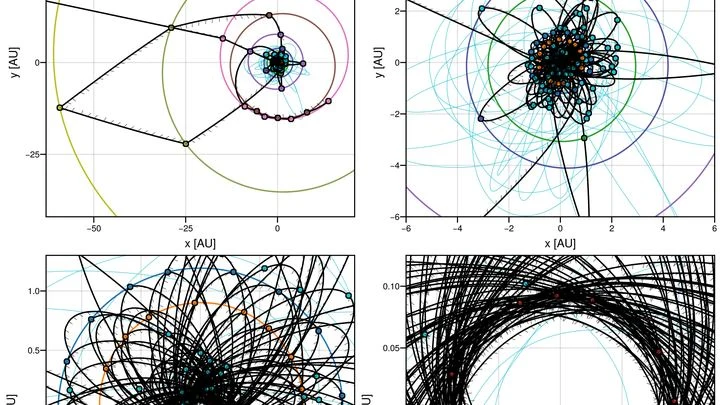
A solar sail doesn't move on water but in space, and it's pushed not by wind but by the pressure of sunlight. Such a spacecraft can fly for years without spending a drop of fuel. Steering it is like sailing a yacht across an ocean where the currents are planetary gravity and the gusts of wind are shifting sunlight.
Exoplanets2026-07-112 minarXiv:2607.10403express
Lunar muons could illuminate subsurface voids
The Moon is an airless sphere of dense rocky grit called regolith. When fast particles from space slam into it, muons are born in the soil — unstable relatives of electrons, but two hundred times heavier. Most fly downward and fade away in the depths. But those that pop upward into the vacuum can travel tens of kilometers before decaying.
Cosmic Debt: How a Planet's Mass Locks Civilizations Forever
Every civilization is born with a gravitational debt. The home planet's mass determines the loan amount, and the Tsiolkovsky equation is the interest rate applied to each kilogram of payload. To send a probe to the stars, you have to pay with fuel, and the debt grows exponentially.
Exoplanets2026-06-222 minarXiv:2606.23483express
Mars's Subsurface Life: Radiation as Fuel
The Martian surface is a place where anything alive quickly dies. Cosmic rays and ubiquitous oxidizers sterilize the top layer of soil. But dig a little deeper, and the picture changes. There, beyond the reach of ultraviolet light, a zone suitable for life may lurk. This zone runs on a strange fuel — radiation.
General Relativity2026-06-212 minarXiv:2606.22531express
Warp drive without exotic matter: a maneuver that costs half the ship
At the heart of a warp drive lies Einstein's idea that massive bodies curve spacetime — the very stage on which all cosmic events unfold. Picture a bubble of such curved spacetime. Inside it, the ship floats without any G-forces, like a passenger in an airplane cabin who doesn't feel the headwind.
Dance of Photons: When the Solar Sail Becomes Its Own Brake
Imagine a three-faced dancer on the crest of a light wave. One face is a catcher, absorbing incoming photons. The second is a perfect mirror, throwing light back. The third is frosted glass, scattering rays in all directions. As long as speed is low, the dance is harmonious. But at near-light speeds, the choreography breaks. This is like a surfer chasing a wave.
A Proton Beam Instead of an Umbrella
On a scorching afternoon, a stifling haze hangs over the city, and not a single cloud is on the horizon. Usually, in such weather, all you can do is wait for nature to take pity and send some cool relief. But what if shade and rain could be switched on schedule, like a light in a room?
High Energy2026-05-131 minarXiv:2605.12931express
The Bicycle Dynamo in Space: How Collapsar Jets Are Born
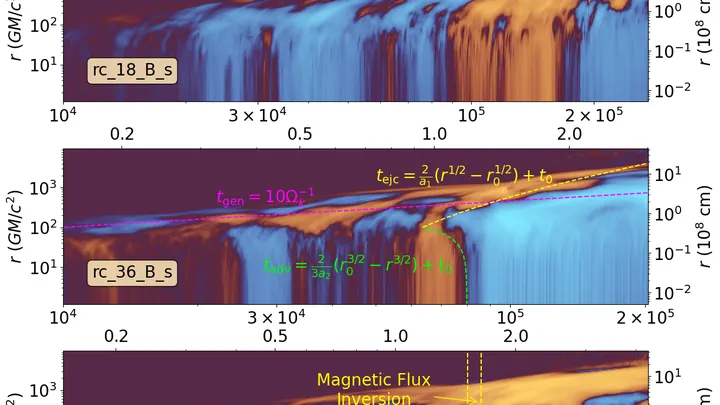
A massive star collapses, and a black hole is born, surrounded by a disk of incandescent plasma. For narrow jets to burst out of this disk, an ordered magnetic field is needed. But inside the star, it's tangled.
Stellar2026-04-151 minarXiv:2604.13585express
Sunspots as a Mirror of the Sun's Interior
Magnetic fields on the surface of the Sun appear as dark spots and bright faculae. But they are born deep inside, where flows of hot gas act like a giant dynamo. The question is whether sunspots on the surface can predict what will happen inside the star years from now. The authors applied a mathematical theorem similar to the rule linking the area of a shape to its boundary.
Instrumentation2026-04-111 minarXiv:2604.10140express
Solar telescope catches the sky's twinkle
By day in Chile's Atacama Desert, the air shimmers with heat like the haze above a hot skillet. Sunlight passing through this shimmer begins to dance and flicker. Astronomers call this airy trembling "seeing" — and it keeps telescopes from getting a sharp view of the stars. To fight this nuisance, engineers have built a special instrument — a solar seeing monitor.
Instrumentation2026-04-101 minarXiv:2604.09182express
A Stack of Prisms Catches X-rays
Light from distant stars travels for millions of years, but X-rays can't be caught with ordinary glass: they pass right through it like a bullet through paper. That's why X-ray telescopes need special lenses: stacks of tiny prisms that gently deflect the rays and focus them to a single point.
Liquid Crystal Steers a Particle Along a Route
In a thin layer of liquid crystal (a substance that flows like a liquid but has molecules arranged in order, as in a solid) vortices smaller than the thickness of a human hair are born. These vortices resemble tiny spinning tops: they can move without breaking apart and behave almost like real particles.
Instrumentation2026-03-171 minarXiv:2603.16981express
A Comet with a Steering Wheel: Four Engines for an Interstellar Voyage
An icy rock is flying through the Solar System on an open trajectory — coming in from interstellar space, swinging around the Sun, and heading back into the dark.
Galaxies2026-02-101 minarXiv:2602.09404express
One-Sided Fountain from a Young Star
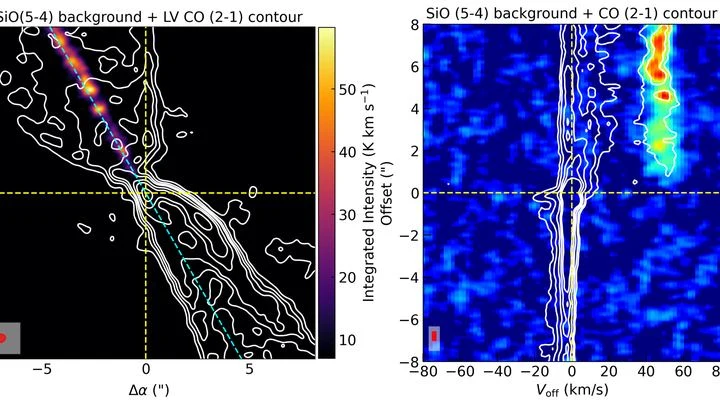
A young star that hasn't yet ignited its thermonuclear furnace is surrounded by a rotating disk of gas and dust. To gain mass, it needs to shed excess rotation — otherwise, material won't fall onto the star but will keep orbiting. Usually, this excess is carried away by two narrow gas jets that shoot from the star's poles in opposite directions, like two fountains.
Optics2026-01-271 minarXiv:2601.19116express
Bone-Chilling: A Cast That Cools Itself
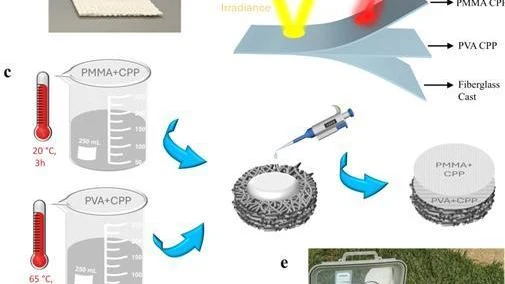
The sun blazes, but the cast on your arm stays cool. The secret lies in a thin coating made from recycled animal bones. Typical cooling surfaces are often rigid and brittle: you can't stick them onto a curved bandage. Here, they took a commercial fiberglass cast that hardens quickly and added two polymer layers. Inside are ceramic particles of calcium pyrophosphate derived from bone waste.
Exoplanets2026-01-051 minarXiv:2601.02533express
Catching an Interstellar Wanderer with a Solar Sling
Spinning a sling, we whirl a stone. Its speed builds, and if released at the lowest point, it flies farthest. In space, the gravity of the Sun acts as the strap: the probe dives as close to the star as possible, and at the moment of maximum speed, a brief engine thrust, like a yank of the hand, gives it a huge boost.