The atmosphere is a unit of pressure defined as the average pressure exerted by Earth's atmosphere at sea level. It provides a convenient reference point for comparing pressures in various contexts, from weather systems to industrial processes. One standard atmosphere is approximately 101,325 pascals, or about 14.7 pounds per square inch.
History
The concept of the atmosphere as a pressure unit was formalized in the early 20th century, building on Torricelli's barometer experiments in the 17th century. The standard value was later defined precisely by international agreement.
How it works
The pressure at sea level arises from the weight of the air column above a given point. This weight compresses the air below, creating a force per unit area. The atmosphere unit simply standardizes this average value, allowing scientists and engineers to express pressures relative to a familiar baseline.
In practice
It is used in meteorology for weather forecasting, in engineering for calibrating pressure instruments, and in physics for describing conditions in planetary atmospheres, such as the thin atmosphere of Mars or the dense clouds of Jupiter.
Fun fact
The pressure at the bottom of the Mariana Trench is over 1,000 atmospheres, equivalent to the weight of about 50 jumbo jets on a single square meter.
Systems:SIOne atmosphere is equal to 101325 pascals, defined as the average pressure at sea level on Earth.
Miners took canaries underground not for their songs. The bird would fall off its perch before the miner noticed carbon monoxide. In ultrahigh vacuum, the canary's role is played by a cloud of one hundred thousand lithium or rubidium atoms.
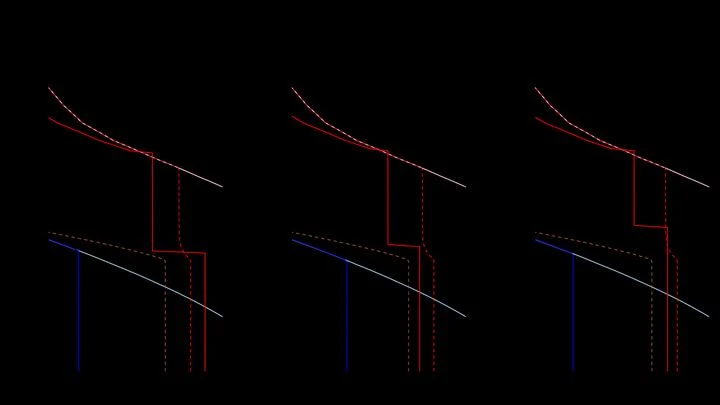
Jupiter's atmosphere resembles a layered cake, where each layer plays its role. Scientists took data from four instruments at once (VLT/MUSE, Cassini/VIMS, IRTF/SpeX, and Juno/JIRAM) and built a model of clouds and ammonia in the planet's equatorial zone, from 0.1 to 10 bar (pressure equivalent to hundreds of kilometers below Earth's…
Today's Martian surface is a cold, nearly airless home. Many dream of a full renovation: warming the planet, filling it with air from carbon dioxide and nitrogen.
Cometary ice slams into the young Earth. The pressure at the impact point is like stacking six aircraft carriers on your thumbnail. In the lab, such conditions are reproduced by squeezing a tiny sample between two rotating anvils.
This time, adenosine monophosphate — one of the letters of future RNA — was placed under the anvils.
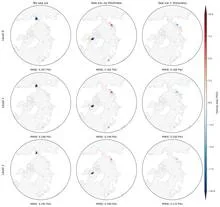
An orchestra of two musicians plays from the same score, but each hears only their own line. The atmosphere and ocean in a climate model resemble such a duet: they exchange heat and moisture every few hours, yet until recently their neural network counterparts could not keep a common rhythm.
Warm air rises from a radiator, and the room seems to heat evenly. But if you put your hand against the wall by the window, it feels cooler than by the door.
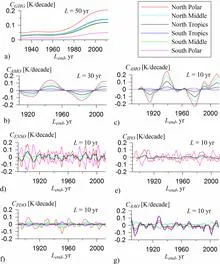
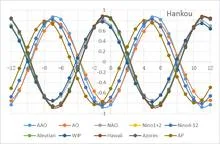
For a century, climatologists have measured the ocean's pulse with a barometer. Indices like El Niño or the North Atlantic Oscillation are built on atmospheric pressure differences between two points, and then we wonder why rivers don't obey.
On April 16, 2012, Washington experienced heat no one expected. The thermometer climbed 18 degrees above normal. Sixty days earlier, Bucharest and Kyiv had weather unusual for them. The link between these events was found by an algorithm that scans pairs of cities worldwide, looking for recurring coincidences.