Bone-Chilling: A Cast That Cools Itself express
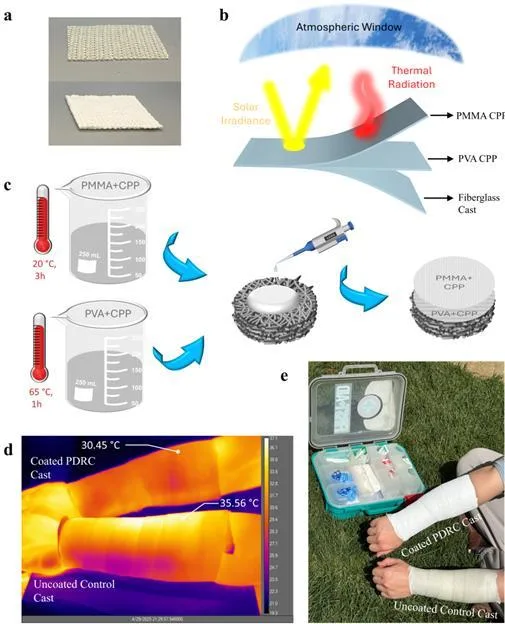
The sun blazes, but the cast on your arm stays cool. The secret lies in a thin coating made from recycled animal bones.
Typical cooling surfaces are often rigid and brittle: you can't stick them onto a curved bandage. Here, they took a commercial fiberglass cast that hardens quickly and added two polymer layers. Inside are ceramic particles of calcium pyrophosphate derived from bone waste. These particles scatter sunlight while also emitting heat as infrared radiation that escapes through the atmosphere into space.
Under direct sunlight, the surface was 15 °C cooler than the surrounding air. Sunlight reflection exceeded 90%. This material requires no electricity, withstands bending, and is safe for skin, so it can be applied to medical dressings or flexible components.
A regular cast usually traps heat, but this version sheds it to the clear sky, as if the bandage breathes cold.
Animal bones that are usually thrown away become a ceramic capable of cooling surfaces without a single watt of energy.