The Star That Flared Like a Lightbulb express
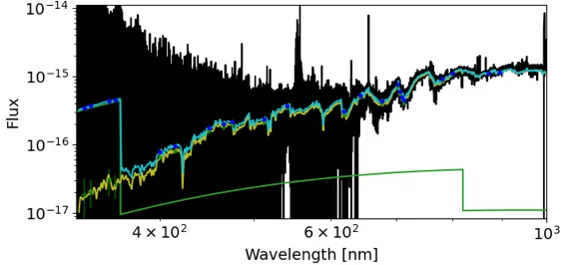
In 2023, an unremarkable star in the constellation Taurus suddenly became dozens of times brighter. The behavior was like a lightbulb someone abruptly turned up to maximum: the star flared, then gradually returned to its previous state.
Astronomers caught the moment and pointed several telescopes at the star. They saw a disk of gas and dust swirling around it, like a whirlpool above a bathtub drain. Normally, material from the disk flows toward the star in a thin stream, but sometimes, as in a clogged pipe, a clump accumulates and suddenly falls inward. That clump caused the flare.
The star itself turned out to be small and cool: its temperature is about 3400 degrees, and its mass is less than a third of the Sun's. But even such a modest star can put on a bright show. After the flare, astronomers noticed a wind blowing from the star — streams of gas carrying some material back into the disk. It's as if the bathtub not only filled up but also splashed a bit.
Such flares are not rare for young stars. They show how a star gains mass and how its surroundings behave in the process. Perhaps it is precisely at such moments that clumps form in the disk, from which planets will later assemble.
Original abstract
as written by the authors arXiv:2602.09777
Stellar outbursts from variable or periodic accretion are thought to be ubiquitous across young stellar populations. However, relatively few outbursting objects have been discovered to date. Here, we present the characterisation of a new EXor-type episodic accretor. We aim to characterise the nature of the 2023 outburst of SPICY 97589/Gaia23bab and characterise the stellar source for the first time, while exploring how an accretion outburst contributes to disk evolution. We employ multi-waveband medium-resolution spectroscopy with UVB-VIS-NIR coverage during the peak of the 2023 outburst and the post-outburst quiescent object. The broad wavelength coverage of the dataset allows for robust measurements of the accretion rate using known line tracers. The addition of quiescent spectra provides a good estimation of stellar parameters of the central star while also informing us on the evolution of the disk during outburst phases. We find the stellar source to be a 3410\,K, M3.0 type star with a luminosity of 0.41 $$L_\odot$$ and an estimated stellar mass of 0.29 $$M_\odot$$. We measure the accretion rate of SPICY 97589 to be $$\dot M = 2.38\pm0.58\times10^{-7}\,\mathrm{M_\odot yr^{-1}}$$. This value is at two orders of magnitude greater than the quiescent accretion rate. Thus, we confirm that the 2023 outburst was driven by an influx of material from the surrounding environment to the central star, an accretion outburst. The spectral fingerprint of emission lines is also characteristic of an outbursting EXor-type source, including variable disk winds.
The rate at which the star consumed material during the flare was about 2.38×10⁻⁷ solar masses per year. That sounds small, but for a star with a third of the Sun's mass, it's like eating a small asteroid every few days.
In Stanisław Lem's novel 'Solaris', the planet's ocean behaves unpredictably, much like the accretion flares of young stars — except there the mystery lies in a mind, while here it lies in physics.