The solar mass is a standard unit of mass in astronomy, equal to the mass of the Sun, approximately 1.989 × 10^30 kilograms. It serves as a convenient yardstick for expressing the masses of stars, black holes, galaxies, and other celestial objects, which would otherwise involve unwieldy numbers. For example, a supermassive black hole might be described as having a mass of a million solar masses, instantly conveying its scale relative to our own star.
History
The concept of using the Sun's mass as a unit emerged naturally with the development of celestial mechanics in the 19th century, though it was formalized as a standard unit in the 20th century as astrophysics matured.
How it works
The solar mass is defined by the gravitational constant and the Sun's orbital parameters, but in practice it is used as a comparative measure. Astronomers determine the masses of other objects by observing their gravitational effects—such as the orbits of companion stars or the bending of light—and then express the result in units of solar masses. This allows for intuitive comparisons across vastly different scales, from small stars to the most massive black holes.
In practice
It is used in stellar evolution models, galaxy dynamics, and the characterization of exoplanets and black holes, providing a common scale for mass in astronomical research.
Fun fact
The Sun loses about 4 million tons of mass every second due to nuclear fusion and solar wind, yet its total mass is so vast that this loss is negligible over human timescales.
Systems:SIA unit of mass equal to the solar mass, approximately 1.98847 × 10^30 kilograms.
At the center of nearly every large galaxy sits a supermassive black hole. It doesn't just devour infalling gas; it also blasts some of it back out in powerful jets. These jets act like giant pistons, shoving the surrounding gas and heating it. Astronomers have long suspected that this is how black holes keep galaxies from cooling into cold star factories.
A black hole with a mass of 35,000 Suns drifts through a galaxy's gas like a barge through fog. Its gravity rakes the material ahead of it, leaving a dense trail behind — a wake of gas. Some of that gas gets pulled into the black hole, and it grows.
A dance floor where couples whirl. At the center, an invisible master of ceremonies sets the rhythm. This is the supermassive black hole at the heart of the Milky Way, and the couples are stars whose orbits astronomers have tracked for years. But what if the master himself is wrapped in a fluffy fur coat of tenuous matter?
Cosmic rays aren't rays in the usual sense: they're fast particles bombarding Earth from all directions. Mostly they're protons and atomic nuclei. Their energies vary widely, from modest to fantastically huge. When such a particle heads our way and the Moon or Sun gets in its path, it gets absorbed.
At the center of the Milky Way, shrouded in dust and glare, lurks a supermassive black hole — Sagittarius A*. Around it, like moths around a flame, swarm dozens of guide stars. Two of them, S2 and S38, with eccentric orbits and periods of just a few years, have become the protagonists in testing the fundamental laws of the cosmos.
The universe sounds with silence. The lion's share of matter — about 85%—remains invisible, manifesting only through gravity. Back when Vera Rubin Vera Rubin showed that galaxies spin as if wrapped in unseen mass.
The cosmological debate is like two craftsmen measuring the same wall but getting different lengths. One uses a tape measure, applying it to nearby landmarks — Cepheids (pulsating beacon stars) and Type Ia supernovae (flashes of dying stars). He finds the wall is stretching at 73.5 arbitrary units.
Physicists have mastered an elegant mathematical trick that lets them translate gravitational equations into the language of electricity. This method — double copy — works like a kind of dictionary: it replaces the complex geometry of curved spacetime, described by high-dimensional tensor fields, with the simpler rules of…
Hydrogen is the most common element. Its atoms are like antennas: they emit and absorb light at very specific frequencies. Einstein predicted that spacetime can ripple: these are gravitational waves.
The cosmos is full of mimicry. The clearwing moth wears a wasp's mask, a harmless fly buzzes like a bee. And in the world of gravity, the role of impersonator is perhaps played by boson stars — colossal clumps of scalar field, indistinguishable from black holes.
A black hole is invisible, but it's betrayed by light from superheated matter swirling nearby. That light is like a double agent: on one side of its orbit, it blueshifts as it races toward us; on the other, it redshifts as it recedes.
Recently, astronomers spotted three interstellar comets coming from deep space. One of them, 3I/ATLAS, turned out to be unexpectedly large: its nucleus is several kilometers across.
At the center of the Milky Way lurks something invisible but extremely massive — about four million times heavier than the Sun. It is usually called a black hole and designated Sagittarius A*. But astronomers are not letting their guard down: what if it is not a hole but something more exotic, like a giant ball of ultralight particles — a boson star?
Every galaxy is wrapped in an invisible shell of hot gas, like steam rising from a pot of boiling water. This gas barely glows in X-rays, making it notoriously difficult to measure. Yet it holds the memory of stellar explosions and the galaxy's growth.
The new method uses light from a galaxy's bright center.
For a long time, the Universe was seen as a strict baker: it was thought that in every corner, stars were mixed from the same recipe — for each giant star, there were roughly the same number of dwarfs, no matter where they were born.
Cosmic rays are charged particles that constantly bombard Earth from deep space. When one of these particles enters the atmosphere, it collides with air nuclei and spawns a whole cascade of secondary particles: electrons, muons, photons.
Black holes heavier than a trillion Suns act like cosmic umbrellas. They cast a shadow on the faint afterglow of the Big Bang — ancient light that fills the entire sky. The shadow turns out not blurred, but with a sharp edge, as if cut out with scissors: around it glows a bright ring of photons trapped by gravity.
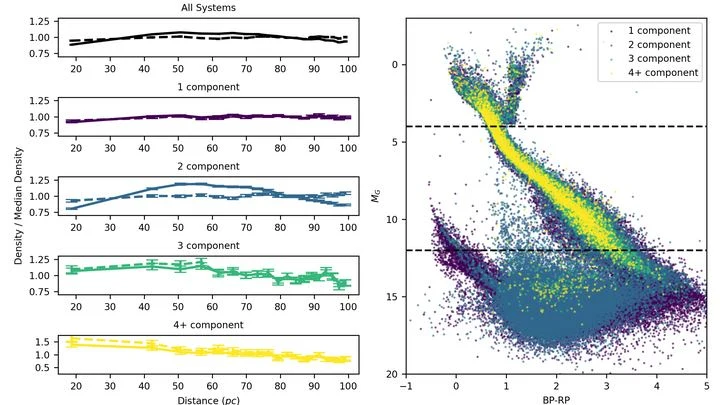
Two spotlights placed side by side: from a distance, their light blends into one patch, and it seems there's a single source. The same happens in space: about 10–20% of faint stars are actually close pairs of identical stars. Individually, they can't be resolved, but together they shine noticeably brighter than a single star with the same parameters.
Two stars circle each other like a pair of figure skaters on ice. Both resemble the Sun, but one shines brighter and has puffed up, while the other remains compact. Astronomers peered into their light using spectrographs, instruments that split light into colors, and found something odd: one star is clearly poorer in heavy elements than the other.
Supermassive bodies warp space, turning into a lens that bends light from distant objects. Such spacetime curvature allows astronomers to see the invisible. Recently, this method helped detect a hidden clump with the mass of a million Suns.
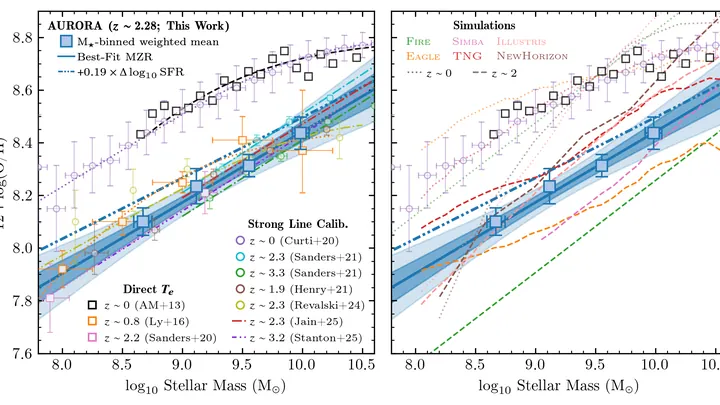
Galaxies are like giant kitchens where, in stellar cores, light atoms are fused into heavy ones — much like flour and water becoming bread. When a star dies, it spills its accumulated riches into the interstellar gas, seasoning it with 'spices': oxygen, carbon, iron.
Astronomers have found an invisible object in the Universe weighing just a million Suns — for cosmic scales, that’s a mere trifle, a hundred times lighter than anything they’ve been able to “weigh” at such distances. The object itself doesn’t shine, but it gave itself away by bending the light from an even more distant galaxy.
The Event Horizon Telescope looks at M87* and sees more than just a ring of light around a dark void. That light is twisted, like a corkscrew. The wavefront carries a helical structure that physicists call orbital angular momentum.