A black holeoutburst is a sudden, dramatic increase in the emission of radiation from a black hole that was previously quiet or dormant. These events can occur across the electromagnetic spectrum, from radio waves to X-rays and gamma rays, and are often triggered by the sudden infall of matter, such as a star being torn apart by tidal forces or an instability in the accretion disk. Outbursts provide a unique window into the physics of black holes, allowing astronomers to study how matter behaves under extreme gravity and how energy is released during accretion episodes.
History
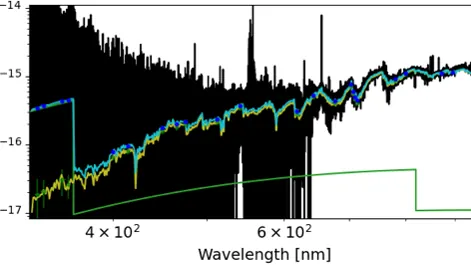
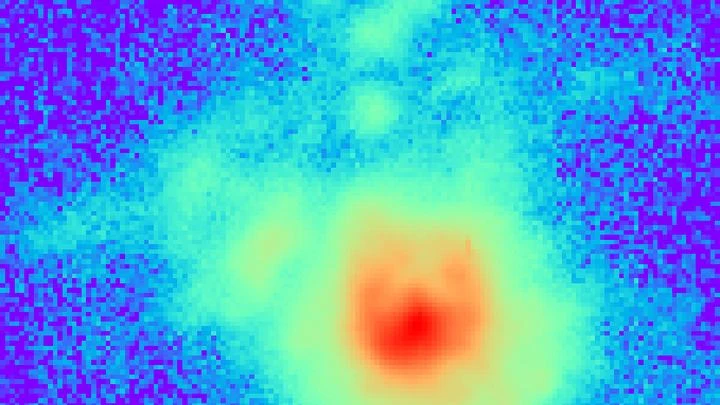
The concept of black holeoutbursts emerged in the 1970s with the discovery of X-ray binaries like Cygnus X-1, but the term became widely used after observations of the first tidal disruption events in the 1990s. The specific phenomenon of a black hole 'waking up' after a long period of silence was highlighted by the 2018 observation of the supermassive black hole in the galaxy SDSS1335+0728, which began flaring after 25 years of inactivity.
How it works
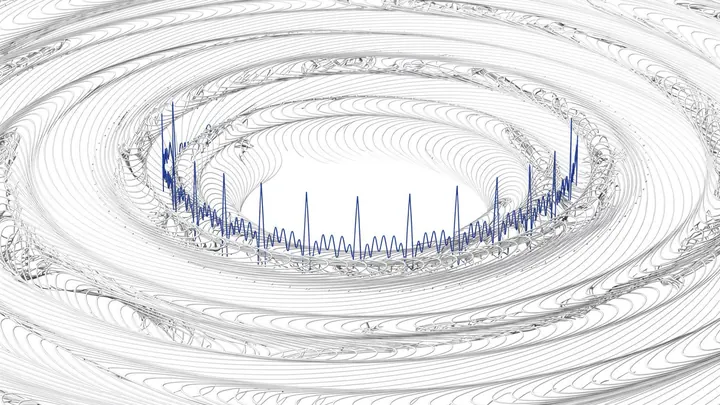
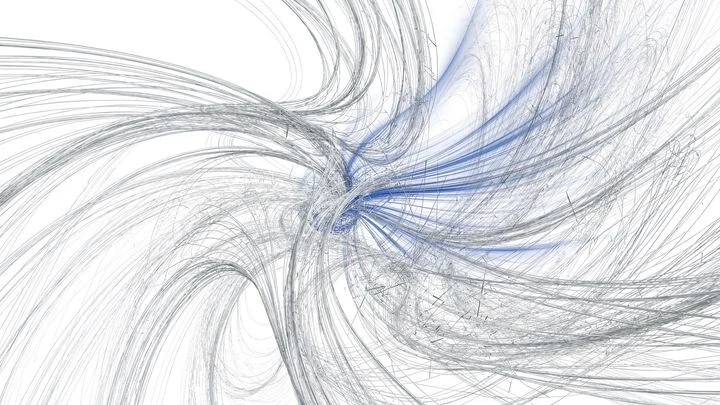
The outburst typically begins when a reservoir of gas, often from a companion star or a passing cloud, is disrupted and starts spiraling toward the black hole. As the material falls inward, it forms a hot, rapidly rotating accretion disk. Friction and magnetic stresses within the disk heat the gas to millions of degrees, causing it to emit intense X-rays and other radiation. In some cases, part of the infalling matter is redirected into relativistic jets that shoot out from the black hole's poles, producing bright radio and gamma-ray emission. The sudden onset of these processes marks the outburst, which can last from weeks to years before the system returns to quiescence.
In practice
Outbursts are used to probe the demographics of black holes, including their masses and spin rates, and to test models of accretion disk physics. They also serve as natural laboratories for studying relativistic jet formation and particle acceleration.
Fun fact
The 2018 outburst of a supermassive black hole in SDSS1335+0728 was so powerful that it increased the galaxy's ultraviolet and X-ray brightness by factors of 4 and 10, respectively, and the emission is still ongoing years later.
In the constellation Orion, in the cloud of gas and dust L1641, the young star PR Ori B suddenly flared up like a furnace that someone had thrown fuel into. Its brightness rose fivefold, and astronomers watched for the first time as a fuor was born, a rare event in which a star begins greedily swallowing material from the surrounding disk.
The night sky is full of rings and bubbles, but in the radio band they look different. In data from the Australian radio telescope ASKAP, a structure has surfaced that resembles two soap bubbles blown from the same straw.
An avalanche in a sandpile starts with a single grain. No one knows exactly where it will slip or how big the slide will be. But if you keep pouring sand, the pile itself reaches a state where avalanches of all sizes, from tiny trickles to massive collapses, follow the same law.
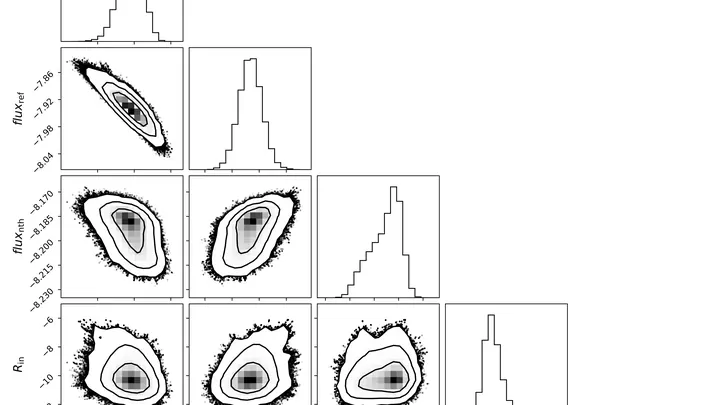
A black hole paired with a star works like a pump: it pulls gas from its companion, swirls it into a glowing disk, and occasionally ejects some of that matter in two narrow jets. In 2021, the system 4U 1543-475 put on such a show.
The cosmic detective story began with a quiet flash in the optical band. AT2019wzc slowly brightened and faded like a smoldering ember. But hidden inside was something more energetic — repeating soft X-ray bursts that astronomers call quasi-periodic eruptions.
These eruptions last minutes to hours and repeat every few hours or days.
Ten billion years ago, the universe was speckled with strange crimson sparks. The JWST spotted them in images at distant redshifts — compact sources blazing like entire galaxies yet no larger than a tiny central region. Astronomers nicknamed them “little red dots.” Their nature long defied explanation.
The cosmos is full of screams we can't hear. Every time a black hole tears a star apart, a blinding flash is born, and often — a narrow relativistic jet, shooting out thousands of light-years. But if that searchlight is aimed away from Earth, we see only a faint afterglow — a radio echo arriving with a delay.
In the quiet of cold molecular clouds, where interstellar gas under gravity condenses into dense clumps, the birth of massive stars is one of the great puzzles of astrophysics.
The NICER X-ray telescope has become a precise stethoscope for astrophysicists. In 2025, it was 'listening to' the black hole in the binary system 4U 1630−47—a compact object born from the core collapse of a massive star (the stability limit for white dwarfs was…
At the heart of massive galaxies, monstrous gravitational 'cocoons' brew — black holes with billions of solar masses, shrouded in a dense veil of gas and dust. But any metamorphosis requires breaking the shell.
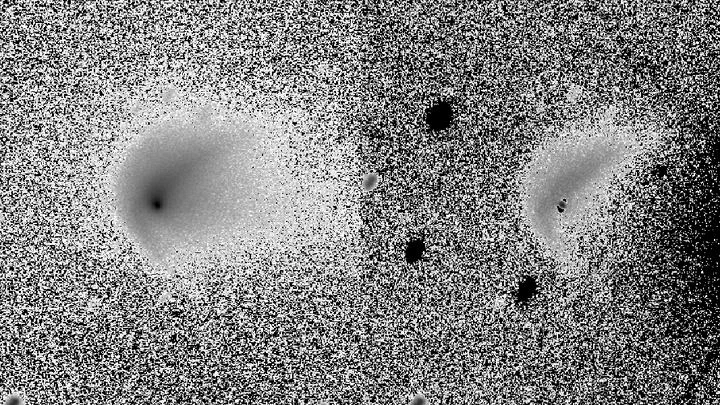
In the summer of 2021, comet 7P/Pons-Winnecke put on quite a show. A network of telescopes, the Las Cumbres Observatory, tracked it for nearly three months and counted eight sudden outbursts.
Blazars are long-lasting beams from black holes at the centers of galaxies. Gamma-ray bursts are the briefest flashes from supernova explosions or neutron star mergers. The former act like eternal spotlights, the latter like camera flashes.
A thick stew slowly cools in a pot. Suddenly, the flame beneath it flares up, and the stew begins to boil, breaking into many small whirlpools. Much the same happens to the disk of gas and dust around a young star when it experiences a flare — a sudden influx of matter from the disk onto the star.
The city has long been asleep: not a single lit window, not a single new house. Only in the very center, in one lone building, someone forgot to turn off a spotlight. That's what a galaxy looks like when stars are no longer born, yet its central black hole still shines.
A black hole rips apart a star, and we see a dazzling flare. Then, a couple of years later, when everyone has forgotten about it, radio telescopes suddenly pick up a new signal, like an echo from the past.
A tiny black hole, no larger than an atomic nucleus, hovers in a cloud of hydrogen. It doesn't swallow everything around it; instead, it slowly radiates away, losing mass with every moment.
Drop a pebble into a pond, and ripples spread across the water. Strike a bell, and it rings at its own frequency. When a black hole collides with another, it too 'rings'—except instead of sound, it's the trembling of space itself.
A tiny black hole — the size of an atom but as massive as a mountain. It wasn't born from a star but in the first instants after the big bang, and it has been quietly losing mass ever since, radiating heat.
At the center of many galaxies sits a supermassive black hole. When gas falls onto it, the gas heats up and shines brighter than an entire galaxy: this is an active galactic nucleus. Sometimes a true hurricane erupts from there: a stream of ionized gas racing at tens of percent of the speed of light.
In a dense cloud of gas and dust where giant stars are born, the ALMA telescope has spotted something familiar. Four thin gas jets shoot out from the same region, each leaving behind a chain of bright knots, like a dashed line.
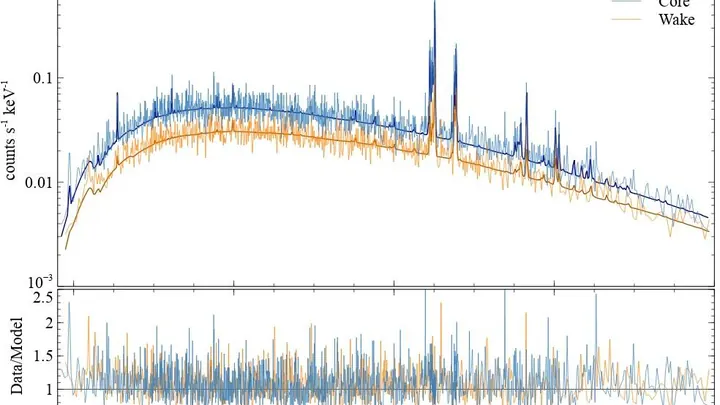
At the heart of the Ophiuchus galaxy cluster floats a bubble of hot plasma the size of several galaxies. It rises like a giant hot-air balloon in the atmosphere, leaving a wake behind it — a region where gas is set in motion.
The black hole GRS 1915+105 usually hides behind a dense gas curtain: its X-ray emission is heavily absorbed on its way to us. But in April 2023, it suddenly flared: the X-ray flux jumped nearly tenfold.
In the galaxy NGC 1566, located in the constellation Dorado, there is an active nucleus — a supermassive black hole surrounded by a cloud of fast-moving gas. As the gas falls toward the hole, it heats up and emits bright spectral lines. Sometimes these lines become very broad — a sign of the gas's rapid rotation.
A black hole can torment a star for years, rather than rip it apart immediately. Tidal forces are when the hole's gravity stretches the star: the near side is pulled harder than the far side. Usually, getting too close rips the star apart instantly — that's a tidal disruption event.
The night sky looks still, but sometimes one of the stars suddenly begins to brighten. That's what happened with the system AT 2019wey: it was spotted by the TESS telescope, which usually hunts for planets around other stars, but happened to be imaging that patch of sky every half hour.
The black hole MAXI J1810-222 behaves like a giant vacuum cleaner with a reverse valve: it pulls in matter, but some of it gets spat back out into space. This "backflow"—a stellar wind — had been spotted by astronomers before, but only as a blurry smudge in X-rays.
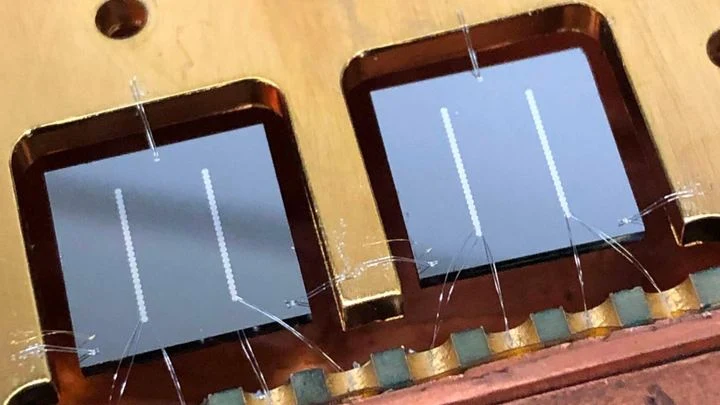
A dark matter detector is like a super-sensitive microphone listening for silence. It picks up tiny heat jolts, phonons, that occur when a particle grazes a crystal. But instead of silence, the instruments have been hearing noise for years: a slew of weak signals below a few hundred electronvolts.
A giant cosmic funnel sucks in gas from its surroundings. But not all of that gas falls in — some is spat back out, like splashes from boiling water. That's exactly what the ultraluminous X-ray source NGC 5204 X-1 does: a compact object (likely a black hole) feeds so voraciously that the excess escapes in powerful jets.
On a deserted road at night, a streetlight flickers rarely but at full power. That's how WZ Sge-type stars behave: they smolder barely noticeably for years, then suddenly flare hundreds of times brighter. Astronomers decided to check what happens in their gas disks during quiescence, and found almost emptiness.
Astronomers are monitoring X-ray flares from the vicinity of a black hole at the center of a galaxy. These flares repeat with a certain rhythm, like heartbeats. Normally, as a star approaches a black hole, the rhythm speeds up — just as a pulse quickens when running. But at the black hole 'Ansky,' the rhythm is slowing down.
The young star B335, which hasn't grown up yet, suddenly sneezed, and that sneeze is still going on. Astronomers spotted the outburst in the scattered light from its outflow cavity, and it offered a rare chance to see how such an energy release affects a jet — a stream of gas shooting out…
In 2023, an unremarkable star in the constellation Taurus suddenly became dozens of times brighter. The behavior was like a lightbulb someone abruptly turned up to maximum: the star flared, then gradually returned to its previous state.
Astronomers caught the moment and pointed several telescopes at the star.
The center of a galaxy is a bustling metropolis where a giant black hole often snatches inattentive stars. But telescopes caught a flare in a quiet suburb, tens of thousands of light-years from the core. This gave away a wandering black hole — an invisible predator, flung out of the center after an ancient galaxy collision.
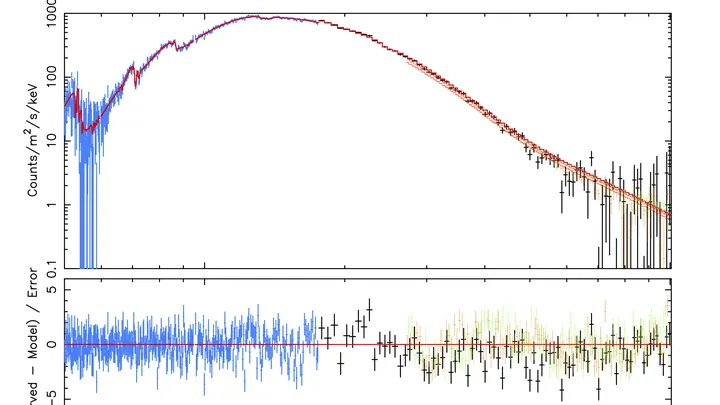
The black hole in the binary system 4U 1755-338 had been silent for 25 years, but in 2020 it suddenly flared up. Astronomers pointed two X-ray telescopes at it simultaneously, NICER on the space station and NuSTAR in orbit, and watched every change in its glow.
A multitude of atoms can act like a synchronized orchestra: if each emits light in unison with the rest, the flash becomes many times brighter. This is superradiance — a phenomenon well studied in the lab, but almost never sought in space. Now astrophysicists suspect that such collective 'notes' also play out in interstellar space.
In the center of galaxy J2344 five years ago, a black hole tore apart a star, and now scorching gas bubbles there — a cosmic “stew pot”. Every 12 hours, giant X-ray bubbles rise in it, and on their ascent, super-hot splashes lasting 5–30 minutes appear.
Two galaxies collided, and from their center an invisible fountain erupts. The ALMA and VLT telescopes peered into the heart of the IRAS20100-4156 system — where two stellar islands are merging. There, work is in full swing: hundreds of new suns are being born, and their heat drives a stream of cold gas outward.
This stream is like a giant's exhale.
At the heart of every galaxy slumbers a supermassive black hole. When it devours matter, its surroundings flare up: this is an active nucleus. How can we learn about past outbursts if the black hole is silent? The answer lies in light echoes.
In October 2022, the space-based detector GECAM-C caught the most powerful gamma-ray burst ever seen, GRB 221009A — an explosion that briefly became the brightest source of gamma rays in the sky. But the most interesting part came after: the instrument detected a series of additional flares, and one of them was record-breaking.