Coupled Oscillations of Particles in an Accelerator express
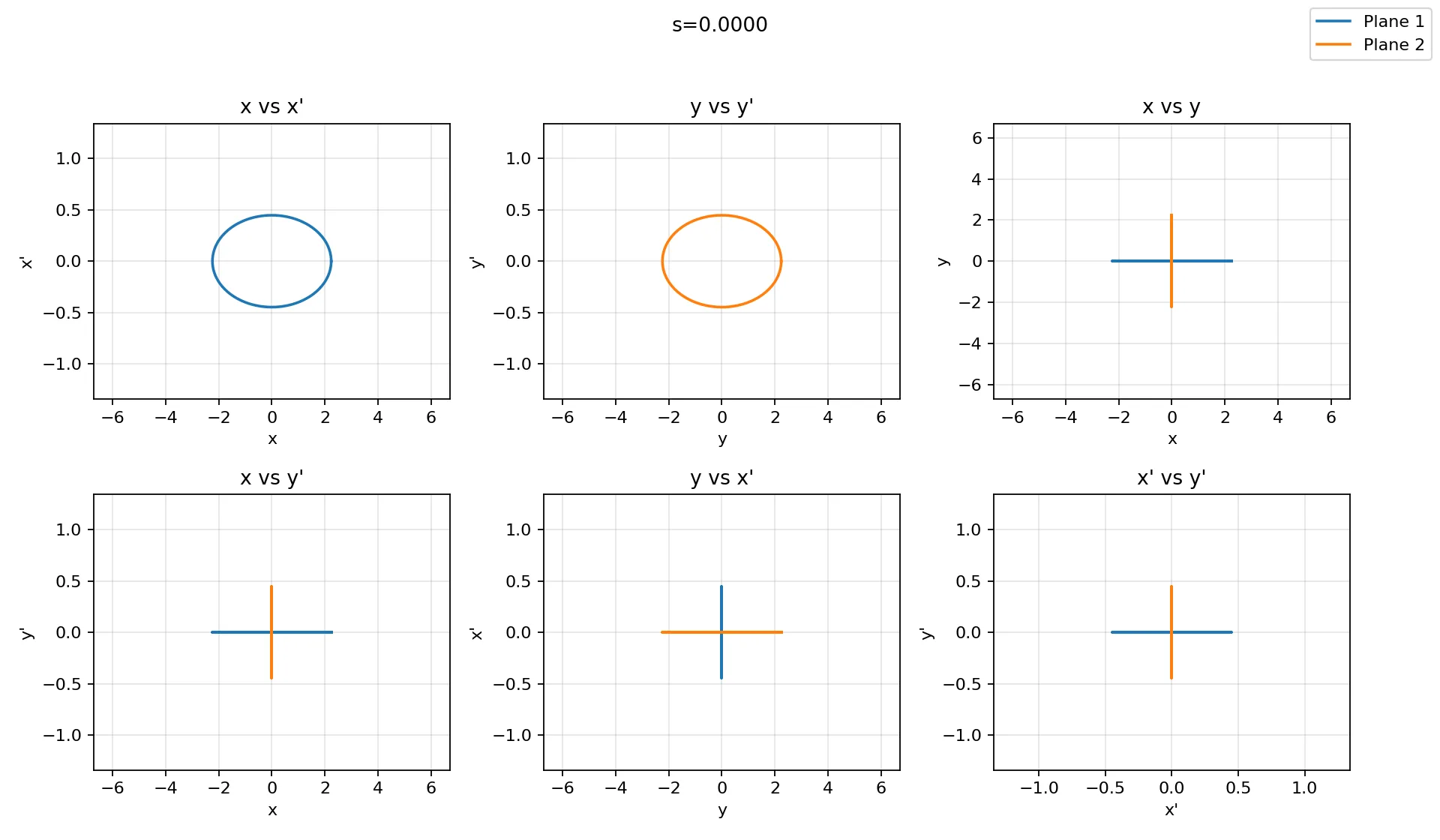
Particles in an accelerator can oscillate in two transverse directions at once, and these oscillations are not always independent. If you give a pendulum a push in one direction and it starts swinging sideways as well: that's coupled oscillations. In accelerators, this happens due to magnet imperfections or special insertions, making particle motion complex.
Describing such motion is tricky because the mathematics allows for different coordinate systems. Two people describe the same room: one measures from the north wall, the other from the east wall. The numbers come out different, even though the room is the same. In accelerator physics, different groups have used their own 'walls' for decades, making their results hard to compare.
The authors found a way to eliminate this arbitrariness. They introduced new parameters that do not change under a change of basis, like the area of a room, which is the same no matter who measures it. These parameters are called invariant coupling fractions. Moreover, it turned out that five previously known descriptions (Edwards–Teng, Mais–Ripken, and others) are just different 'viewpoints' on the same thing, related by allowed transformations.
The new approach has already been tested on numerical models of coupled accelerator rings. It allows smooth tracking of the beam optics variation along the ring and correctly compares calculations with measurements. This is a step toward everyone speaking the same language when describing complex particle motions.
Original abstract
as written by the authors arXiv:2603.04195
Coupled beam optics can be geometrically described in terms of invariant eigenmode planes of a stable symplectic ``one-turn'' map $$\mathcal M\in Sp(4)$$. We show that the non-uniqueness of symplectically normalized bases within each eigenmode plane constitutes an in-plane gauge freedom $$Sp(2)\times Sp(2)$$, and that many coupled-optics parametrizations differ primarily by gauge choice. Building on this fact, we identify basis-independent descriptors of lattice and beam optics and introduce bounded, gauge-invariant coupling parameters or fractions $$u_{k,\mathrm{inv}}$$ computed from orthogonal projectors onto the eigenmode planes. To obtain smooth $$s$$-dependent optics functions and consistent mode labeling, we present a unifying and practical approach based on an $$SO(2)$$ continuity gauge (Procrustes alignment), together with diagnostics for stability and invariance. We further relate Edwards--Teng, Mais--Ripken, Lebedev--Bogacz, Wolski, and Sagan--Rubin parametrizations as gauge-equivalent representations within the respective $$Sp(2)\times Sp(2)$$ gauge freedom. Numerical examples of coupled lattices and beam optics illustrate the proposed invariants and show how representation-dependent scalar coupling parameters (e.g.\ in the Lebedev--Bogacz gauge) can leave their nominal bounds while $$u_{k,\mathrm{inv}}$$, defined here, remain bounded and physically interpretable.
Coupled oscillations in an accelerator are similar to the behavior of a tuning fork: if you strike one prong, the other also starts vibrating due to the common handle.