An invariant is a property of a physical system that remains unchanged when the system undergoes certain transformations, such as rotations, translations, or Lorentz boosts. In relativity, for example, the spacetime interval between two events is invariant under Lorentz boosts, meaning all observers, regardless of their relative motion, agree on its value. This constancy is not a mathematical curiosity; it underpins the structure of physical laws, ensuring they hold identically for all observers in uniform motion.
History
The concept of invariants was formalized in the 19th century in mathematics, but its deep physical significance emerged with Albert Einstein's special relativity (1905), which highlighted the invariant spacetime interval. Emmy Noether's theorem, published in 1918, established the general link between symmetries and conservation laws.
How it works
Invariants arise from symmetries of the underlying equations. According to Noether's theorem, every continuous symmetry of a physical system corresponds to a conserved quantity—an invariant in time. For instance, the symmetry of physical laws under time translation leads to conservation of energy, and under spatial translation leads to conservation of momentum. In more abstract settings, such as gauge theories, invariants like the electromagnetic field tensor's magnitude are constructed to remain unchanged under local transformations, guiding how particles interact.
In practice
Invariants are used to validate numerical simulations in astrophysics, such as checking that total energy is conserved in black hole merger models, and to design particle detectors that rely on Lorentz-invariant quantities to identify events.
Fun fact
The speed of light in a vacuum is the most famous invariant in physics—it is the same for all observers, no matter how fast they move.
Newton gave us a world where bodies move in a void and clocks tick the same for everyone. For three centuries, this picture worked flawlessly. But it relies on many invisible props: absolute position, the 'up-down' direction, and a single rhythm of time for the entire universe. We have never measured these directly — only through the relations between objects.
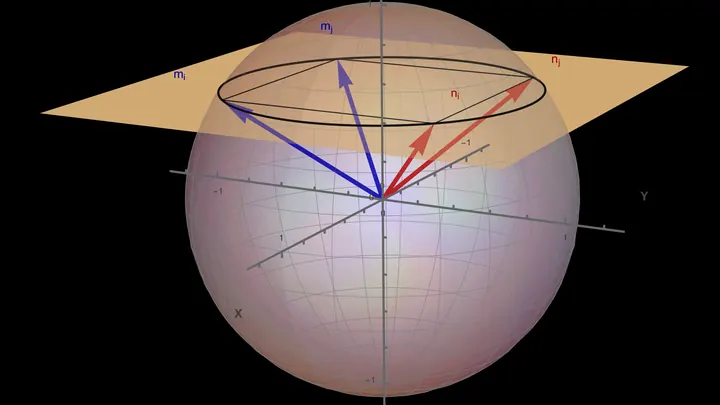
A lead sphere hangs above another lead sphere. According to the usual laws of gravitation, they attract each other exactly along the vertical — along the line connecting their centers.
Inside planets and stars, in rotating oceans of plasma, turbulent flows, Coriolis forces, and magnetic tension collide. The central question is how the energy of this chaos crystallizes into a stable magnetic framework that can last billions of years.
In quantum field theory, there is a long-standing mystery: infrared divergences. Usually they are seen as an annoying technical nuisance that must be carefully 'papered over' in calculations. But what if this is not a bug, but a feature?
The explosion of a distant supernova told us something hard to believe: the universe is expanding faster and faster. The engine of this acceleration is dark energy — nearly 70% of everything that exists.
A billiard ball strikes another, and the sum of their velocities before and after the collision obeys strict rules. The same happens in the microscopic world: energy, momentum, and charge cannot simply vanish.
A builder checks the strength of an arch not by running through all possible shapes in their head, but by mentally nudging it and seeing how much force is expended. That's essentially how the principle of virtual work works in mechanics. The authors of a new study have applied this approach to the very geometry of spacetime.
They constructed a covariant framework of virtual work for the metric.
The vacuum is not as empty as it seems. If an observer moves with acceleration, the vacuum around them heats up: this was predicted by William Unruh back in the 1970s. The effect is akin to black hole radiation, but in flat space.
Tea in a cup cools quietly on the table. But if you zoom past at near-light speed, the thermometer will read higher — even though no one heated the tea. Calculations confirm: the needle will creep up.
A century ago, physicists split into three camps.
If you accelerate one of four entangled particles to enormous speed, their quantum entanglement doesn't just melt away: it first weakens, then strengthens again. Physicists discovered this unexpected twist while studying the behavior of a special state called the Dicke state in a world governed by the laws of relativity.
The quantum world is known for uncertainties: for example, you can't measure a particle's position and its speed at the same time. But new research shows that in a 'fuzzy' spacetime, even probability itself — the measure of chance — loses sharpness. A foggy compass doesn't give an exact direction: its needle wavers.
In one model, spacetime is a smooth lake, and quantum particles are fish swimming in it. Their motion inevitably creates ripples. The math insists that the water trembles — otherwise the theory collapses. This trembling is strictly ordered and comes in two types.
In particle physics, it has long been taken for granted that the forces of nature (electromagnetism, the weak and strong interactions) obey a strict symmetry called gauge symmetry. It's like a set of rules by which particles exchange force carriers. But where do the rules themselves come from?
A stone drops into a pond. Ripples spread, fade, and soon the surface is smooth again. But what if the pond has no shores, no bottom, and no characteristic ripple size? That is the world, a scale-free world, where quantum systems live when surrounded by an environment that picks out no particular length or energy.
Before measurement, a quantum object lives in a world of possibilities, where wave amplitudes add up like sound waves in a studio before pressing the “record” button. Crests amplify each other, troughs cancel out.
In two neighboring ponds, the same microorganisms swim. Food appears now in one, now in the other — randomly, with no rule. After a month, there are a hundred times more of them in the first pond than in the second. No one chose where to live. Just luck.
This is how disequilibrium works. While the environment keeps changing, abundances don't have time to even out.
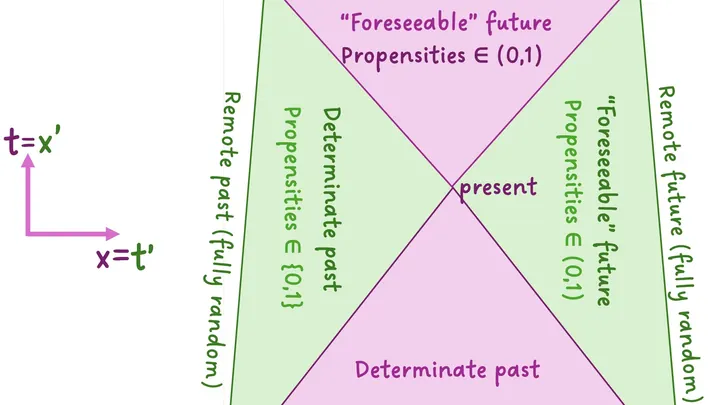
According to the laws of physics, nothing can outrun light, otherwise for some observers the effect would occur before the cause. Artur Ekert and Andrzej Dragan showed that this situation creates an uncertainty resembling quantum indeterminacy.
Astronomers, including Vera Rubin, noticed that stars on the outskirts of galaxies rotate faster than visible mass allows. To explain this, they invented dark matter — an invisible ballast. But there's another possibility: gravity isn't always the same.
Quantum mechanics is a linear theory. This property is so fundamental that violating it would mean losing the superposition principle and, consequently, the possibility of superluminal information transfer. But physicists have long suspected that at a deep level, where gravity meets quanta, linearity might not survive.