A sequence of functions fn converges to f uniformly on a set E if for any ε>0 there exists N such that for all n≥N and all x∈E, |fn(x) - f(x)| < ε. This is stronger than pointwise convergence, where N may depend on x. Uniform convergence implies the limit function is continuous if the fn are continuous, and allows termwise integration on a finite interval.
History
The rigorous definition appeared in 1870 in the works of Eduard Heine, based on Weierstrass's lectures. Weierstrass showed that the series ∑bk cos(akπx) for certain ak, bk converges uniformly, but its sum is nowhere differentiable — this shattered intuition about the connection between smoothness and convergence. Henri Poincaré in the 1880s used uniform convergence in the theory of automorphic functions and differential equations, and later the concept became part of the foundation of functional analysis through spaces C(X) with the uniform norm.
How it works
The key tool is estimation of the supremum. Weierstrass M-test: if |fn(x)| ≤ Mn and ∑Mn converges, then ∑fn converges uniformly (and absolutely). Uniform convergence is closely related to compactness: on a compact set, a pointwise convergent sequence may not be uniform, but from any uniformly bounded and equicontinuous sequence one can extract a uniformly convergent subsequence (Arzelà–Ascoli theorem). In numerical methods, uniform convergence ensures stability of approximation under parameter variation.
In practice
When designing an airplane wing, engineers expand flows into Fourier series; uniform convergence ensures that the approximation is equally good at all points of the profile.
Fun fact
The Fourier series of a continuous function can converge non-uniformly, and before Weierstrass's work, many believed this was impossible. The mistake cost several false proofs.
A drop of ink spreads in a glass of water: its edges move faster than its center, and the drop's shape changes. Likewise, a clump of dark matter collapsing under its own gravity expands unevenly, with different shells flying apart at different speeds. Previously, astrophysicists could accurately describe only the simplest case, a uniform sphere with a sharp boundary, which has a single expansion rate.
Imagine an interferometer as a giant ear listening to the radio whisper of a distant galaxy. Three antennas spread across continents capture the signal, and the difference in their phases combines into a quantity that is immune to atmospheric jitter. This quantity is called the closure phase.
A handful of coins drops onto a table — heads and tails land wherever they please. The same goes for an instantaneous snapshot of a quantum chain: in some places a particle is present, in others it is not. But behind the disorder lurks a precise angle.
In this work, a chain of particles closed into a ring was considered. It was divided into four arcs: two were measured, two were left untouched.
A quantum particle moves in a circle, passing through several stations. At each station, something happens to it — for example, its properties change slightly. After completing a full circle, the particle returns, but its state is no longer exactly what it was at the start.
A neural network predicts the future of a system — say, how plasma will swirl in a magnetic field or how a face in a video will change. Errors are inevitable, and the further it looks ahead, the more they accumulate. Checking against the correct answer during operation is impossible: it simply doesn't exist.
The quantum vacuum is not empty: it is permeated by entanglement linking distant regions. But when physicists tried to compute this entanglement, it turned out to be infinite. The culprit: particles with very low energy that can smear out over arbitrarily large volumes. They are like waves with no shores to contain them.
A protein in a cell is not a frozen sculpture but a restless mechanism. Its parts are constantly vibrating, and these movements determine how it grabs molecules, transmits signals, or builds the cellular scaffold. But filming the life of a single protein was hampered by two nuisances at once. First, the movements last millionths of a second — ordinary cameras simply cannot catch them.
A large neural network like Whisper masters hundreds of languages and resembles the standard model of the universe: everything is balanced. But training on a rare language disrupts this equilibrium — it turns into a black hole, pulling in all training resources. The network starts forgetting the other languages.
Imagine a ball in an unfamiliar hall: two guests start from opposite corners. Their movements are not a smooth waltz but chaotic improvisation in search of rare treasures. Contrary to intuition, the outcome hinges not on tempo but on the geometry of the floor.
A geometer runs a finger along an invisible surface, and by how the geodesics bend, lifts its fingerprint. That fingerprint can be the maximum normal curvature κ(F): the largest curvature among all geodesics passing through a point of the immersed manifold.
2 is the threshold beyond which a well-behaved sequence risks losing its structure.
Instead of the usual uniform scale, picture a rubber ruler with uneven elasticity. That's exactly how Orlicz spaces work: Banach spaces of sequences where each scale has its own stiffness, described by a convex Young function (a kind of spring).
A stone falls into a pond, and ripples spread across the water. Long waves and short ones travel at the same speed: that's how ordinary sound behaves in almost any medium. But in quantum liquids, things can be different.
Physicists considered a superfluid where particles move along a "flat" energy band.
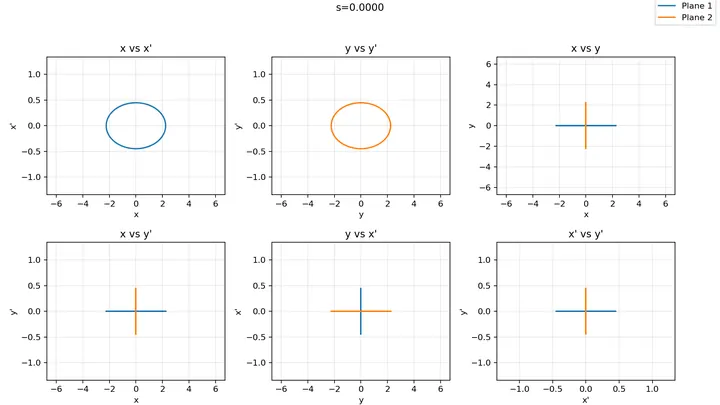
Particles in an accelerator can oscillate in two transverse directions at once, and these oscillations are not always independent. If you give a pendulum a push in one direction and it starts swinging sideways as well: that's coupled oscillations. In accelerators, this happens due to magnet imperfections or special insertions, making particle motion complex.
The wind blows steadily, but suddenly a gust hits, and leaves swirl up in a vortex. Inside such a gust, the air speed changes not smoothly but in jumps — sometimes sharply forward, sometimes sideways. These rare and strong bursts are called intermittency, and they are the main mystery of turbulence.
At the edge of spacetime, where all light rays end, live symmetries that physicists have debated for half a century. They are called superrotations, transformations of the celestial sphere that diverge at isolated points, like vortices in superfluid helium.
A team assembling a jigsaw puzzle from random pieces: how many simultaneous moves does it take to complete the picture? If the pieces are independent, they all go down at once. If each piece depends on the previous one, you have to work one at a time. So it is with systems: some states assemble instantly, others require a long sequential effort.
Fog thickens over the line "def max(a: Int, b: Int): Int". What does it do? It returns the larger of two numbers, but how can you verify that? You could write a dozen tests with specific pairs: max(2,3)=3, max(5,5)=5, max(-1,0)=0. Still, a nagging doubt remains: what if it breaks for, say, a million and minus a million?