A reference beam is a well-characterized light beam used in interferometry and holography. It is combined with a signal beam (often reflected or scattered from a sample) to create an interference pattern. The pattern encodes the phase and amplitude differences between the two beams, allowing precise measurement of distances, surface shapes, or optical properties. This technique is fundamental to many precision measurement tools, from gravitational wavedetectors to surface profilometers.
History
The concept of a reference beam dates to the early 20th century with the development of interferometry, notably by Albert Michelson. The term became prominent with the invention of holography by Dennis Gabor in 1948, where a reference beam is essential for recording and reconstructing wavefronts.
How it works
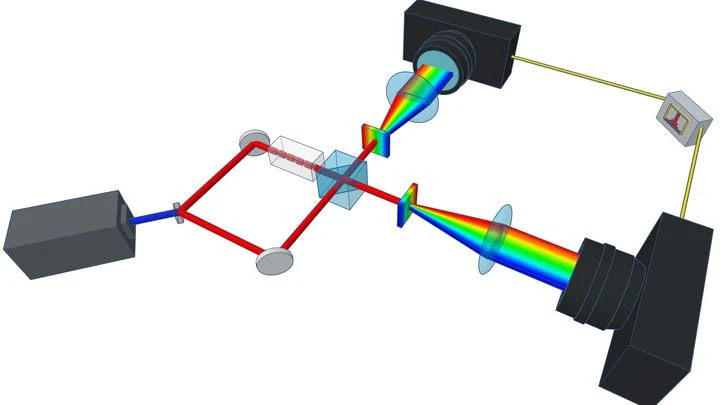
The reference beam is typically split from the same laser source as the signal beam, ensuring coherence. When the two beams recombine, their electric fields add, producing bright and dark fringes depending on the phase difference. By analyzing the fringe pattern—either spatially or temporally—one can extract the phase shift introduced by the sample. In holography, the interference pattern is recorded on a medium, and illuminating it with the reference beam reconstructs the original wavefront, creating a three-dimensional image.
In LIGO, the reference beam travels along a 4-kilometer arm, and the interference pattern shifts by less than a thousandth of a proton's width when a gravitational wave passes.
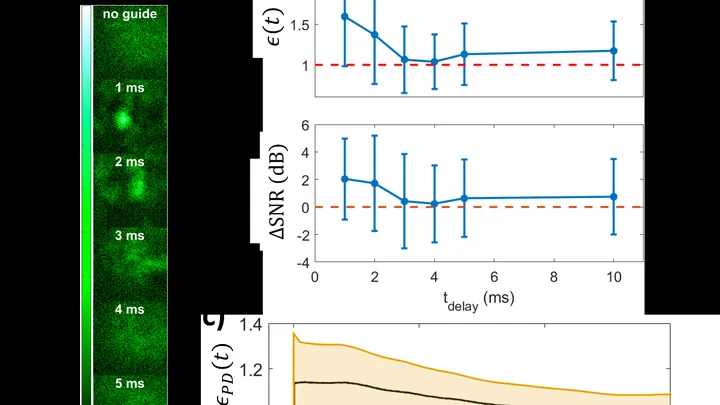
An ordinary flashlight shines in all directions, and after just a couple of dozen meters its beam fades so much it barely lights a wall. The atmosphere scatters light, and wind and heat currents distort it even more. But if you lay an invisible pipe for light right in the air, the beam will travel through it like water through a hose.
Two photons meet at a half-silvered mirror. If they arrive at exactly the same time, they always leave together — side by side, like twins who refuse to be parted. This effect, discovered in 1987, became the basis of a quantum ruler for measuring tiny delays.
When a radio wave encounters a building in its path, it doesn't just reflect or get absorbed: it bends around it, much like ocean waves flowing around a rock, leaving calm water behind. In radiophysics, this phenomenon creates a radio shadow — a complex pattern of zones where the signal is amplified or attenuated, which scientists call a radio portrait.
The Universe is pervaded by an invisible substance — ultralight dark matter, which doesn't collide with ordinary matter but can tremble like a taut string. Its oscillations alter the world's most fundamental properties: the electron charge, the speed of light — as if the tuning of a single cosmic note slightly drifts.
A drummer stays silent, but from the pauses you can tell where he didn’t hit. Similarly, physicists built an image by catching not light, but moments of absolute darkness. The picture emerged from silence.
In the experiment, they shone light from an ordinary lamp onto the object.
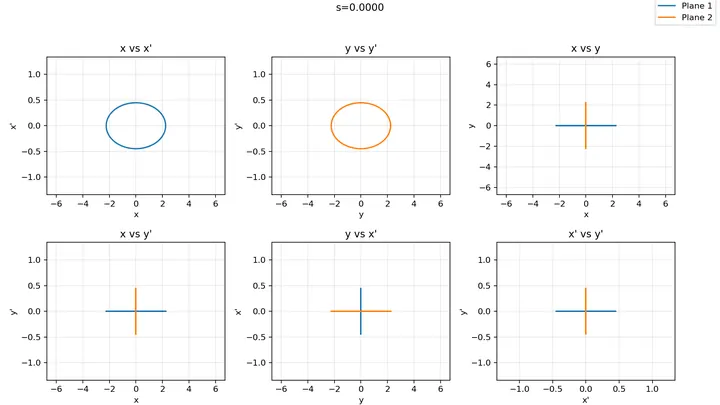
Particles in an accelerator can oscillate in two transverse directions at once, and these oscillations are not always independent. If you give a pendulum a push in one direction and it starts swinging sideways as well: that's coupled oscillations. In accelerators, this happens due to magnet imperfections or special insertions, making particle motion complex.