physics.acc-ph physics.acc-ph

35 articles

articles

Plasma Physics2026-01-041 minarXiv:2601.01367express
How a Gold Accelerator Stopped Falling Apart
A heavy ion beam in an accelerator is like a crowd of people shoving each other with elbows: the more people, the wider the crowd. Charged particles repel each other, and at currents above a few microamps the beam spreads and loses its shape.
physics.acc-ph2026-01-201 minarXiv:2601.13517express
How to Paint a Beam in an Accelerator
In a ring accelerator, particles race around in circles like cars on a roundabout. Normally, when new particles are injected, they take random spots on that roundabout — the beam becomes 'fluffy.' In a new experiment at the SNS accelerator, the eigenpainting method was applied: particles were injected so that they only entered one 'lane'—a single oscillation mode…
physics.acc-ph2026-01-261 minarXiv:2601.18719express
Catching the Shivers: How to Detect Ultra-High-Frequency Gravitational Waves
Pluck a guitar string, and it vibrates — the air around it carries the tremor to your ear. Spacetime vibrates differently: when a gravitational wave passes through, it stretches and squeezes slightly. Spotting such a tremor at frequencies from 10 kilohertz to 100 megahertz is the challenge that new detectors are being built for.
physics.acc-ph2026-01-272 minarXiv:2601.19579express
Mirror Bounces Light Back and Creates Gamma Rays
In a particle accelerator, electrons race around a ring at nearly the speed of light. When such an electron collides with a photon, a particle of light, the photon bounces off like a ball hitting a moving truck and flies away with much greater energy.
physics.acc-ph2026-01-272 minarXiv:2601.19865express
A Laser Wall for Particle Beams
In giant particle accelerators, particles fly at nearly the speed of light and smash head-on. But sometimes one beam is slightly denser than the other, like someone stepping onto a packed escalator the wrong way. Then collisions become uneven, and detectors start 'flickering,' throwing off measurements.
physics.acc-ph2026-01-282 minarXiv:2601.20997express
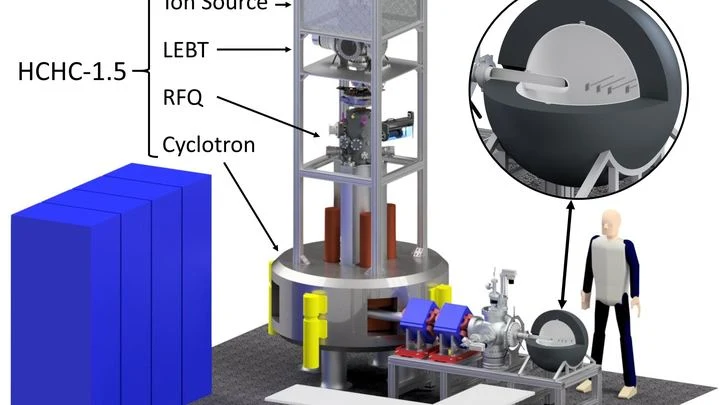
A hospital cyclotron instead of a nuclear reactor
Every year, in the United States alone, doctors perform more than 16 million scans using the radioactive isotope technetium-99m. It lights up the heart, bones, and lungs in images, helping to find tumors or check blood flow. But the isotope itself has a half-life of only six hours, so you can't stockpile it: you need a steady supply.
physics.acc-ph2026-02-021 minarXiv:2602.01504express
Electron beam trapped in a ring the size of a dinner plate
A ring the size of a dinner plate made an electron beam run in circles. Its diameter is 22 centimeters, and a full turn takes just 4.7 nanoseconds. To put that in perspective: in one second, such an electron would complete more than two hundred million laps.
physics.acc-ph2026-02-061 minarXiv:2602.06684express
Beam Instability in Plasma Accelerators
In a plasma accelerator, particles are accelerated like surfers riding a wave created in the plasma. If the leading bunch and the trailing bunch are not aligned, an instability arises that shakes the trailing bunch. It's as if a surfer on a wave starts wobbling from side to side: their trajectory gets messed up, and they might fall off the wave.
HEP Phenomenology2026-02-111 minarXiv:2602.10562express
How LHC can hear dark matter
Hidden in the heart of the Alps is the Large Hadron Collider. From time to time its detectors register sudden bursts — scientists call them UFOs (Unidentified Falling Objects). According to one theory, these are not equipment malfunctions at all, but traces of dark matter.
physics.acc-ph2026-02-131 minarXiv:2602.12765express
An Electron Beam as Fine as a Pencil
An electron beam can be compared to the light from a laser pointer: if it diverges, the spot on the wall quickly spreads out. In the lab, physicists created such a narrow beam that it remained thin over a long distance, like the beam of a good pointer.
Plasma Physics2026-02-132 minarXiv:2602.13408express
Laser Beam in a Plasma Channel: How to Measure Its Speed
A laser pulse racing through plasma is like a runner carving a path through a crowd. It shoves electrons aside, leaving behind a rarefied channel, just as the crowd parts for a sprinter. In this channel, the crest of the light wave moves slightly faster than light in a vacuum, and it is this speed that determines how efficiently the pulse transfers energy to particles.
physics.acc-ph2026-02-141 minarXiv:2602.13743express
Harmonic Laser: Compact Light Without Compromises
An ordinary free-electron laser is like a musical instrument with a single string: it can play only one note until you change its design. To get a different wavelength, you have to retune magnets or accelerate electrons harder. That's expensive and bulky.
physics.acc-ph2026-02-221 minarXiv:2602.19081express
Light from a Perfectly Even Stream
Modern X-ray light sources are like an orchestra without a conductor: electrons in the beam fly every which way, and the radiation comes out blurry. The new idea is to make electrons line up in neat rows with a spacing of a few nanometers. Then the light they emit becomes coherent, like a laser beam.
Plasma Physics2026-02-241 minarXiv:2602.20564express
A Levitating Magnet in a Fusion Reactor
Inside a future fusion reactor, a magnet weighing as much as a small car will float. It holds the superheated plasma like an invisible hand holding a cloud. Previously, such a magnet was considered unsuitable for deuterium-tritium fuel: neutron fluxes would quickly destroy it.
physics.acc-ph2026-03-041 minarXiv:2603.04052express
Plasma Cleans Accelerators Like Steam Scrubs a Pan
Inside large particle accelerators, there are hollow metal chambers where beams are accelerated. Over time, grime settles on their walls, like in an old pan. This grime prevents the accelerator from running at full power. To restore the accelerator's strength, plasma, a glowing gas of argon or neon with a bit of oxygen, is sent into the chamber.
physics.acc-ph2026-03-042 minarXiv:2603.04195express
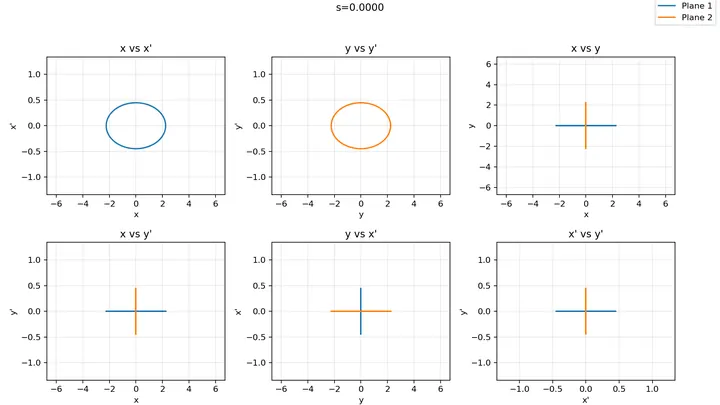
Coupled Oscillations of Particles in an Accelerator
Particles in an accelerator can oscillate in two transverse directions at once, and these oscillations are not always independent. If you give a pendulum a push in one direction and it starts swinging sideways as well: that's coupled oscillations. In accelerators, this happens due to magnet imperfections or special insertions, making particle motion complex.
Medical Physics2026-03-072 minarXiv:2603.07103express
The Radiation Scalpel Gets Sharper
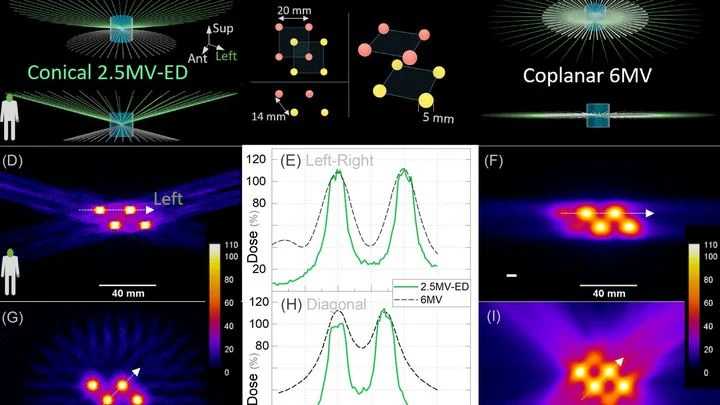
Radiation therapy is like shooting at a small target with a very large-caliber rifle: even a precise shot hits a large area around it. The thickness of the 'trace'—called the penumbra — is 2–3 millimeters in standard machines. For a tumor in the lung, that's not a big deal, but next to a nerve or a blood vessel, those millimeters decide whether a person stays healthy.
physics.acc-ph2026-03-161 minarXiv:2603.15996express
Laser Printing of Electron Bunches
A typical accelerator is like an assembly line where electrons are the workpieces. To get the desired X-ray pulse, the workpiece is fine-tuned after it's already on the line: squeezed, filtered, corrected. In the new work, engineers decided to take a different approach — shaping the workpiece before it even hits the conveyor. At LCLS-II, electrons are knocked out of a metal by a short laser pulse.
physics.acc-ph2026-03-291 minarXiv:2603.27692express
The beam squeezes itself
An electron beam in an accelerator is like a flock of birds: it flies in a tight group, but over time it spreads out. To keep particles together, heavy magnets are usually used. Here they did without them — the beam squeezed itself.
physics.acc-ph2026-03-301 minarXiv:2603.28549express
Digital Twin Teaches a Laser to See
A laser strikes a tiny glass grating, and electrons passing through it are accelerated. You can't see inside, so you judge what's happening by the energy of the electrons after acceleration, like judging the shape of a stone by the splash it makes. Scientists built a digital twin: a computer model that mimics the behavior of the real accelerator.
The Reactor That Eats Its Own Fuel
An ordinary nuclear reactor is like a boiler where fuel burns evenly throughout the volume. Here the picture is different: a fission wave, a narrow zone where atoms split and release heat, slowly creeps along a cylindrical rod of uranium carbide. Ahead of the wave, the fuel is untouched; behind, it is already spent. So fire runs along a candle wick, leaving wax behind.
physics.acc-ph2026-04-111 minarXiv:2604.09969express
Attosecond X-ray Flashes from an Accelerator
An ordinary camera flash lingers for hundredths of a second, but for atoms, that's an eternity. Inside molecules, electrons jump in attoseconds: billionths of a billionth of a second. To capture that, you need a light pulse shorter than the event itself. Physicists take an electron beam in a linear accelerator and compress it so that individual bunches become thinner than a hair — in time.
physics.acc-ph2026-04-171 minarXiv:2604.16189express
Instrumentation2026-04-232 minarXiv:2604.21846express
A Sensitive Thermometer for X-rays
An X-ray beam is a stream of tiny packets of energy, photons. Ordinary detectors count them but don't distinguish shades: two photons with close energies look the same to them. The new device works like a sensitive thermometer: it catches each photon and measures how much it warms a thin film. From the warming, you can tell exactly how much energy the photon brought.
physics.acc-ph2026-05-132 minarXiv:2605.13065express
A Proton Shower in a Single Breath
A long, narrow garden bed needs watering, but you can't move the hose: you can only turn the water on and off. If you just open the tap, water flows in a steady stream and floods everything at once. But if you quickly flip the lever, you can send short bursts of water: each landing exactly where it's needed.
HEP Phenomenology2026-05-261 minarXiv:2605.26432express
How Heavy Electrons Ignite an Artificial Sun
Atomic nuclei are wrapped in fluffy electron coats — in such attire, they can't get close enough to embrace. But swap the light coat for a heavy one: a muon, a particle from the standard model, shrinks the cloud by nearly 200 times.
A Proton Beam Instead of an Umbrella
On a scorching afternoon, a stifling haze hangs over the city, and not a single cloud is on the horizon. Usually, in such weather, all you can do is wait for nature to take pity and send some cool relief. But what if shade and rain could be switched on schedule, like a light in a room?
Plasma Physics2026-06-052 minarXiv:2606.07147express
Industrial laser accelerates electrons
A factory laser that cuts and welds metal on production lines has been made to work as a particle accelerator for the first time. Physicists took a standard ytterbium laser, its heart is a crystal the size of a palm, and turned its flashes into a tool for accelerating electrons to nearly the speed of light.
Plasma Physics2026-07-071 minarXiv:2607.06458express
How to Wake Up Plasma with a Proton Bunch
A proton bunch flies into a plasma cloud, and leaves behind an invisible trail: an electric wave. This wave can pick up other particles and accelerate them to enormous energies. But controlling it is tricky: there are too many details in plasma behavior.
HEP Phenomenology2026-08-061 minarXiv:2608.05698express
How Light Twists an Electron's Spin
A laser beam is like a swift vortex that briefly captures a passing electron. As the particle moves through the pulse, its spin (the intrinsic rotation, like a tiny top) experiences a weak kick. After leaving the beam, the top no longer points in the same direction; it has turned a little.
physics.acc-ph2026-08-121 minarXiv:2608.11934express
How an Electron Beam Keeps Its Shape
In a ring accelerator, a beam of electrons circles millions of times. If the electrons are twisted like strands in a rope, their vortex motion should persist. But along the way, random jolts from imperfect magnets can disturb them. Scientists have described how vortex motion changes under such perturbations.
physics.acc-ph2026-08-151 minarXiv:2608.15106express
Two Beams from One Bunch
A shooter aims at a target, pulls the trigger, and hears two shots: one loud, one quiet. That's how the new setup works, except instead of bullets, there's an electron bunch, and instead of shots, there are two flashes of light. One flash is X-ray, the other is terahertz. They fly to the same point with perfect timing.
physics.acc-ph2026-08-181 minarXiv:2608.17554express
A Table-Sized Particle Accelerator
For three days straight, a laser blasted a jet of gas, and every second it produced a beam of electrons with the energy of a tiny lightning bolt. Previously, such beams could only be produced in huge halls where the accelerator takes up an entire building. Now the whole setup fits in a room and ran without a glitch for 72 hours.
A Pinhole That Sees Chemistry: 3D Element Maps in a Single Shot
In a dark room, a sunbeam passes through a pinprick in cardboard, and an upside-down image of the street appears on the wall. A pinhole camera needs no lenses: the tiny hole itself selects the rays coming from each point of the scene. Scientists at the ESRF applied this principle not to light but to X-rays, and made the camera see not shape but chemical composition.
Plasma waveguide for twisted electrons
A laser pulse slams into a gas cloud and knocks electrons out of it, leaving behind a bubble: a cavity almost devoid of particles. This bubble races through the plasma at nearly the speed of light, and its walls drag along the electrons trapped inside, much like a speedboat tows a water skier.