A pendulum is a weight suspended from a pivot so it can swing freely. When displaced from its equilibrium position, gravity provides a restoring force that causes it to oscillate back and forth. The period of a simple pendulum — the time for one complete swing — depends only on its length and the local gravitational acceleration, not on the mass of the bob or the amplitude (for small swings). This remarkable property makes pendulums precise timekeepers and sensitive instruments for measuring gravity.
History
Galileo Galilei observed the isochronism of pendulums around 1602, and Christiaan Huygens built the first pendulum clock in 1656. The theory was refined by Newton and later by mathematicians like Euler and Lagrange.
How it works
The pendulum's motion is governed by the balance between gravitationalforce (pulling the bob downward) and the tension in the string or rod (constraining it to move along an arc). For small angles, the motion is approximately simple harmonic: the restoring force is proportional to the displacement, leading to sinusoidal oscillations. The period is T = 2π√(L/g), where L is the length and g is gravitational acceleration. For larger amplitudes, the period increases slightly, a correction that can be calculated with elliptic integrals.
In practice
Pendulums are used in clocks, seismometers, and gravimeters; Foucault's pendulum demonstrates Earth's rotation. In modern physics, torsion pendulums measure weak gravitational forces and test the equivalence principle.
Fun fact
A pendulum's period is independent of the mass of the bob, which is why a heavier pendulum swings at the same rate as a lighter one of the same length.
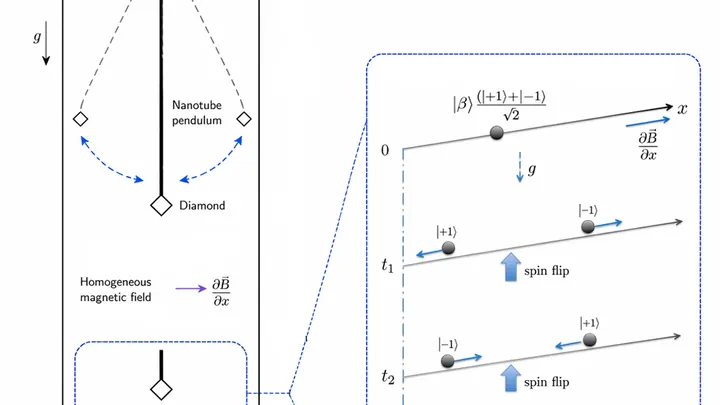
Two tiny diamonds float in a vacuum, separated by a distance that light cannot cross during the experiment. Inside each, like a frozen spark, resides an entangled spin — a quantum state linking them into a single whole. Now the diamonds begin to move, but not just any motion: each one seems to split, existing in two places at once.
A pendulum weighing a few grains of sand swings on a hair-thin glass fiber. Its motions are so faint that the thermal jostling of air molecules seems like a hurricane. Yet such a pendulum is the key to witnessing quantum wonders in the world of large objects.
A massive aluminum cylinder weighing a ton hangs in a vacuum. A gravitational wave, a ripple in spacetime, passes through it, and the bar begins to tremble almost imperceptibly. That trembling can be heard as sound: gravitational waves turn into a phonon — a quantum of sound vibrations.
A quantum particle traveling around a closed ring leaves two distinct 'records' along its path. The first is like a fingerprint on a doorknob: it remains unchanged no matter how many times you turn the knob, and it only tells you about the shape and material.
Quantum objects live in a world of superpositions — being here and there at the same time, with one spin and another. But as soon as they gain enough mass, this magic fades. Roger Penrose suggested that gravity itself is to blame.
Two balls suspended on threads swing side by side. Each moves on its own, but between them is an invisible thread — the attraction of masses. If gravity is quantum, it could bind them into a single whole: nudge one, and the other responds, even without contact.
A coin spinning on a table is a familiar sight. At first it rotates quickly, then it tilts, and its rattling becomes faster and faster. In the last seconds it seems to hover: the rotation slows, but the coin just won't finally lie flat. This final moment is a real puzzle for physicists.
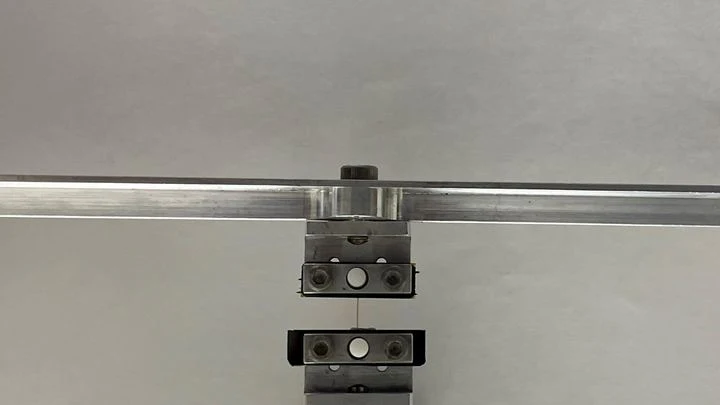
A weight about the size of a small apple hangs from a thread hundreds of times thinner than a human hair. The thread doesn't snap and barely interferes with the weight's swinging. This setup is the heart of a new lab scale for measuring gravitational attraction.
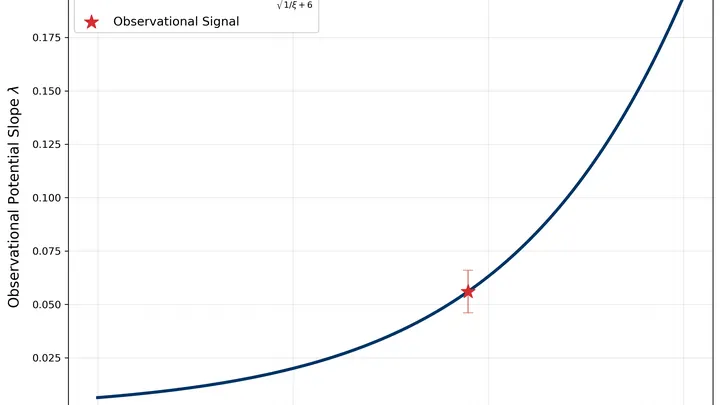
Modern telescopes see distant galaxies flying apart faster and faster. The cause is called dark energy, but its nature has been a mystery. On top of that, calculations of the expansion rate in the early and late Universe don't match. The answer might lie in an event much like a falling pencil.
Two particles can become linked so that a nudge on one instantly reverberates in the other, even if they are separated by galaxies. Einstein called it "spooky action at a distance." Physicists wondered: can gravity itself, a simple mutual attraction, create such a connection?