Tuning the Universe: How to Make the Spectrum Perfectly Flat express
In its first moments, the Universe expanded faster than light could cross it. This process, inflation, left behind ripples — tiny density fluctuations from which galaxies later grew. The spectrum of these ripples is usually described by a number: if it is exactly 1, then all fluctuations, large and small, were equally strong.
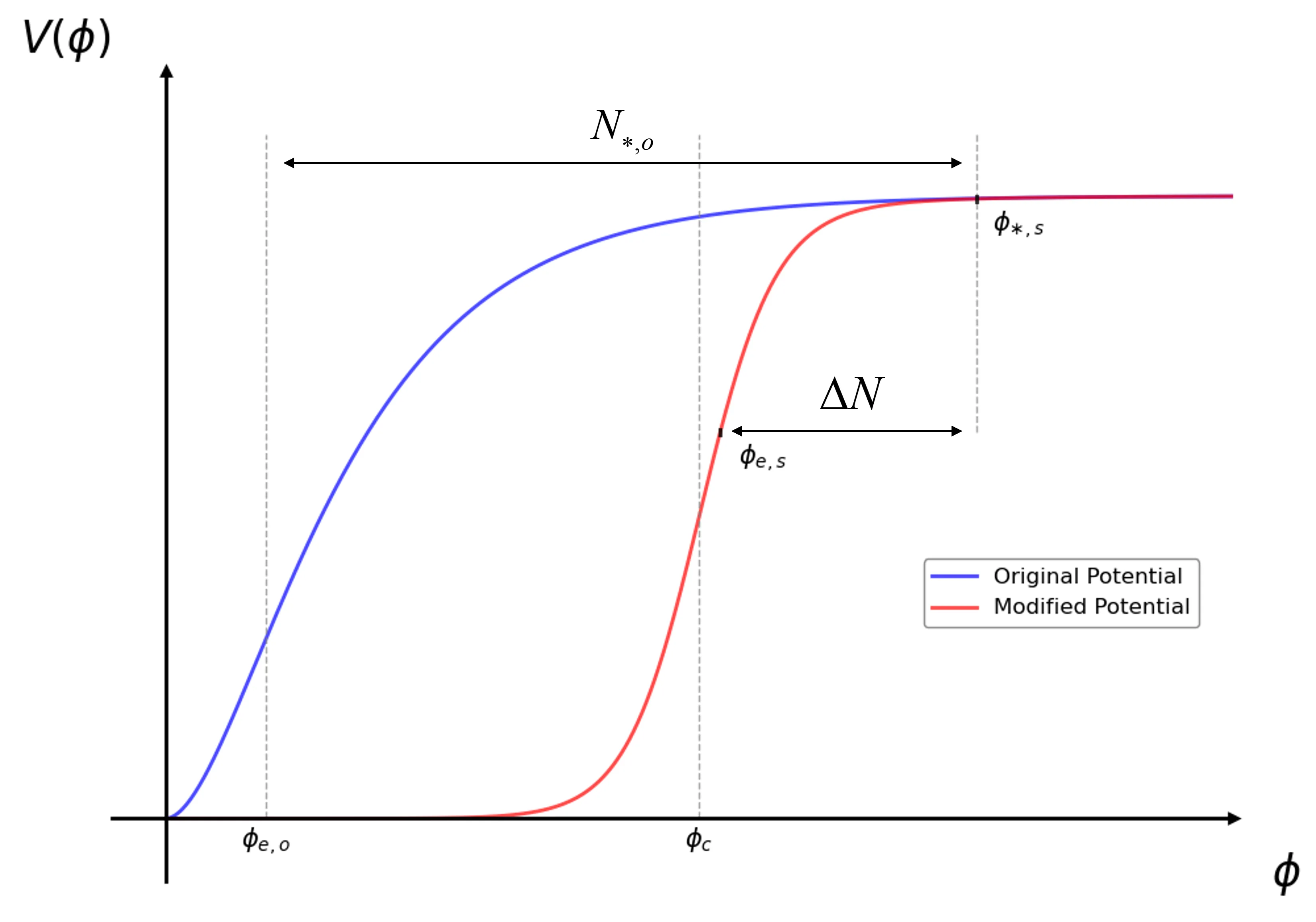
Observations give a value slightly less than 1, but recent attempts to settle the debate over the expansion rate require exactly 1. The authors propose a simple way out: let inflation end not smoothly but with a sharp drop, like a ball rolling down a hill suddenly falling off a cliff. Then even in the simplest models, such as chaotic inflation or the Starobinsky model, the desired spectrum emerges.
This scenario requires no complicated additions and stays within a single scalar field. If future observations confirm the value of exactly 1, it would be a strong argument for models with a sudden stop of inflation.
A spectral index of exactly 1 means the Universe showed no preference for large or small details, like perfectly mixed dough with no lumps.