Starobinsky inflation is a cosmological model that explains the rapid exponential expansion of the universe in its earliest moments, known as inflation. It modifies Einstein's general relativity by adding a term proportional to the square of the Ricci curvature scalar (R²) to the action. This extra term acts like a scalar field—the 'inflaton'—that drives inflation naturally, without introducing new particles. The model predicts a specific spectrum of primordial density fluctuations, which seed the formation of galaxies and the cosmic microwave background.
History
The model was proposed by Alexei Starobinsky in 1979, before the term 'inflation' was coined, and it remains one of the most successful inflationary models.
How it works
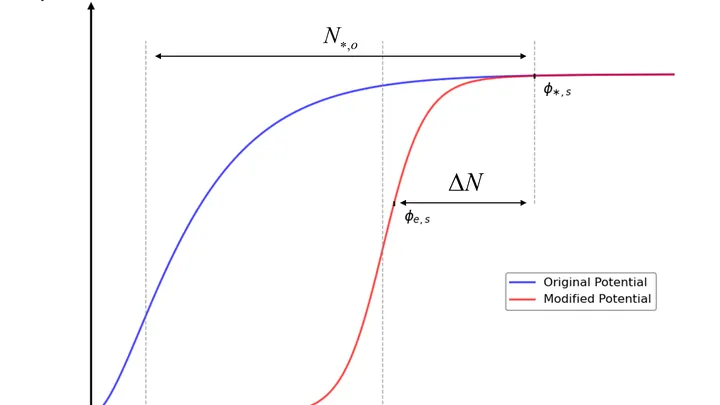
The R² term in the gravitational action leads to a modified field equation that, in the early universe, behaves as if there is a scalar field with a potential that has a flat plateau. During inflation, the field slowly rolls down this plateau, causing the universe to expand exponentially. As the field reaches the steeper part of the potential, inflation ends, and the field oscillates, converting its energy into particles—a process called reheating. The model's predictions for the primordial power spectrum (tilt and tensor-to-scalar ratio) are consistent with observations from Planck and other missions.
In practice
It is used as a benchmark in cosmology to test inflationary theories against observational data from cosmic microwave background experiments.
Fun fact
Starobinsky's model was initially proposed as a quantum correction to gravity, not as an inflationary theory, and its inflationary nature was recognized later.
When you blow up a balloon too quickly, its surface starts to quiver. Something similar happened to space in the first moments after the Big Bang: the universe expanded rapidly, and the very fabric of space began to ripple.
In the first moments after the Big Bang, the universe underwent a rapid expansion — inflation. Space stretched faster than light, and quantum jitters of the vacuum turned into real particles. This is how dark matter, the invisible substance that holds galaxies together, could have been born.
The early Universe was like a tightly coiled spring. In the first moments, it expanded at an unimaginable rate — a phase called inflation. Usually, this is attributed to a special field, but there's another idea: spacetime itself twists like a spring, and this twisting (in physics, torsion) becomes the engine of expansion.
Gravity is a remarkably weak force. A small magnet holds a paperclip against the pull of an entire planet. Physicists have long sought the reason for this weakness, and one guess leads us into hidden dimensions. Perhaps gravity 'leaks' into them, losing strength in our three-dimensional world.
In the first moments after its birth, the universe expanded faster than a match lights. This process is called inflation. It explains why today's cosmos is so homogeneous and flat. But what happened before it? Perhaps the laws of quantum gravity were at work then, and their traces can be found in the data.
Imagine a pot of boiling water. Toss in a handful of pasta, and it quickly overcooks and clumps into a sticky mess. But in a huge restaurant kettle where the pasta floats freely, each piece stays separate.
The first three minutes after the birth of the world are a cosmic kitchen where nature cooked the lightest atomic nuclei. The recipe is set by gravity: it controls the cooling rate of the hot 'broth' of particles. If gravity worked differently than we are used to, the dish would have turned out different — with different amounts of helium and deuterium.
Gravity isn't just the force that keeps us on the floor. On cosmic scales, it conducts galaxies, bends light rays, and decides the fate of everything. A century ago, Einstein described it as the curvature of space and time.
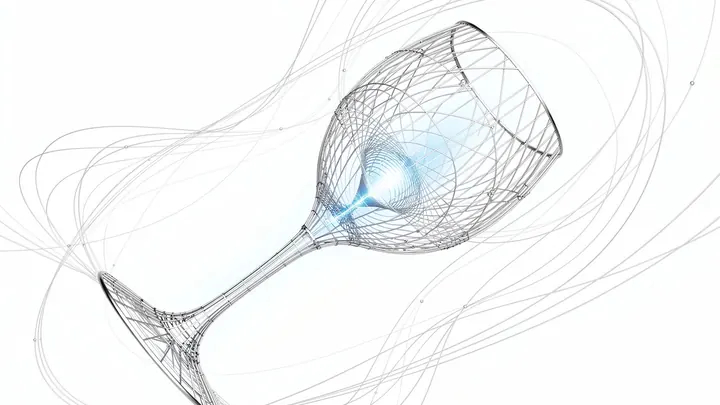
Picture the early Universe as an unimaginably large bell. Inflation — the era of rapid expansion, dreamed up by Alan Guth, strikes it, sending a wave rippling across the fabric of spacetime.
A quantum wave is like a long-exposure photograph: everything’s blurred, but the blur itself reveals motion. Usually these frozen waves are treated as convenient abstractions. Yet if at each point in the image you estimate, by brightness, the moment on the particle’s internal clock it landed there, flat space suddenly acquires curves.
In the first moments after the Big Bang, the universe underwent a rapid expansion — inflation. Like a balloon inflated not uniformly but with tiny pulsations, it stretched billions of times over a fraction of a second. These pulsations froze into density ripples, from which galaxies later grew.
A new tuning fork for the cosmic symphony sounded from the Chilean highlands: the ACT telescope refined the note of primordial perturbations — the spectral index nₛ shifted upward, disrupting the harmony of many previous models.
In the first moments, the universe expanded at an unimaginable rate — a phase called inflation. It is thought that particles of dark matter, the invisible substance that holds galaxies together, could have been born from the vacuum during this time. But what determines exactly how many are produced?
The authors considered a model with two fields.
The very first moments of the Universe's life resemble tuning a complex musical instrument. Quantum fluctuations, stretched by rapid inflation, became the 'notes' from which galaxies later formed. In the new work, physicists considered an unusual opening chord — a superoscillating state.
When an orchestra is just tuning up, disjointed sounds drift through the hall, but as soon as the conductor raises the baton, chaos turns into a symphony. Much the same can be said for the beginning of our Universe. In its first moments, it expanded at an unimaginable speed — faster than light could cross it.
The birth of the universe resembles not an explosion, but a traffic jam. At first, a tiny fraction of a second after the Big Bang, space expanded sluggishly, like cars stuck in gridlock. Then came a sharp surge — accelerated expansion, which cosmologists call inflation.
Baking bread starts with nearly homogeneous dough, in which tiny gas bubbles are already hidden. They grow, and the rate of their growth determines the future structure of the crumb. In cosmology, the role of such bubbles is played by the seeds of galaxies — barely noticeable density enhancements in the hot 'soup' of the early universe.
Cosmology is going through strange times. On one hand, the standard model with dark matter and dark energy beautifully describes the large-scale structure. On the other, it's cracking at the seams.
Cosmology has long sought a loophole behind the Big Bang. Inflation, proposed by Alan Guth, stretches and smooths out primordial inhomogeneities, but what lit the fuse itself?
A pendulum chooses how to swing on its own. If you give it a strong push, it quickly returns to a smooth rhythm. If you hold it at its extreme position, it will stay there, but as soon as you let go, it resumes its usual motion.
The quantum birth of the Universe is like a game of dice, where the chance of rolling a six is catastrophically small. The formalism of Hawking and Hartle, an elegant recipe for a world born from timelessness, has spent decades predicting that a universe like ours is fantastically improbable.
The mystery of dark energy is a chasm. Quantum field theory predicts a density 10¹²⁰ times larger than observed. In the string landscape, this abyss takes shape — myriads of vacua with different energies, and we are nestled in one of them.
Right after the Big Bang, space rippled with gravitational waves, like those from a thrown stone. These tremors in the very fabric of the cosmos, predicted by Alan Guth, stretched across the entire universe. The ripples slightly compressed primordial matter in some places and thinned it out in others.
The idea of inflation, the superfast expansion of space just after its birth, was proposed by Alan Guth in 1980. It explained why our world is so uniform. But fresh snapshots of the Big Bang from the ACT telescope showed a pattern that slightly didn't match the predictions of two leading models.
Usually, the story of the universe goes like this: there was nothing, then a bang, and ever since everything has been flying apart. But what if there was no 'nothing'? A group of physicists has shown that the universe could have existed forever: it just sometimes contracts and then expands again, like a spring.
A balloon is being inflated faster and faster. At first, it stretches smoothly, but at some point, the pump stutters — the speed drops, then picks up again. During this brief respite, tiny bubbles appear on the rubber. As inflation resumes, they turn into dense knots.
Something similar happened to the universe itself right after the Big Bang.
A balloon in your hand springs back equally in all directions. But a bottle of soda behaves differently: along the neck it is stiff, while across it is easily squeezed. This is roughly how pressure works inside some stars: it can be unequal in different directions. Such stars are called anisotropic, and their behavior has so far been described by disparate methods.
To understand how the universe emerged from the Big Bang, physicists look to Georges Lemaître's idea of expansion, which rests on the laws of Hendrik Lorentz. One daring approach replaces elementary particles with giant tables of numbers — as if instead of the usual roulette balls, you use numbered cards.
Humanity is a pot on a stove. Sixty years of data show: the heat is being turned up faster than astrophysicist Nikolai Kardashev expected — about 2% per year, not 1%. But even so, the pot will never hold an ocean: to harness all the energy of the Sun with even heating would take a time comparable to the age of the Universe.
In its first moments, the Universe expanded faster than light could cross it. This process, inflation, left behind ripples — tiny density fluctuations from which galaxies later grew. The spectrum of these ripples is usually described by a number: if it is exactly 1, then all fluctuations, large and small, were equally strong.
The James Webb Space Telescope has spotted ancient galaxies harboring supermassive black holes — far too massive for their young age after the Big Bang. There wasn't enough time for normal growth, so they must have formed differently.
A wormhole is a hypothetical tunnel that shortens the path between distant corners of the universe, like a soap bubble stretched between two points. To keep the bubble's walls from closing, a special film is needed — matter with negative pressure, akin to dark energy. But this support isn't eternal: remove half the film, and the bubble bursts.
In the first instants after the Big Bang, the Universe expanded faster than light could cross it. This rapid growth, inflation, stretched tiny quantum jitters to the size of entire galaxies. But from what state did these jitters begin?
In its first moments, the universe resembled dough that alternately rises rapidly and then pauses for a second. During these short bursts, called expansion of the universe with interruptions, even tiny magnetic fields could have grown like bubbles in well-beaten dough.
In one hospital ward it's +40°C, in another +10°C, and on average it's +25°C. If temperature affected something nonlinearly (say, the rate of bacterial growth) the average would give a wrong prediction. The same problem arises when cosmologists describe a universe where galaxies are packed into clusters and voids yawn between them.
In the first moments after the Big Bang, the cosmos was like a pot of boiling broth. In it, like lumps of flour, dense clumps of energy — oscillons — curdled and swelled. They grew, gained strength, and soon took over the expansion of the Universe.
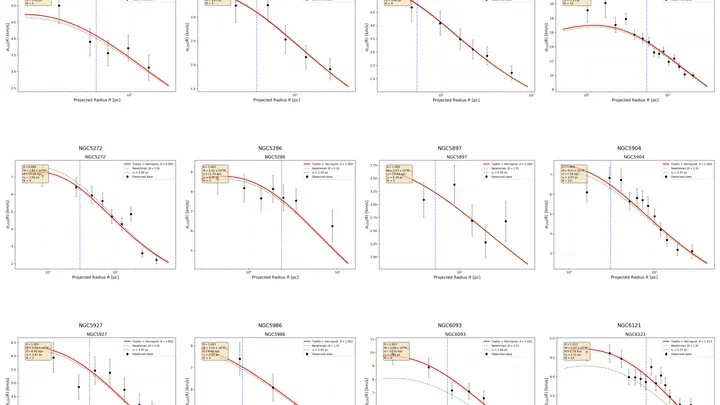
Back in the last century, Vera Rubin discovered that stars on the outskirts of galaxies rotate too fast, as if held by some invisible substance. Since then, dark matter has remained a puzzle. Usually, its origin is linked to new particles or forces. But a new study points to a simpler source — the geometry of space itself.
According to the Big Bang theory, developed by Georges Lemaître, the Universe began from a hot dense point and then rapidly expanded — an inflation proposed by Alan Guth. Echoes of that time reach us as a faint glow — the ancient light.
The Universe is expanding, and it's doing so faster and faster. This acceleration is driven by mysterious dark energy. For a long time, it was thought to be as constant as a textbook constant. But new data from DESI, an instrument that captures spectra of millions of galaxies, hint that dark energy may have been stronger or weaker in different epochs.
In 1929, Edwin Hubble discovered that galaxies are receding — the universe is expanding, like rising dough. Today we know it's growing faster and faster, and usually the accelerator is called dark energy.