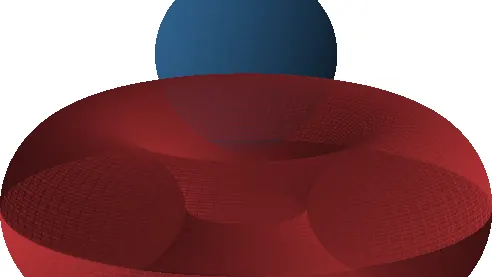
De Sitter space is a solution to Einstein's field equations of general relativity that describes a universe with no matter or radiation, but with a positive cosmological constant. This constant acts as a form of dark energy, causing the universe to expand exponentially at an accelerating rate. De Sitter space is the simplest model of an inflating universe and is used as a baseline for understanding cosmic inflation and the late-time accelerated expansion of our own universe. It is also a key concept in quantum gravity and holography, serving as a playground for theoretical physicists.
History
The de Sitter space solution was discovered by Willem de Sitter in 1917, shortly after Einstein introduced the cosmological constant. It was initially proposed as a model for a static universe, but its expanding nature was later recognized.
How it works
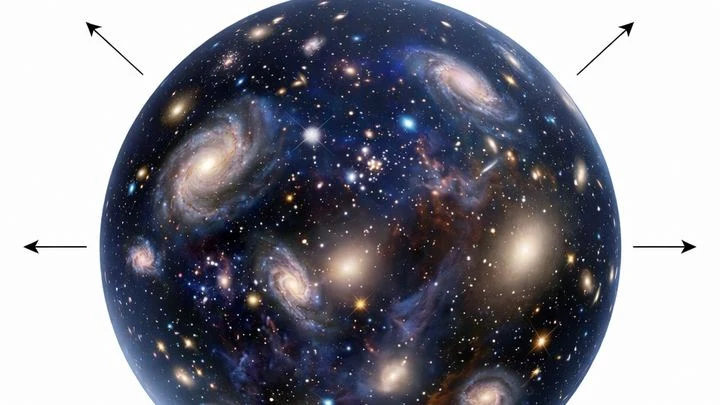
In de Sitter space, the positive cosmological constant creates a uniform, repulsive gravitational effect that drives the expansion of space itself. The geometry is highly symmetric, with a constant positive curvature in spacetime, and it can be visualized as a hyperboloid embedded in a five-dimensional Minkowski space. Any two points in de Sitter space will eventually recede from each other at an exponentially increasing rate, leading to a horizon beyond which events are causally disconnected. This exponential expansion is the hallmark of cosmic inflation and the current dark-energy-dominated era.
In practice
De Sitter space is used as a model for the early universe during cosmic inflation and for the late-time accelerated expansion driven by dark energy. It is also a central object of study in the AdS/CFT correspondence and other approaches to quantum gravity.
Fun fact
In de Sitter space, an observer will eventually see all distant objects redshift away and disappear behind a cosmic horizon, leaving a finite observable universe.
A spotlight beam fades into the darkness, but if you trace it backward, you hit the lamp. The history of the universe might be the same: tracing its expansion backward, we run into a beginning.
Physicists took the simplest model — a universe that stretches equally in all directions, like a cube with all sides growing.
In the first instants after the Big Bang, the universe expanded faster than light could cross it. Like an inflating balloon, but instead of rubber, it was space itself. On this balloon, ripples inevitably formed — tiny compressions and rarefactions from which all galaxies and stars later grew.
Space is expanding, and that expansion is accelerating. But what if, in the first instants after the Big Bang, gravity behaved differently? The authors of a new study added an invisible field to Einstein's equations that siphons energy from ordinary matter and radiation.
In the far reaches of space, there exists a hypothetical object: an ultracold black hole. It is charged and resides in an expanding universe (de Sitter space). Its temperature hovers just above absolute zero — about one trillionth of a degree above it.
It all started with stretching. In the first fractions of a second, the universe ballooned — physicists call this inflation. Then the rapid expansion gave way to a phase where the field's energy converted into ordinary particles.
The early universe resembled an overheated cauldron, seething with quantum fluctuations (random bursts of energy). In this chaos, like steam over boiling water, a special field, the scalar field, condensed. It became the 'engine' that made space expand at an incredible rate. This process is called inflation.
Clocks in the Universe are tricky things. Usually, in calculations of the birth of the world, a special scalar field plays the role of a clock — something like an invisible fluid filling all of space. It ticks, and physicists watch how the world changes relative to that ticking. But these clocks are man-made, introduced for convenience.
The authors of the new work took a different path.
In 1929, Edwin Hubble pointed his telescope at distant galaxies and discovered they were receding. Ninety years later, two measurements of this recession rate, from ancient light and from nearby stars, stubbornly disagree. A 9% discrepancy cannot be chalked up to error. It is as if the Universe in its youth and in its maturity runs on different clocks.
In 1973, Jacob Bekenstein proposed that black hole possess entropy — a measure of hidden disorder. Stephen Hawking later confirmed this by adding radiation, but the microscopic origin of entropy remained obscure.
After a hit, a black hole rings like a bell. But instead of sound, it emits gravitational waves whose frequency rapidly decays: these are called quasinormal modes. From such a 'ring,' you can infer the hole's mass, spin, and other properties.
Inflate a balloon, and the dots on its surface move apart from each other. Our universe expands in much the same way. The mathematical model of this process is called de Sitter space — where scientists study how the tiniest 'building blocks' of matter, elementary particles, behave.
But in a curved, constantly expanding space, the usual description of particles breaks down.
10⁻¹²⁰. That's not just a small number: it's a chasm. That's the ratio of dark energy density to the Planck density, the natural scale of quantum gravity. The colossal difference of 120 orders of magnitude has long seemed an unsolvable puzzle. But the answer might lie in a drama played out at the dawn of time.
An inflatable balloon with magnetic field lines drawn on it with a marker is a simple model of how a weak magnetic field behaves in an expanding universe. While the balloon is small, the lines lie obediently on the rubber and don't hinder its stretching. That's roughly how a field fills ready-made space without arguing with its geometry.
In the first moments after the Big Bang, the universe expanded at a terrifying rate. This process is called inflation, and it smoothed out all the wrinkles, making the cosmos homogeneous. But what started inflation itself?
Ever since Fritz Zwicky noticed that galaxy clusters were moving too fast, and Vera Rubin measured the rotation of spiral arms, dark matter has remained cosmology's greatest mystery.
In the ordinary world without dark energy, the mass of any object is always positive. That seems obvious: positive mass attracts, creating gravity. But the real universe has dark energy — a mysterious force making the cosmos expand faster and faster.
In the first moments of the universe's life, there was not even a hint of dark energy — the very force that today pushes galaxies apart ever faster. But if you look deeper, down to the Planck scale (billions upon billions of times smaller than an atomic nucleus), spacetime ceases to be smooth.
A runner on the middle of a track suddenly switches to a walk — not speeding up or slowing down, but maintaining a constant pace. Something similar may have happened to the universe itself shortly after the Big Bang.
The quantum vacuum is not a dead void but a boiling cauldron of probabilities. In some theories, our Universe is frozen in a metastable state: like superheated water, it's ready to explode into steam at the slightest nudge.
Dim the lights. The stage belongs to a shadow theater, with just r puppeteers, but the screen obeys the laws of hyperbolic geometry. Every wave of the hand births a pattern that mathematicians call a discrete group of isometries.
Inflation is the rapid expansion of the newborn Universe, when quantum fluctuations were stretched to cosmic scales. The cosmic microwave background is the fossilized light of that epoch, shadows on the wall of our cosmic cave.
The Universe is an orchestra playing the symphony of the Big Bang. For a long time, the conductor was thought to be dark energy — an unwavering metronome setting the pace of expansion.
The explosion of a distant supernova told us something hard to believe: the universe is expanding faster and faster. The engine of this acceleration is dark energy — nearly 70% of everything that exists.
At the centers of many galaxies lurk giant rotating black holes. Astrophysicists have long suspected that these objects are remarkably resilient: after swallowing a star or merging with another hole, they quickly settle down and forget the catastrophe.
The void is never truly empty. In curved spacetime (for instance, in an expanding universe or near a black hole) the vacuum heats up. This is reminiscent of how acceleration makes particles appear seemingly out of nowhere: a phenomenon known as thermal vacuum radiation.
After the Big Bang, the universe may have been stuck in a false vacuum — a temporary state like a soap bubble ready to pop. A rare true vacuum bubble could then erupt, stretching space in the blink of an eye.
The cosmological constant is causing the universe to expand at an accelerating rate. In the far future, when all matter has dispersed, only empty de Sitter space will remain — an ideal cosmic backdrop.
In the first moments, the universe expanded at an unimaginable rate — a phase called inflation. It is thought that particles of dark matter, the invisible substance that holds galaxies together, could have been born from the vacuum during this time. But what determines exactly how many are produced?
The authors considered a model with two fields.
The early universe was a restless place. Space trembled with gravitational waves — ripples in the very fabric of reality. In this churning cauldron, dark matter is thought to have been born. But the newborn particles had no mass: it had to come from somewhere.
Usually, the Higgs field is responsible for mass.
When massive bodies accelerate (say, two stars orbiting each other) the space around them doesn't stay calm. It trembles like the surface of a pond after a stone is thrown. These tremors are called gravitational waves. They carry energy away, and the source gradually loses mass.
A builder checks the strength of an arch not by running through all possible shapes in their head, but by mentally nudging it and seeing how much force is expended. That's essentially how the principle of virtual work works in mechanics. The authors of a new study have applied this approach to the very geometry of spacetime.
They constructed a covariant framework of virtual work for the metric.
In the early 20th century, Einstein showed that gravity is the curvature of space and time. A bit earlier, Maxwell had unified electricity and magnetism into a single theory.
The universe is expanding at an accelerating rate, like dough that keeps rising faster even though the yeast ran out long ago. For twenty years, astronomers have been searching for the cause and call it dark energy. But what it is remains a mystery.
New work proposes an unexpected source: the vacuum inside the atomic nucleus.
The Universe behaves like a soap bubble swelling in a multidimensional foam. The dark bubble model explains why it's expanding ever faster: the spacetime bubble grows, and its membrane gains a tiny thickness — about a micron, like a bacterium. At such distances, gravity 'blurs' across this thickness and weakens.
Our universe is expanding, and its future, according to cosmologists, is empty, cold de Sitter space. Understanding its quantum nature is like trying to read a book by looking only at its cover. The holographic principle suggests that all information about what happens inside a volume can be encoded on its boundary, like a picture on a film.
An empty glass on the table seems reliable. But if there's a microcrack in the bottom, one day it will break — not with a crash, but quietly, spreading in a web of lines. So too with the vacuum: it may not be the true vacuum but a false one — temporarily stable, yet ready to transition to a deeper, real state.
A translator hears not just words, but intonation, pauses, the tremor in a voice. Ordinary entropy analysis of cosmic perturbations is like meeting minutes: it records facts but loses the nuances. Pseudoentropy entropy is a new tool that captures the hidden "music" of the early universe.
Inflation is the ultra-fast expansion of the universe in its first moments. It was driven by a field resembling a ball rolling down a hill. But there could have been a second, almost imperceptible ball nearby. The authors of this work considered exactly that scenario: a light spectator field (the axion), frozen at the top of its potential.
The early universe expanded at an unimaginable rate — faster than light could cross it. In this boiling cauldron, any region of space resembled an open can of paint: its boundaries continuously captured new 'vapor' from outside, while some of its own contents irrevocably escaped.
Drop a pebble into a pond, and ripples spread across the water. A black hole 'sounds' much the same when matter falls into it or when its spacetime gets a gentle jolt. These fading oscillations are called quasinormal modes, like the tolling of a bell that gradually fades away.