The scalar spectral index (often denoted n_s) is a number that characterizes how the density fluctuations in the early universe vary with scale. In cosmology, it appears in the power spectrum of primordial perturbations, which describes the seeds of cosmic structure. A value of n_s = 1 corresponds to a perfectly scale-invariant spectrum (Harrison–Zel'dovich), while deviations from 1 indicate a slight tilt.
History
The concept was introduced in the context of inflationary cosmology in the early 1980s, with key contributions by Mukhanov, Chibisov, and others. The Harrison–Zel'dovich spectrum was proposed earlier, in the late 1960s and early 1970s.
How it works
The power spectrum of density fluctuations is often approximated as P(k) ∝ k^(n_s - 1), where k is the wavenumber (inverse of scale). If n_s < 1, there is slightly more power on large scales; if n_s > 1, more on small scales. Measurements from the cosmic microwave background and large-scale structure constrain n_s to about 0.96, meaning the universe is nearly but not exactly scale-invariant.
In practice
The scalar spectral index is a key observable for testing models of cosmic inflation and distinguishing between competing theories of the early universe.
Fun fact
The measured value n_s ≈ 0.96 is one of the strongest pieces of evidence that the early universe underwent a period of accelerated expansion (inflation), as simple inflation models naturally produce a slight red tilt.
The universe rang piercingly in its first moments. During the inflation epoch, when space expanded faster than light, energies were monstrous — trillions of times higher than in the Large Hadron Collider.
At the dawn of time, the universe experienced a brief moment of frantic expansion — inflation. Tiny quantum jitters of spacetime stretched to cosmic scales. These jitters, primordial fluctuations, became the seeds from which galaxies and stars later grew.
2.1 × 10⁻⁹ — that's the temperature variation across the sky, about the same as measuring ripples a fraction of a millimeter high on the ocean surface. This microscopic non-uniformity is imprinted in the cosmic microwave background and tells the story of the very beginning of time.
In the first moments after the Big Bang, the universe expanded at a terrifying rate. This process is called inflation, and it smoothed out all the wrinkles, making the cosmos homogeneous. But what started inflation itself?
A lump of sugar drops into hot tea, a spoon stirs a few times, and the sugar disappears. But how exactly does it spread through the churning liquid? Physicists have peered into this process with unprecedented detail: they simulated turbulence on a grid of 8192³ points. If you were to split every millimeter of the cup into a hundred cells, you'd get a similar resolution.
When an orchestra is just tuning up, disjointed sounds drift through the hall, but as soon as the conductor raises the baton, chaos turns into a symphony. Much the same can be said for the beginning of our Universe. In its first moments, it expanded at an unimaginable speed — faster than light could cross it.
Right after the Big Bang, space rippled with gravitational waves, like those from a thrown stone. These tremors in the very fabric of the cosmos, predicted by Alan Guth, stretched across the entire universe. The ripples slightly compressed primordial matter in some places and thinned it out in others.
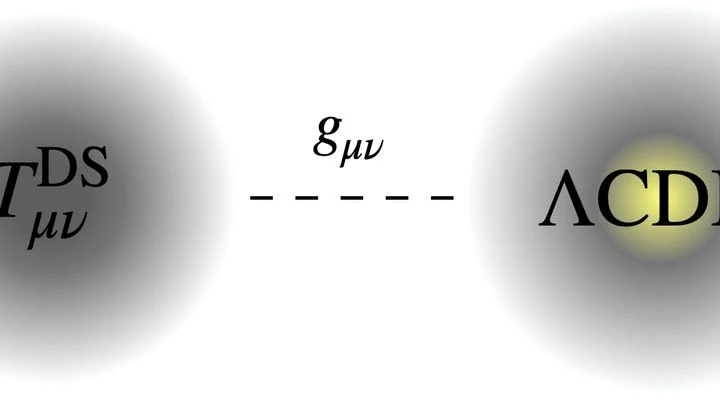
A pond with ripples spreading from a fallen stone. So it is on cosmic scales: a sudden burst of energy in the dark sector, an invisible substance that emits no light, creates ripples in the fabric of space. These ripples alter the path of light particles traveling to us from the very birth of the cosmos.
The authors of the new study built a mathematical framework to describe these distortions.
In its first moments, the Universe expanded faster than light could cross it. This process, inflation, left behind ripples — tiny density fluctuations from which galaxies later grew. The spectrum of these ripples is usually described by a number: if it is exactly 1, then all fluctuations, large and small, were equally strong.
An attempt to suppress room background noise by adding anti-sound turns into speaker howl if the circuit has an error. A similar glitch occurred with a theory that set out to remove the main cosmic hum — the inexplicably weak dark energy.
In the first instants after the Big Bang, the Universe expanded faster than light could cross it. This rapid growth, inflation, stretched tiny quantum jitters to the size of entire galaxies. But from what state did these jitters begin?
According to the Big Bang theory, developed by Georges Lemaître, the Universe began from a hot dense point and then rapidly expanded — an inflation proposed by Alan Guth. Echoes of that time reach us as a faint glow — the ancient light.
Some superluminous supernovae show a bright oxygen imprint in their light and expand rapidly, while others do not. It seemed like different phenomena. But supernova PTF12dam broke the rules: as its brightness grew, its oxygen signature changed, shifting from one type to another.
Galaxies in the Universe are not scattered randomly: neighboring ones move in the same direction, like a school of fish, while distant ones each go their own way. Where the boundary between 'together' and 'apart' lies has been unclear until now.
Cosmic rays are atomic nuclei accelerated to near-light speeds. They arrive at Earth from all directions, and their composition tells us what's happening in the far reaches of the Galaxy.
The ATIC balloon rose over Antarctica and caught particles older than Earth itself. Among them are atomic nuclei from sulfur to chromium, and the higher their energy, the larger their fraction compared to iron. The standard 'leaky box' model predicted the opposite: heavy nuclei should dissolve like salt in water. But the data stubbornly rose.