Hairy Black Holes and Strings
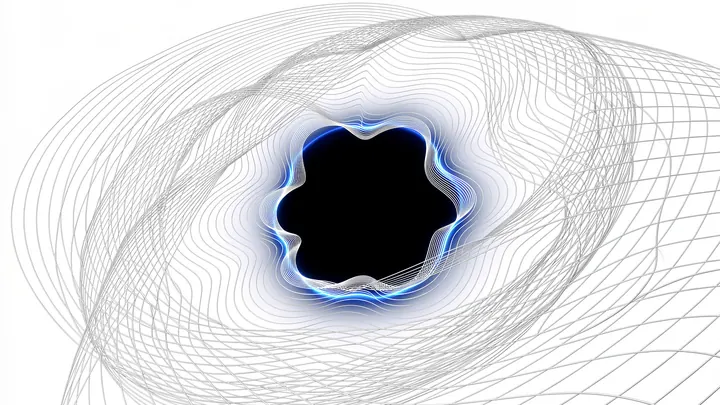
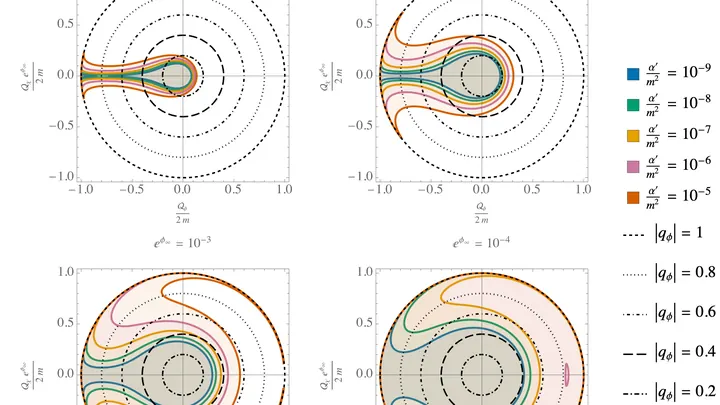
A black hole is not just a dark sphere. In string theory, it can grow 'hair'—extra scalar fields such as the axion and the dilaton. These fields gently alter the geometry of space around the hole.
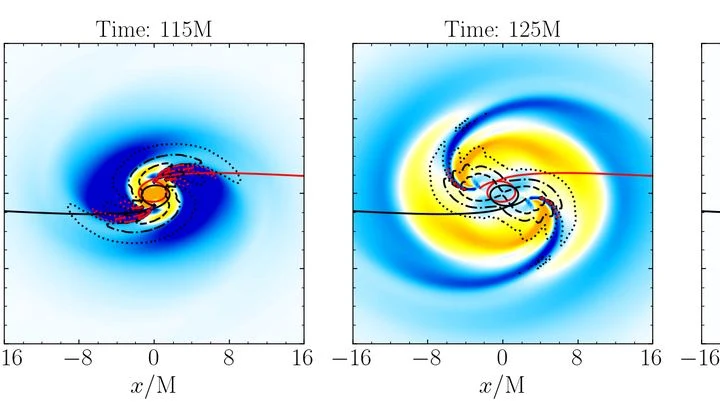
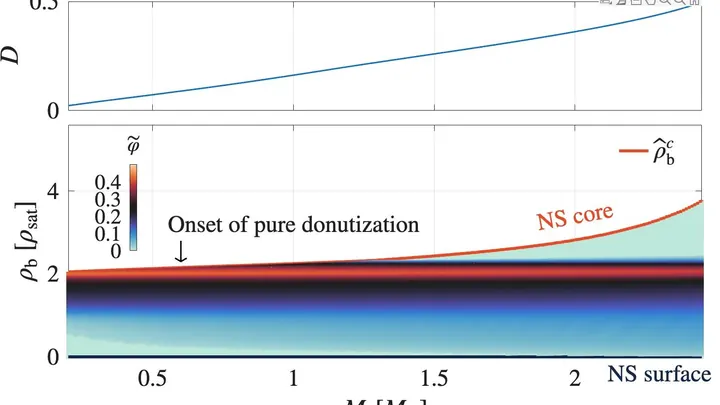
A process where a scalar field acquires a nontrivial configuration around a compact object under certain conditions.Spontaneous scalarization is a phenomenon in which a scalar field—a field with a single value at each point in space—suddenly acquires a nontrivial configuration around a compact object, such as a neutron star or black hole, under certain conditions. In the standard state, the scalar field is constant and has no observable effect. But when the object's compactness (the ratio of its mass to its radius) exceeds a threshold, the field 'turns on' and develops a spatial profile, effectively giving the object a 'scalar hair'. This is a nonlinear effect that arises in modified theories of gravity, where the scalar field is coupled to matter or curvature.
Spontaneous scalarization was first proposed by Damour and Esposito-Farèse in 1993 for neutron stars in scalar-tensor theories of gravity. It was later extended to black holes in the 2010s, notably by Doneva and Yazadjiev, who showed that black holes can also undergo scalarization.
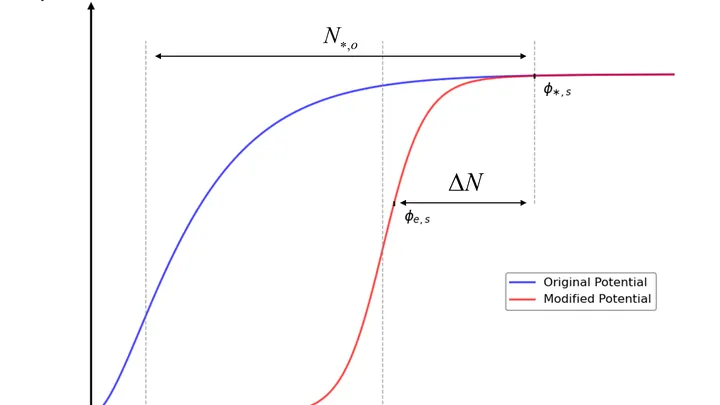
The mechanism is analogous to spontaneous magnetization in ferromagnets. In the underlying theory, the scalar field has an effective potential that depends on the local matter density or curvature. For low compactness, the potential has a single minimum at zero field. But for high compactness, the potential develops a double-well shape, and the zero-field configuration becomes unstable. The field then 'rolls' to one of the new minima, creating a nontrivial profile around the object. This transition is sudden and depends on the object's properties, not on external tuning.
Spontaneous scalarization is a key target for testing modified gravity theories. If it occurs, it would produce observable deviations in gravitational waves from neutron star mergers or in the orbital decay of binary pulsars, which current and future detectors like LIGO and LISA might detect.
In some theories, a black hole can 'lose' its scalar hair if it spins too fast, a phenomenon called spin-induced descalarization, which is the reverse of scalarization.