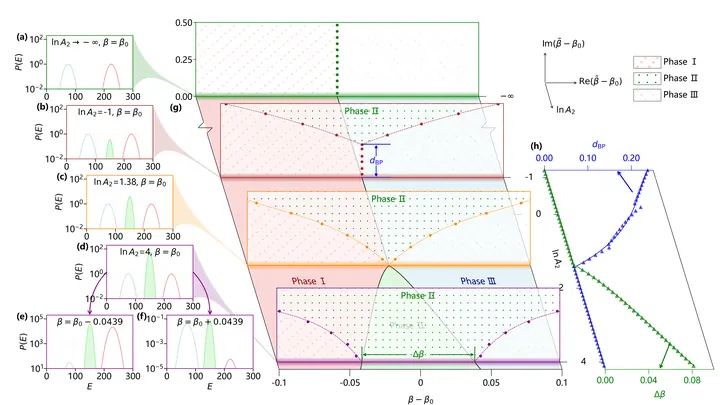
A phase transition is an abrupt change in the state of a thermodynamic system when external conditions, such as temperature or pressure, change. First-order transitions, like ice melting or water boiling, involve the release or absorption of latent heat and a jump in density. Second-order transitions occur without latent heat but with a sharp change in heat capacity; examples include the disappearance of iron's magnetization upon heating (the Curie point) or the transition to a superconducting state. Near the critical point, where differences between phases vanish, critical phenomena are observed, described by renormalization group theory.
History
Early experimental research was conducted by James Joule and William Thomson. Thomas Andrews discovered the critical point in 1869. Paul Ehrenfest proposed the classification of transitions in 1933. Lev Landau created a phenomenological theory based on the order parameter in 1937. Lars Onsager provided an exact solution of the two-dimensional Ising model in 1944. Kenneth Wilson developed the renormalization group approach to critical phenomena in 1971. Boltzmann's statistical mechanics laid the foundations for describing phase transitions.
How it works
The thermodynamic potential (e.g., Gibbs free energy) determines the stable phase as the global minimum. When parameters change, the minimum point may shift abruptly (first-ordertransition) or continuously give way to another when stability is lost (second-order). Near the critical point, large-scale fluctuations develop, and mean-field theory breaks down. The renormalization group allows one to compute critical exponents. In quantum systems, phase transitions can occur even at zero temperature due to quantum fluctuations.
In practice
The basis of many technologies: metal quenching, semiconductor production, climate modeling, and creation of superconductors.
Fun fact
At the critical point, a liquid and its vapor become indistinguishable: one can observe opalescence—a cloudiness due to intense density fluctuations.
Electrons in an ultra-clean gallium arsenide film behave like a crowd at a crossroads, where the tilt of the magnetic field sets the direction. At zero tilt, they form a compressible liquid of composite fermions, particles made of an electron and a pair of vortices.
The map of dense nuclear matter resembles a road map: lines of phase transitions cross at critical points, like highways at intersections. Until now, only two intersections were known on such a map: the nuclear liquid-gas and deconfinement, where hadrons dissolve into quarks.
The map of dense nuclear matter resembles a road map: lines of phase transitions cross at critical points, like highways at intersections. Until now, only two intersections were known on such a map: the nuclear liquid-gas and deconfinement, where hadrons dissolve into quarks.
Inside Earth, at depths from 660 to 2,900 kilometers, lies a layer known as the lower mantle. There, pressures reach 1.3 million atmospheres, and temperatures rival the surface of the Sun. Under these conditions, the mineral davemaoite exists as the third most abundant mineral in the lower mantle.
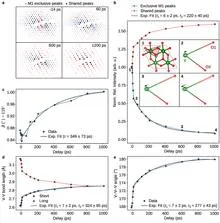
The camera captures not a race but a dance of atoms. In vanadium dioxide, the transition from an insulating to a metallic state occurs within trillionths of a second, yet until now no one had seen exactly how the vanadium and oxygen atoms move. Now, ultrafast electron diffraction has captured this route frame by frame.
In a thin layer of liquid crystal, molecules usually lie like matches in a box — aligned in one direction but randomly oriented: some point up, others down. To make all the matches point the same way, you need a special molecular architecture. Scientists have found a chemical trick that does this almost automatically.
In the layered crystal CrSBr, the magnetic moments of atoms are arranged like notes in a score: within each layer they point in the same direction, but between layers they point in opposite directions. This antiferromagnetic melody plays up to 132 kelvin, beyond which thermal motion destroys the order.
When a ψ(2S) particle decays into a proton and an antiproton, two different mechanisms act simultaneously: the strong interaction, like glue holding quarks together, and the electromagnetic one, like light pushing charges apart. Their contributions add up with a certain phase shift.
A translator who has memorized all the lines in advance responds instantly — no need to listen to the whole conversation again. That's how the new model works: instead of running atoms through a computer for hours, it immediately outputs the crystal's free energy at any temperature and pressure.
An empty dance floor where people occasionally appear. Each moves on their own, chaotically, with no connection to the others. But when the right music starts and the hall cools down a bit, the dancers suddenly begin to form long chains and move in unison. That's roughly how electrons behave in a dilute three-dimensional gas.
Graphene, a sheet of carbon just one atom thick, can change its magnetic properties the way water changes shape: sometimes flowing, sometimes freezing into ice. In a new study, physicists peered inside this process for the first time using a sensor the size of a needle tip.
When two atomic nuclei smash together, a tiny fireball is born. It lives for an instant, but inside, entire epochs pass: compression, heating, expansion. Physicists have learned to eavesdrop on this process, and their "microphone" is the pairs of electrons and positrons that fly out of the ball at different stages.
In the new work, two scenarios were compared.
Ordinary ice turns into water at zero degrees. And matter at nuclear density, quark-gluon plasma, undergoes something similar at about 155 MeV (roughly two trillion degrees).
A tiny sandwich of oxides, grown layer by layer, becomes perfectly conducting at about minus 200 degrees Celsius. This is not a magic trick but a new chapter in the search for high-temperature superconductors.
Drop by drop from a faucet, or a steady stream without a single splash. That's roughly what the two regimes of current in a superconducting contact look like. Only here, the role of water is played by Cooper pairs — bound electrons that move without resistance.
The universe right after the Big Bang was like a boiling cauldron: bubbles of a new state of matter were bursting and growing everywhere. These were first-order phase transitions — exactly like water boiling, only at temperatures reaching trillions of degrees.
In a vast hall, billiard balls are scattered about. At first they lie sparsely, each on its own. Then someone adds more, and suddenly the balls compress into dense clusters. This is a phase transition — the moment when matter abruptly changes its state.
Physicists have long described such a picture with the hard-sphere model: particles are identical balls that cannot overlap.
In a glass of water, oil gathers into droplets: that's equilibrium separation dictated by chemistry. But there are systems where order arises not from rest but from a constant flow of energy.
Water turns to ice at zero degrees — sharply, with no intermediate states. Something similar happens to complexity when we take a random quantum state of an entire system and look only at a part of it. As long as that part occupies less than half the system, its complexity grows smoothly. But as soon as the fraction crosses 50%, a jump occurs.
Water boils at one hundred degrees — everyone knows that. But why exactly one hundred? Why not smoothly, but abruptly: a second ago it was liquid, and suddenly — bubbles, steam, bubbling. Such sharp changes are called phase transitions, and they have a rigorous mathematical foundation.
Imagine water as a ballroom, where each molecule is a dancer, constantly forming fleeting partnerships. These hydrogen bonds give rise to local patterns: some resemble a stiff waltz — an ordered network with cavities (low-density structure), others a wild jitterbug, where partners crowd into chaotic dense clusters.
The Mpemba effect is a mystery where hot вода sometimes freezes faster than warm water. Usually this is attributed to how вода loses heat and энтропию (a measure of disorder). But in a glass of water, chaos prevents a precise model.
Physicists built a quantum model: a particle in a well with two depressions separated by a barrier.
Water is not just a wet substance. On a picosecond scale, it resembles a dance floor where molecules continuously break and form bonds with each other. Usually, this dance is described by one main movement — collective relaxation, as if the whole crowd simultaneously slows down after the music stops.
A neutron star is a city squeezed to the size of a metropolis, where matter is packed to the limit. At the very center of such a city, a redevelopment may begin: familiar neutrons and protons give way to quark plasma — free quarks, the building blocks of almost everything around us.
Diamond is a symbol of perfection, but its true magic is revealed through flaws. Perfect lattice purity gives transparency and hardness, while defects, such as color centers, open a portal to the quantum world, becoming the foundation for quantum computers and quantum sensors.
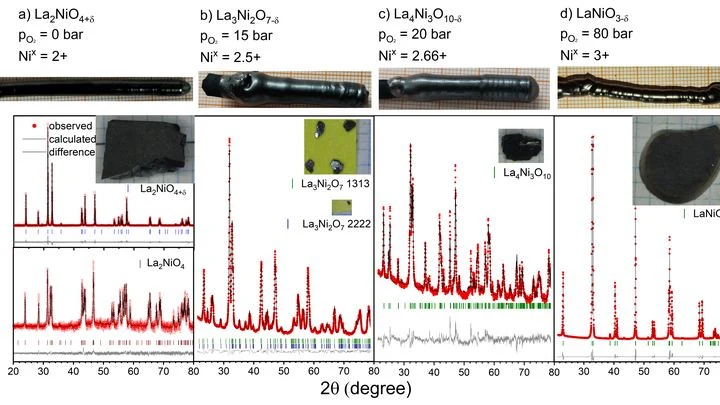
The nickelate family consists of layered crystals, like a stack of pancakes: nickel and oxygen layers alternate with lanthanum spacers. Two years ago, superconductivity was discovered in them — the ability to conduct electricity without resistance when cooled.
In a hot mug, water sometimes freezes faster than in a warm one. This paradox is over half a century old and is called the Mpemba effect. It is usually attributed to fluid motion or evaporation. Now physicists have shown that a similar trick is possible without water, just through radiation of heat.
Usually, superconductivity is a story about cold. The lower the temperature, the easier it is for electrons to pair up and flow without resistance. But in a new study, physicists grew thin films of nickelates doped with europium and saw the opposite picture.
If you squeeze water between two glass plates so that only two layers of molecules fit, it becomes something between a liquid and ice. At room temperature, molecules in such a trap still move but arrange themselves into a semblance of a crystal lattice.
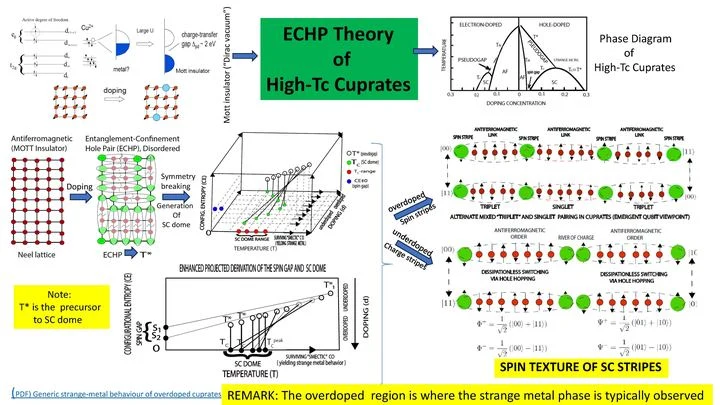
In some materials, electric current can flow without any loss: this is superconductivity. But before becoming a superconductor, a substance often passes through a strange state: electrons already sense each other and form pairs, yet they cannot move in unison.
Imagine a slide with three dips: the deepest one is a stable position for a ball, the middle one is precarious. A slight push and the ball rolls down. Yet, constant vibration of the right strength can hold it in the middle hollow for a long time.
In the 1950s, physicists Lee and Yang discovered that all states of matter are separated by invisible points in the world of imaginary numbers.
Inside a neutron star, matter is squeezed so hard that atomic nuclei stop being separate clumps. Neutrons and protons get closer together, and their innards, quarks, begin to feel their neighbors through the walls of their 'bags'.
A neutron star is a sphere about the size of a small city but with a mass of one and a half Suns.
Ice, water, steam — phase transitions we all know. But what happens if you squeeze and heat an atomic nucleus itself? Theorists think protons and neutrons inside it 'melt,' releasing smaller building blocks — quarks and gluons.
Inside the proton, life is boiling. Quarks don't just sit there: they're glued together by carrier particles called gluons (from the word glue). Usually, this glue is spread evenly, like butter on a skillet. But when energies become enormous, gluons start clumping together. This is the gluon condensate — an ultra-dense state of the gluon field.
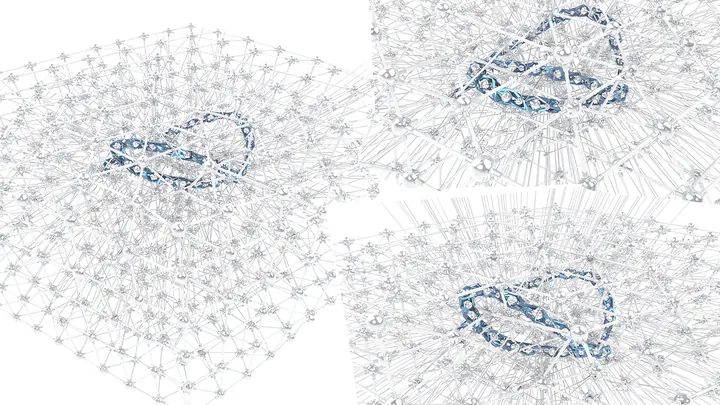
Time crystals are quantum phases of matter that spontaneously oscillate, like a tuning fork with an infinitely decaying echo. If an ordinary spatial crystal repeats an atomic pattern in space, breaking translational symmetry, a time crystal exhibits periodicity in time, breaking time translation symmetry.
A long chain of atoms, each a tiny magnet. They talk to each other and to a common field, like musicians in an orchestra who hear both the conductor and their neighbors. When the external field changes, the orchestra either plays out of sync or all instruments come in together: that's a quantum phase transition.
Hot tea in a freezer doesn't freeze all at once. First, tiny ice needles dart around — forming and melting until the temperature drops enough for the ice to set solid. The early universe behaved similarly as it cooled and changed its internal structure.