Grid Therapy Takes on Large Tumors express
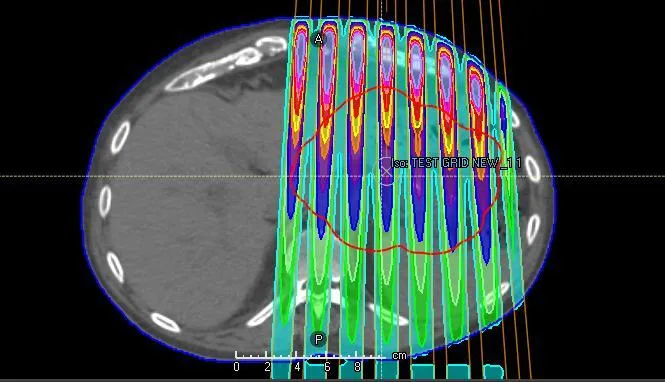
When treating large tumors, a conventional solid radiation beam can damage surrounding healthy tissue. Doctors came up with the idea of splitting the beam into many thin streams, like water from a watering can with fine holes. This approach is called spatially fractionated radiation therapy, or GRID therapy.
To apply GRID therapy, you need to calculate precisely how the beams will travel through the patient's body. For this, special computer programs, treatment planning systems, are used. The authors were the first to configure such a system, called RayStation, for GRID therapy. They used a lead plate with holes, a GRID block, placed in front of the patient, which turns a solid beam into a grid of thin rays.
Accuracy was checked using special detectors that measure dose at various points. The researchers also developed a way to standardize the setup of the GRID block in RayStation, so other clinics can replicate the method without lengthy trial and error. This is a step toward making treatment of large tumors safer and more predictable.
GRID therapy has been around for over a century, but only now is it being integrated into modern computer-based treatment planning systems.