Radiotherapy AI planning involves using artificial intelligence to automate and optimize the creation of radiation treatment plans for cancer patients. Traditionally, medical physicists manually adjust parameters like beam angles, intensities, and doses to target tumors while sparing healthy organs—a process that can take hours or days. AI-driven planning aims to reduce this to minutes while maintaining or improving plan quality. This is critical because radiotherapy is a balancing act: too little radiation fails to kill the tumor, too much damages surrounding tissue.
History
The application of AI to radiotherapy planning began in earnest in the late 2010s, with early work on dose prediction using convolutional neural networks. The field has since grown rapidly, with commercial systems now available.
How it works
The AI is trained on historical treatment plans that were manually created by experts. Given a new patient's CT scan and the contours of the tumor and organs at risk, the model predicts the optimal dose distribution or directly generates the machine parameters (like multi-leaf collimator positions). Some approaches use reinforcement learning to iteratively refine a plan based on a reward function that penalizes overdosing healthy tissue. The result is a plan that can be reviewed and approved by a human physicist, but generated in a fraction of the time.
In practice
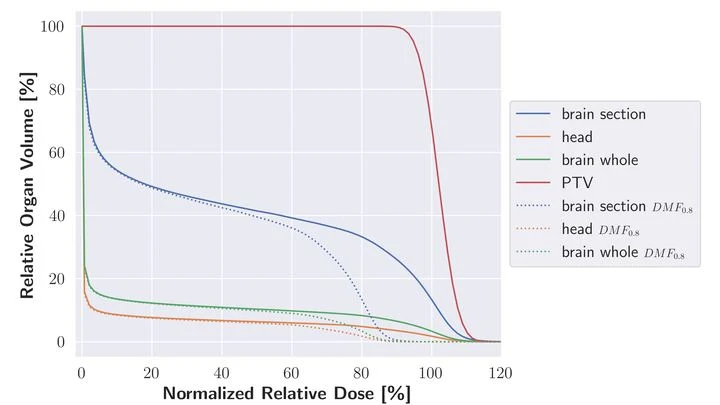
AI planning is used in clinics to create intensity-modulated radiation therapy (IMRT) and volumetric modulated arc therapy (VMAT) plans for brain, prostate, and head-and-neck cancers, significantly reducing planning time from hours to minutes.
Fun fact
Some AI planners can generate a treatment plan that is indistinguishable in quality from a human expert's plan, but in less than one minute, allowing for same-day adaptive radiotherapy where the plan is adjusted to daily anatomical changes.
An architect reinforces the foundation but leaves a door open for remodeling: that's how living systems balance reliability against renewal. A cell copies hereditary information with a fidelity any scribe would envy, yet it can also allow changes that help it survive under new conditions.
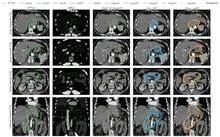
A radiation oncologist looks at an abdominal scan and mentally outlines the area to be irradiated. That area is not visible as a separate organ: its boundaries are set by protocol, not by tissue. So the doctor needs a map of the surroundings to avoid hitting healthy structures.
The nnU-Net model starts with the same task.
In a lab where patient data resemble a scattering of gold dust, every test is a speck, and Alzheimer's disease is a river washing away the precious metal. Scientists set a task for the neural network: to tell whether a person received rapamycin, a drug that slows cellular aging, or not.
High-frequency sound focused on a single point acts like an invisible lens gathering sunlight. Inside a tumor, such a lens can raise the temperature to about 72°C in a second, like hot water from a tap, but inside living tissue. Meanwhile, surrounding healthy cells remain almost untouched.
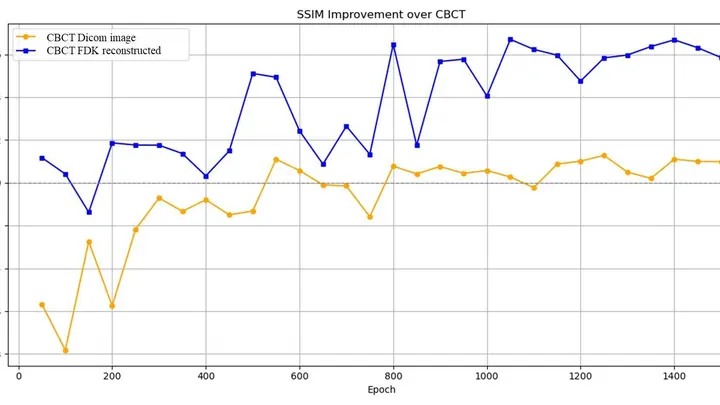
A low-dose X-ray image looks like a view through a fogged-up window: outlines are there, but details drown in a hazy veil. Doctors need such images during radiation therapy — to aim the beam precisely at the tumor and spare healthy tissue. But saving on radiation comes at the cost of noise, streaks, and artifacts that obscure what matters.
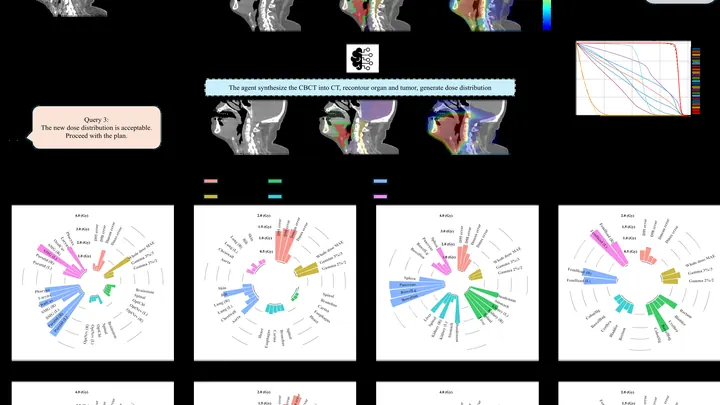
The proton beam is like a sniper's bullet: it delivers most of its energy at a precisely set point, barely touching tissues on the way in. But over 4–6 weeks of head and neck tumor treatment, the target shifts: the patient loses weight, the tumor shrinks, posture changes. The sniper aimed at one spot, but the target has already moved.
Each morning, a navigator plots a route, bypassing traffic jams and roadblocks. Similarly, before a radiation therapy session, a new AI agent recalculates the irradiation path.
Genes are like houses in a city: in some, life bustles; in others, silence reigns. This 'urban' genetic landscape was analyzed in a thousand women with breast cancer.
Communicating with a satellite is like trying to hear a whisper in a storm: the signal drowns in noise. Engineers have created an AI algorithm that runs directly on the satellite and, with minimal power consumption, detects distortions more accurately than previous methods.
In a soup pot, you only need two thermometers to gauge the temperature everywhere — if you know heat travels in circles from the bottom. Science works the same way: from a handful of measurements, you want to reconstruct the full heat picture.
The system captures the gist of heat flow, compressing it into a handful of governing numbers.
Imagine a fleet of many ships, resembling a galaxy — a vast stellar system where every element follows the overall dynamics. From time to time, one ship breaks down, exploding like a supernova — a catastrophic event that can disrupt the integrity of the entire formation. If the damaged unit isn't replaced in time, the fleet loses combat capability.
Inside each of us, invisible clocks are ticking. They control the release of cortisol — the hormone that helps us wake up in the morning, cope with anxiety, and keep our immune system on its toes. In adrenal insufficiency, these clocks break down: the body can't produce the right amount of cortisol on its own.
A gardener wants to grow a rare flower. Watering and fertilizing can't be done haphazardly; it must follow a strict schedule: a bit more warmth in the morning, a bit less moisture in the evening. Otherwise, the bed will be overrun by common weeds. Molecules on a metal surface behave in much the same way.
When organic molecules settle on a metal, they assemble into patterns, like pieces of a mosaic.
3I/ATLAS burst into the Solar System like an uninvited guest, a gift of fate for hunters of extraterrestrial intelligence. This comet-like wanderer from the depths of the Galaxy flew close enough to be heard in all its details — unlike distant exoplanets.
The brain is like a noisy city where each district has its own business. Neurons communicate via electrical signals, and sometimes you need to reach a specific block without disturbing the neighbors.
Many cutting-edge physics calculations hit a brick wall — not for lack of ideas, but because of arithmetic. We're talking about integrals that express particle collision probabilities or the shape of gravitational wave bursts.
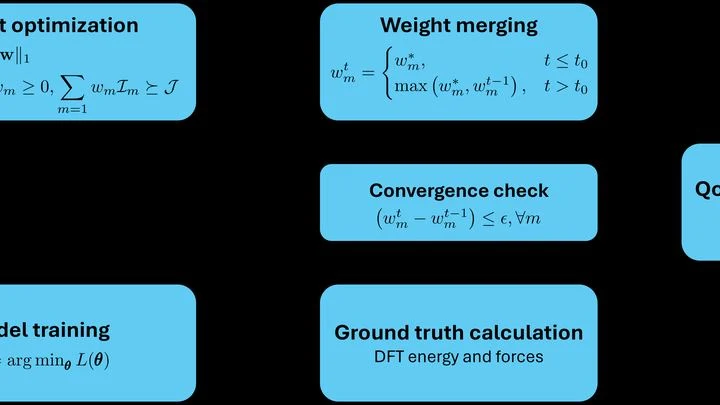
A chef doesn't waste ingredients cooking the whole dish to check the taste: they just taste a drop of sauce. The same logic underlies the "information matching" method for predicting metal strength. Instead of expensive calculations of every atom's behavior, scientists "taste" only simple indicators linked to plasticity — a metal's ability to bend without breaking.
A factory laser that cuts and welds metal on production lines has been made to work as a particle accelerator for the first time. Physicists took a standard ytterbium laser, its heart is a crystal the size of a palm, and turned its flashes into a tool for accelerating electrons to nearly the speed of light.
A single camera shot stores both a normal picture and a hidden map of how light rippled through the scene. Quantum entanglement makes this possible. Pairs of linked photons are generated: one visits the object, its twin takes a detour. Later, measuring the twin one way pulls out the brightness information.
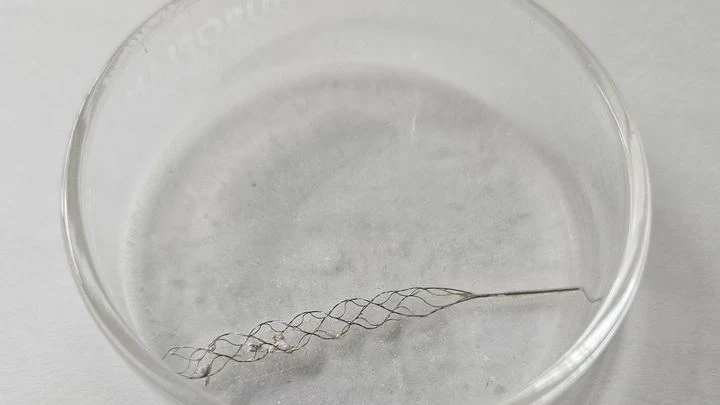
A plumber clears a clog in a narrow, winding pipe — by feel, without seeing inside. That's roughly how a surgeon feels during mechanical thrombectomy, the operation to remove a blood clot from a brain vessel. Time is short, and every move can either save a life or damage the vessel wall.
A proofreader checks a manuscript before it goes to print. They don't know every possible mistake, but they know exactly what flawless text looks like. Spotting a strange symbol or a blurred word, they immediately circle it in red. That's roughly how the new program for checking medical images works.
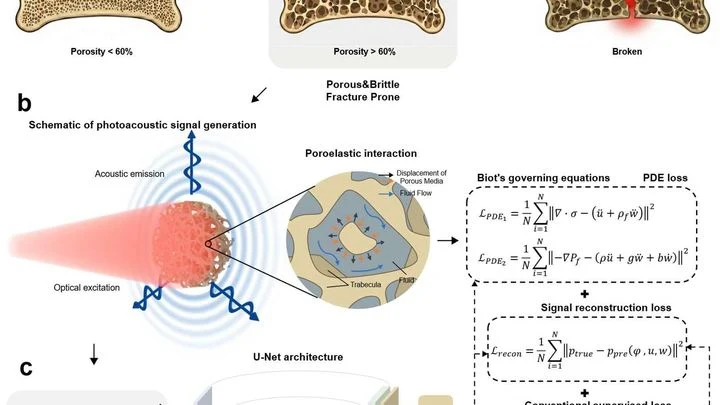
A laser beam strikes bone, and it responds with a nearly inaudible ultrasonic echo. Hidden in that sound is information about every microcrack and every fluid-filled pore. The trouble is that conventional computer programs don't understand this language: they see the signal but don't know the physics that produced it.
When you need to see inside the brain, you usually lie in a tight tube of an MRI scanner or get zapped with X-rays. Both methods are costly, bulky, and not always available.
In a car, the steering, brakes, and accelerator gradually fail. At first, you can still swerve around a pothole, but each year the maneuver takes more effort. At some point, even a perfect road becomes impassable — the car no longer obeys the driver.
That's exactly how the authors describe aging: not as the accumulation of rust or wear and tear, but as the loss of "controllability" of the body.
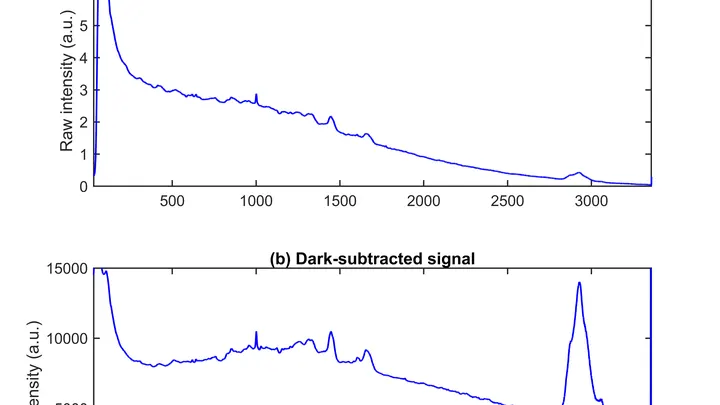
A drop of blood from a vein falls under three beams, and each one drags its own clues into the light. The infrared beam makes molecules vibrate — from that trembling, you learn how much sugar and fat is in the sample. A green laser scatters off proteins and lipids, shifting color — revealing the remodeling of cell membranes.
An X-ray tomograph is like a carpenter who examines a log from all sides to see where the void is inside. It takes dozens of flat shadow images, rotating the source and detector around the object. Then a 'reconstruction' program glues these shadows into a 3D model. The quickest reconstructor is the FBP algorithm (filtered back projection).
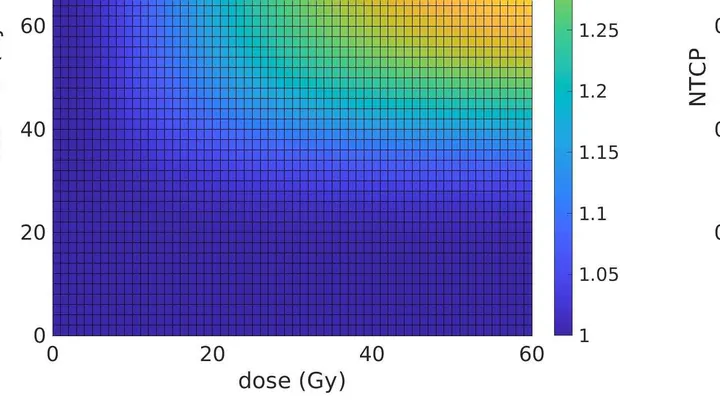
Radiation therapy targets tumors, but healthy tissue suffers too. Flash therapy delivers radiation in a fraction of a second and, remarkably, spares healthy cells without reducing the punch to the cancer. Exactly how this works remains unclear, but the authors set out to test whether this protection depends on the organ's own architecture.
A garden hose shoots a thin, powerful jet. If you sweep it across the yard, you can water the whole bed without flooding the path. That's roughly how the new approach to treating deep tumors works: instead of a broad radiation field, you take a narrow beam of electrons accelerated to nearly the speed of light and scan it across the tumor like a jet of water.
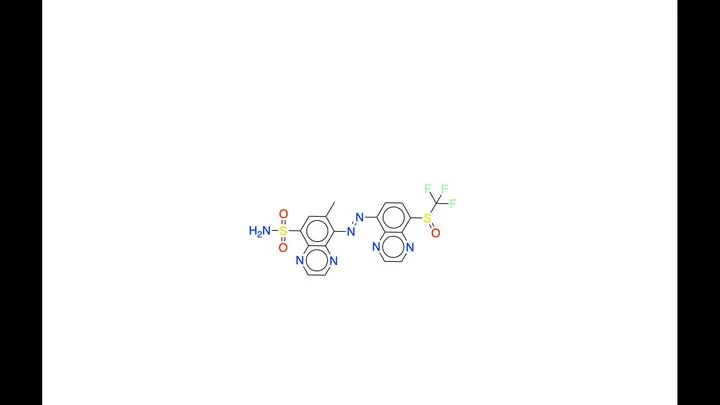
The light bulb turns on only in the room where you need it. That's roughly how photoactivatable drugs work: they 'switch on' only where light is directed, leaving the rest of the body untouched. This is especially important in cancer treatment: conventional chemotherapy hits all dividing cells indiscriminately, causing severe side effects.
A neutron spectrometer is like a blind geologist who taps on rock and guesses what's inside by the sound. It sends a beam of neutrons into a crystal and watches how they scatter. From this pattern, you can deduce how atomic magnets, spins, oscillate. But where exactly to dig and how long to listen used to be decided by a human.
Now, the TAS-AI algorithm has taken the helm.
Two specialists look at the same breast image. One is an experienced doctor, the other is an artificial intelligence program. Sometimes their opinions match, sometimes they diverge. How often they agree determines how accurately they can together distinguish healthy tissue from a tumor.
A tomograph is like a photographer who walks around an object and takes pictures from different sides. Usually, it snaps at regular intervals and uses the same amount of light for each shot. But if you need to shoot quickly and not waste extra film, you have to choose: which angles matter more and where to direct more light.
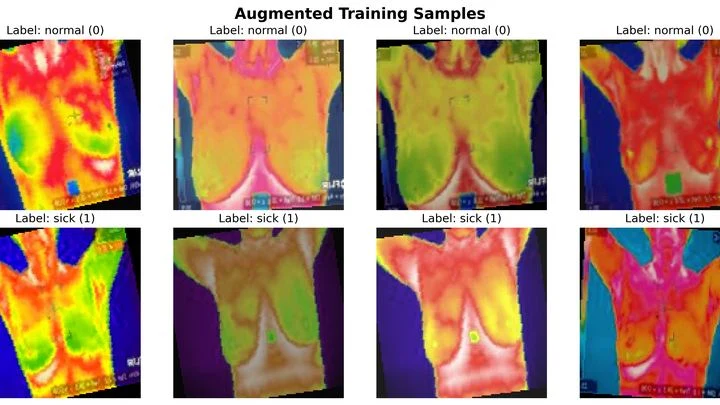
The hot air above asphalt shimmers, betraying the heated surface. Medical thermography works in a similar way: the skin over a tumor is often slightly warmer than healthy skin — by just fractions of a degree. Computer programs try to catch this difference and determine whether it's dangerous.
Two nearly identical locks are opened by the same pick. They look alike on the outside, but inside the mechanisms differ. Much the same can be said for the two main types of non-small cell lung cancer — adenocarcinoma and squamous cell carcinoma. Under a microscope, they can be confused, yet they require different treatments. That's where the quantum "magnifier" comes in.
At Fermilab's accelerator, a particle beam strikes a target of frozen ammonia. The hydrogen nuclei inside are like tiny tops, and physicists need them all spinning the same way. Then the collisions reveal how the proton's spin is put together.
Prostate cancer radiation therapy requires precise calculation of the radiation dose at every point in the body. The classic Monte Carlo method simulates millions of particles and takes hours, while adapting the plan to daily anatomical changes needs seconds.
An ordinary camera captures light reflected from objects and builds a picture from it. But if the object is hidden behind an obstacle or does not reflect light, radio waves come to the rescue: they pass through walls and fog, and a computer reconstructs the image from scattered signals.
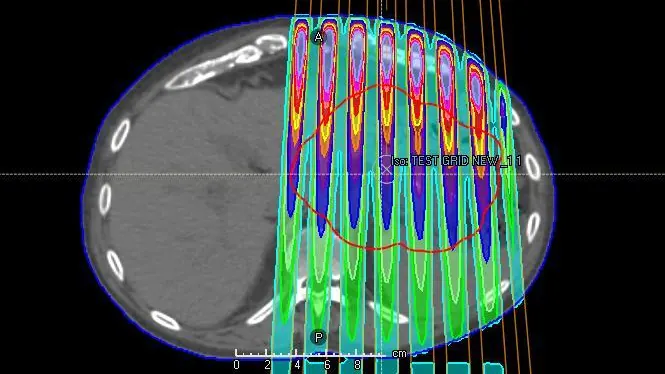
When treating large tumors, a conventional solid radiation beam can damage surrounding healthy tissue. Doctors came up with the idea of splitting the beam into many thin streams, like water from a watering can with fine holes. This approach is called spatially fractionated radiation therapy, or GRID therapy.
The radioactive isotope terbium-149 acts like a tiny homing bomb: it latches onto cancer cells and detonates with alpha particles that destroy the tumor from within, barely touching healthy tissue. But this bomb has a quirk: it also glows with positrons, and that glow can be captured by a special camera.