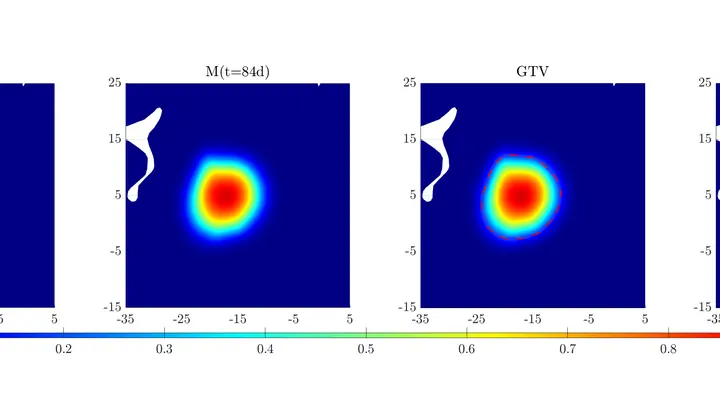
Healthy tissue refers to the normal, non-cancerous cells and organs in a patient's body that must be protected during medical treatments, especially radiation therapy. The goal of many cancer treatments is to deliver a lethal dose to tumor cells while minimizing damage to surrounding healthy tissue, because radiation can cause mutations, cell death, and long-term side effects.
History
The concept became central to radiotherapy in the early 20th century, as physicians like Marie Curie's daughter Irène Joliot-Curie and others worked to improve dose delivery, but the systematic study of tissue tolerance dates to the 1930s–1940s.
How it works
Radiation damages DNA, and both cancer and healthy cells are affected. However, cancer cells often divide more rapidly and are less efficient at repairing damage, making them more vulnerable. Techniques like shaping radiation beams, using multiple angles, or delivering protons that stop at a precise depth exploit this difference, concentrating the dose on the tumor and sparing healthy tissue. Imaging and planning software help map the tumor's location relative to critical organs.
In practice
It is the guiding principle in modern radiation oncology, including proton therapy and intensity-modulated radiation therapy, where treatment plans are optimized to spare organs like the brain, lungs, and heart.
Fun fact
The tolerance of healthy tissue to radiation varies by organ—for example, the lens of the eye is highly sensitive, while the skin can withstand much higher doses.
A watchdog that yawns and turns away instead of barking at an intruder is a bad guard. That is roughly how CD8+ T cells behave in people with type 2 diabetes. These cells are professional killers: they patrol the body, find infected or cancerous cells, and destroy them. But in diabetes, something breaks in the recognition system itself, and the watchdogs stop recognizing the enemy.
After a nuclear explosion, soot rises into the sky. It settles high above the clouds, in the stratosphere, and stays there for years. This soot acts like a thick curtain: it blocks some sunlight and alters the chemistry of the sky.
A sponge slowly watered from a watering can gets soaked all the way through. But if you dump the same bucket of water on it all at once, the middle gets wet while the edges stay almost dry. That's roughly how a material with nonlinear absorption behaves: the more intense the flux, the more it gets stuck at the point of impact.
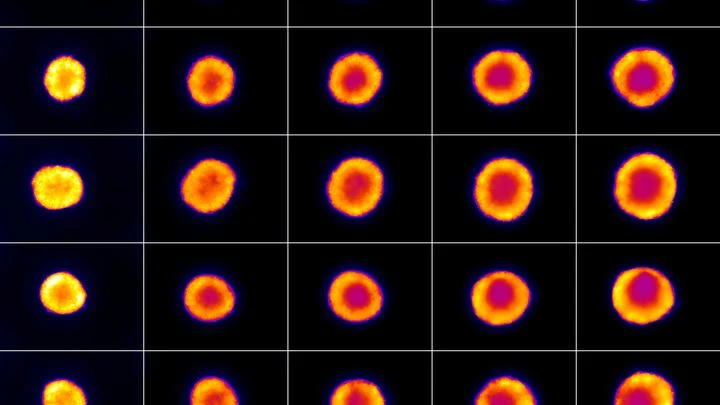
Radiation therapy is a precision strike on a tumor, but every shot must be calibrated to within a millimeter and a fraction of a second. The problem is that existing dosimeters are either bulky, or they distort the beam themselves, or they require pauses for readout.
An ordinary flashlight emits light whose waves oscillate in all directions at once. But pass that light through a special filter, and you get a beam that oscillates strictly in one plane: that's polarized light. When such a beam travels through biological tissue, the tissue's internal structure slightly alters the orientation of the oscillations.
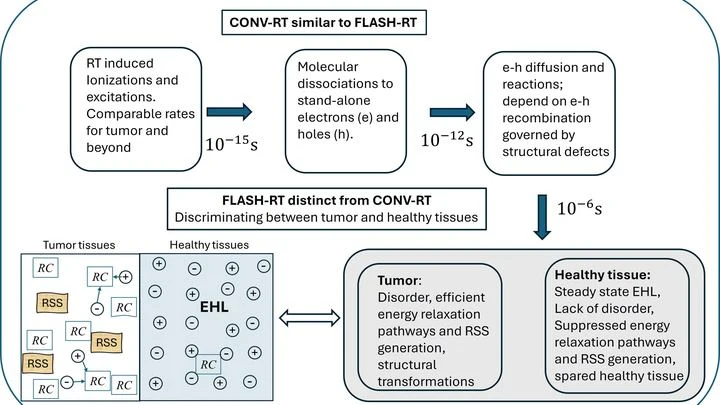
A camera flash that fires in a thousandth of a second doesn't heat the subject — unlike a regular flash that lasts a full second. A similar trick has been found in radiotherapy: when a radiation dose is delivered in milliseconds instead of minutes, healthy tissues suffer less. This is called the FLASH effect.
Forget the flat sheet: embryonic tissue is a dynamic landscape of hills and folds. On convexities, cells stretch; in concavities, they compress, as if performing a dance governed by laws eerily similar to spacetime curvature.
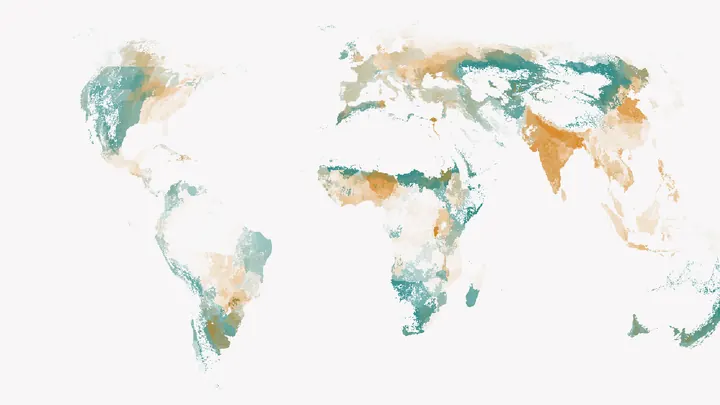
Every year, the food we eat costs humanity tens of millions of years of life due to unhealthy diets. At the same time, a third of all greenhouse gases warming the planet are produced along the journey from farm to plate. It seems obvious: switch to healthier eating, and we'll save the climate and improve our health. But new research shows these two goals don't always go hand in hand.
In a car, the steering, brakes, and accelerator gradually fail. At first, you can still swerve around a pothole, but each year the maneuver takes more effort. At some point, even a perfect road becomes impassable — the car no longer obeys the driver.
That's exactly how the authors describe aging: not as the accumulation of rust or wear and tear, but as the loss of "controllability" of the body.
A tongue tumor is like a stranger in a crowd. On the surface, they all look much alike, but beneath the surface hide very different personalities. Some tumors behave aggressively, others grow slowly. Doctors need to understand who they're dealing with before surgery.
Usually, this means taking a tissue sample — a biopsy.
Imagine a city where streets are not straight but winding, with dead ends and hidden passages. A bike courier will take much longer to deliver a package than in a city with a regular grid of roads. Similarly, molecules inside living tissue: their path depends on how "tangled" the tissue structure is.
Scientists built a model that describes the movement of molecules in such a "tangled" environment.
Two cities: one with neat, straight streets, the other with a tangle of alleys. If you send a powerful flood of water through both, in the first the water quickly drains away through channels, while in the second it swamps everything. That's roughly how tissues behave under ultrafast radiation therapy, known as FLASH.
A piece of dough, when pulled from the sides, doesn't stretch evenly: in one spot it thins and tears. Living tissue behaves similarly, but instead of a tear, shear bands appear — narrow zones where cells begin to slide past each other, like cards in a deck when cut.
A lightning bolt strikes an anthill. Some ants die instantly, some freeze, and a few days later the survivors start rebuilding the tunnels. That's roughly how a tumor behaves after electroporation — a method where short electric pulses are passed through tissue to poke holes in cancer cell membranes and kill them.
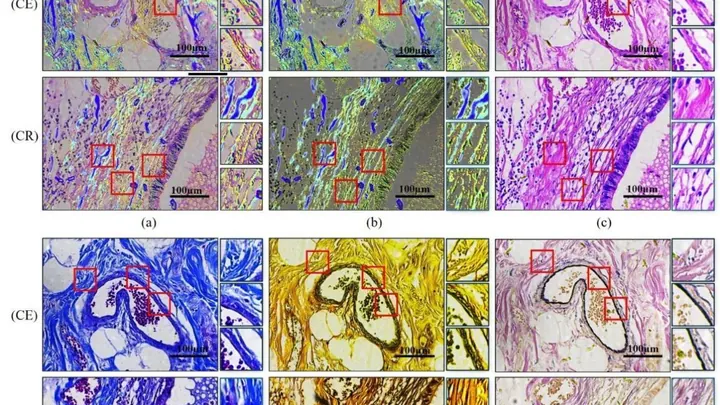
Inside our bodies, between cells, there is a support network — the extracellular matrix. It's like scaffolding made of proteins and carbohydrates that holds cells in place. When the fibers in this network change, it can be a sign of disease — for example, cancer or fibrosis.
Usually, to see these fibers, tissue is cut into thin slices and stained with special dyes.
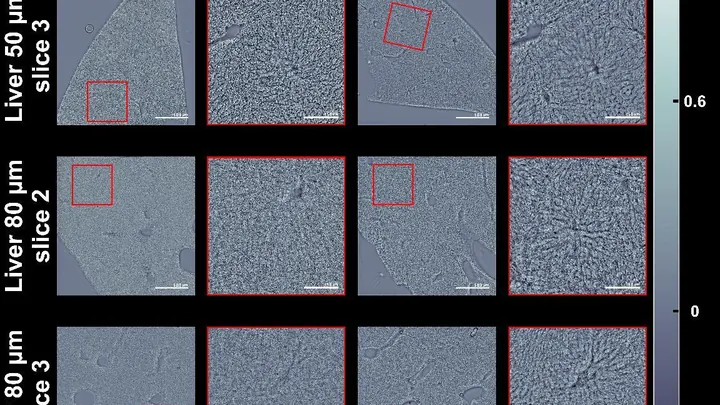
A thick slice of tissue under a microscope looks like fogged glass: light scatters and details are lost. Usually, to see cells, you stain them or cut them into very thin slices. But there's a simpler way — make the slice itself transparent, as if you've wiped the glass clean.
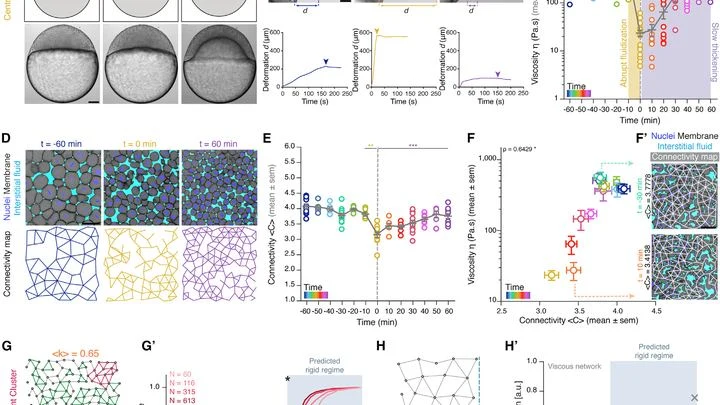
As an embryo grows, its cells don't just divide: they constantly touch their neighbors, like people in a crowded bus. The strength of these contacts determines where a cell moves and what shape the tissue takes. Scientists studied how cell 'stickiness' changes during the earliest stages of development.
A brain tumor is like a traveler trudging through a dense forest: trees and bushes are the different types of brain tissue, some easier to traverse than others. Glioma cells don't move in a straight line; they constantly loop around, bumping into obstacles and going around them.